Ruby Zoisite
The Heart of Tanzania
Affiliate links. We may earn a commission, at no cost to you.
Quick Facts
Formation & Origin
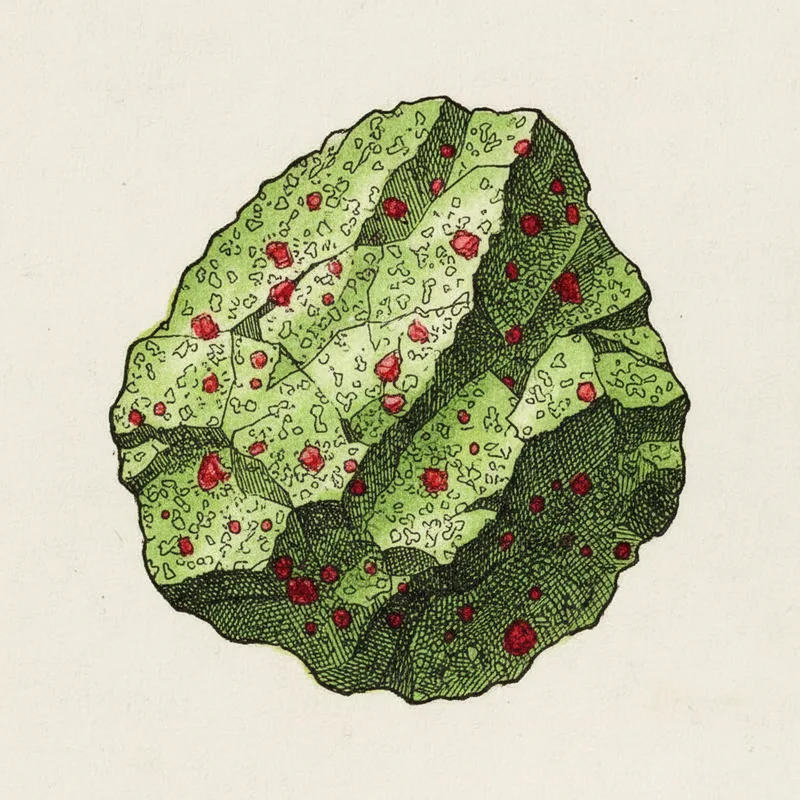
Ruby zoisite, also called anyolite, is a metamorphic rock in which crystals of red ruby (a chromium-bearing corundum) are embedded in massive green zoisite, a calcium aluminum silicate. Ruby zoisite (also called anyolite, from the Maasai word 'anyoli' meaning green) forms through regional metamorphism of aluminum-rich rocks. The combination requires very specific conditions: enough chromium to create corundum (ruby) alongside calcium-aluminum silicate conditions that produce zoisite.
The green zoisite matrix formed first during metamorphism of pelitic rocks. As temperatures and pressures shifted, chromium-bearing corundum crystallized within the zoisite mass. Black hornblende (tschermakite) often accompanies the pair, creating the distinctive tricolor pattern. The rubies in these specimens are rarely gem quality but are visually striking within their green matrix.
The deposit near Longido, Tanzania was discovered in 1954 by Tom Blevins, a British prospector. It remains the primary world source for high-quality specimens.
Identification Guide
The combination of opaque red ruby crystals set in bright green zoisite with black hornblende patches is unmistakable. No other commonly available mineral combination looks quite like it. The green is distinctly different from the blue-green of fuchsite, and the red is clearly corundum rather than garnet.
Test with a UV light: the ruby portions will often fluoresce red under longwave UV. The green zoisite matrix has a hardness around 6.5 while the ruby portions reach 9, so you may notice differences when testing different areas of the same piece.
Spotting Fakes
Ruby zoisite is rarely faked because it's relatively affordable and the natural tricolor pattern is hard to replicate convincingly. The main issue is misleading quality claims. Specimens where the ruby is prominently visible and well-distributed command higher prices. Pieces that are mostly green zoisite with tiny, scattered red specks are less valuable but still genuine.
Some links in this post go to Amazon and Etsy. Crystal Almanac earns a commission from qualifying purchases at no extra cost to you. Tools recommended here are ones we would use ourselves to run the tests described - the recommendation comes first, the link is downstream of it.
Cultural & Metaphysical Traditions
Presented as cultural traditions, not scientific evidence
Crystal practitioners value ruby zoisite for combining the passion and vitality associated with ruby with the growth and heart-healing properties attributed to zoisite. It's considered a stone of vitality and creative energy. The Maasai people who named it 'anyolite' have long regarded the green stones of their homeland as symbols of fertility and life.
Metaphysical and “healing” associations are cultural traditions, not medical advice or scientific fact. Crystals are not a substitute for professional medical care.
Where It's Found
Primary source, discovered 1954, also called anyolite
Smaller deposits, generally lower quality
Minor source near Tanzanian border
Price Guide
Good to Know
Scratch test: At hardness 6.5, Ruby Zoisite resists scratching from a knife but can be scratched by quartz. Best for pendants and earrings rather than rings.
Global supply: Found in 3 notable locations worldwide, from Tanzania to Kenya.
Heft test: Ruby Zoisite has average mineral density (3.10-3.40). It feels about as heavy as you'd expect from a stone its size.
Common Questions
What is the chemical formula of Ruby Zoisite?
The chemical formula of Ruby Zoisite is Ca₂Al₃(SiO₄)(Si₂O₇)O(OH) with Cr-bearing corundum.
What is Ruby Zoisite's Mohs hardness?
Ruby Zoisite has a Mohs hardness of 6.5 on the 1 to 10 Mohs scale, hard enough to scratch glass but softer than quartz.
Is Ruby Zoisite a mineral?
Yes. Ruby Zoisite is a naturally occurring mineral (Silicate Mineral (Epidote Group)) with a definite chemical composition and an ordered crystal structure.
Care & Safety
The water, salt, and sunlight questions people actually ask before cleansing or displaying ruby zoisite, answered from its hardness (Mohs 6.5) and chemistry (Ca₂Al₃(SiO₄)(Si₂O₇)O(OH) with Cr-bearing corundum).
Can Ruby Zoisite go in water?
Yes. Ruby Zoisite is not water-soluble and durable enough (Mohs 6.5), so a rinse or a quick wash with mild soap is no problem, cleanse it in water freely if that is your practice. A long soak does nothing for it either way, so skip that, and dry the stone afterward.
Can Ruby Zoisite go in salt water?
Not recommended, even though ruby zoisite itself is hard and not water-soluble. Salt is both corrosive and mildly abrasive: it can dull a polished surface, attack metal settings, and crystallize inside small fractures as the stone dries. A quick dip will not destroy ruby zoisite, but rinse it with fresh water afterward and dry it. For routine cleaning, plain water is the kinder choice.
Sources & References
The mineralogical and gemological data on this page is drawn from and can be cross-checked against these external references.
- WikipediaZoisite on Wikipedia
- WebmineralZoisite mineral data (Webmineral)
- Handbook of MineralogyZoisite (Handbook of Mineralogy, PDF)
Explore More
Save This Stone

Keep this ruby zoisite reference handy. Save the card to a Pinterest board and the profile is one tap away.
Save to PinterestNewsletter
Something shiny, now and then
A stone worth knowing, or a fake worth spotting, every so often. No spam.