Quick Facts
Formation & Origin
Tugtupite is an extremely rare beryllium-bearing member of the sodalite group, found almost exclusively in the Ilimaussaq alkaline complex of southern Greenland. It forms in nepheline syenite pegmatites and hydrothermal veins within this unique geological setting.
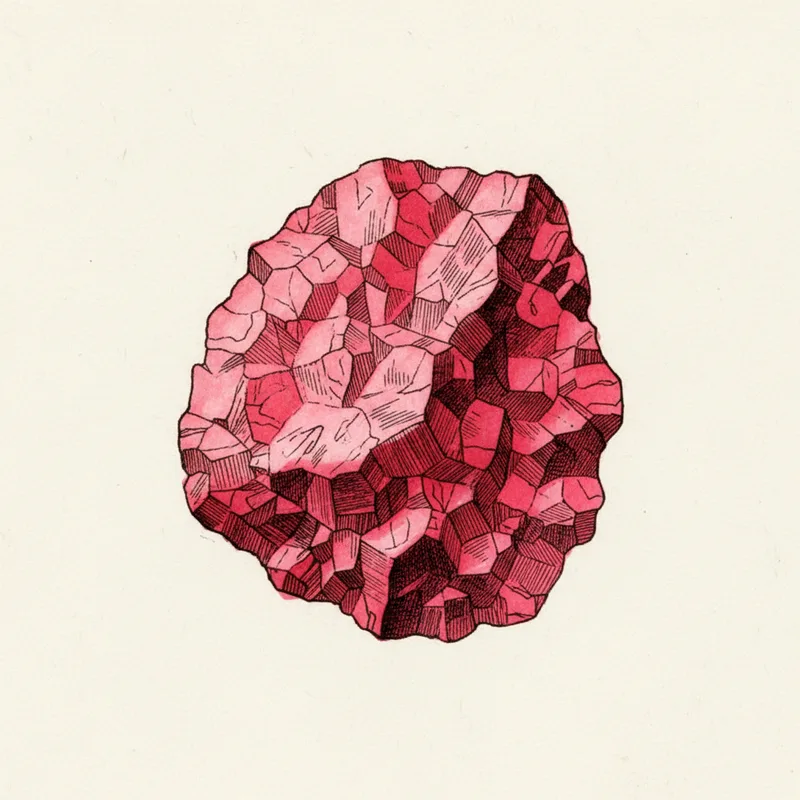
Like hackmanite, tugtupite displays tenebrescence (reversible photochromism): it deepens from pale pink to intense raspberry-red when exposed to UV light or sunlight, then slowly fades back in darkness. Additionally, it fluoresces a brilliant cherry-red under shortwave UV light, making it one of the most dramatically fluorescent minerals known.
The Inuit name means 'reindeer blood stone,' referring to the rich red color. According to Greenlandic legend, the stone was formed from the blood of reindeer and glows when lovers are near. This romantic association has made tugtupite a popular stone for jewelry in Greenland.
Identification Guide
Tugtupite is identified by its pink to raspberry color, strong tenebrescence (deepening in sunlight, fading in dark), and brilliant cherry-red fluorescence under shortwave UV. Its occurrence is essentially limited to Greenland.
Distinguish from rhodonite (harder, doesn't show tenebrescence), hackmanite (similar tenebrescence but different colors), and dyed stones (lack the UV response). The combination of tenebrescence, fluorescence, and Greenlandic provenance is uniquely diagnostic.
Spotting Fakes
Tugtupite's rarity and unique properties make it difficult to fake convincingly. The tenebrescence and fluorescence tests are definitive. Any claimed tugtupite that doesn't show color change under UV light or deepening in sunlight is not genuine. Dyed quartzite or glass could mimic the color but won't display the photochromic or fluorescent properties. Due to limited supply, genuine tugtupite commands premium prices.
Some links in this post go to Amazon and Etsy. Crystal Almanac earns a commission from qualifying purchases at no extra cost to you. Tools recommended here are ones we would use ourselves to run the tests described - the recommendation comes first, the link is downstream of it.
Cultural & Metaphysical Traditions
Presented as cultural traditions, not scientific evidence
Tugtupite is called the 'stone of true love' in Greenlandic tradition, where legend says it glows when lovers touch it. Crystal practitioners associate it with opening the heart to deep emotional connection, healing past romantic wounds, and recognizing genuine love. Its ability to deepen in color with light exposure symbolizes love that grows stronger with attention.
Metaphysical and “healing” associations are cultural traditions, not medical advice or scientific fact. Crystals are not a substitute for professional medical care.
Where It's Found
Only significant source, named after the type locality
Very minor occurrences
Extremely rare specimens
Price Guide
Good to Know
Scratch test: At hardness 4, Tugtupite can be scratched with a copper coin. Handle gently and keep away from harder stones in your collection.
Global supply: Found in 3 notable locations worldwide, from Greenland to Canada.
Heft test: With a specific gravity of 2.33-2.57, Tugtupite feels lighter than most minerals. This lightness can help identify it.
Common Questions
What is the chemical formula of Tugtupite?
The chemical formula of Tugtupite is Na₄AlBeSi₄O₁₂Cl.
What is Tugtupite's Mohs hardness?
Tugtupite has a Mohs hardness of 4 on the 1 to 10 Mohs scale, which a steel knife will scratch.
Is Tugtupite a mineral?
Yes. Tugtupite is a naturally occurring mineral (Feldspathoid (Sodalite Group)) with a definite chemical composition and an ordered crystal structure.
Care & Safety
The water, salt, and sunlight questions people actually ask before cleansing or displaying tugtupite, answered from its hardness (Mohs 4) and chemistry (Na₄AlBeSi₄O₁₂Cl).
Can Tugtupite go in water?
Only briefly. A quick rinse under running water is fine for tugtupite, but do not let it soak or sit submerged. At Mohs 4 it is tough enough for a rinse but not for a long soak. Dry it thoroughly afterward.
Can Tugtupite go in salt water?
No. Tugtupite can take a brief fresh-water rinse and nothing more, and salt water is harder on it both ways: corrosive while wet, then abrasive as the salt dries into crystals. If it does meet salt water, rinse it with fresh water and dry it promptly.
Does Tugtupite fade in sunlight?
No, the opposite. Tugtupite is tenebrescent: its pink-red color deepens with exposure to sunlight or UV and fades when the stone sits in the dark. The change is reversible, not damage, and many collectors give tugtupite regular light exposure to keep the color saturated.
Sources & References
The mineralogical and gemological data on this page is drawn from and can be cross-checked against these external references.
- WikipediaTugtupite on Wikipedia
- WebmineralTugtupite mineral data (Webmineral)
- Handbook of MineralogyTugtupite (Handbook of Mineralogy, PDF)
Explore More
Feldspar Group
The Love Collection
Called the 'stone of true love' in Greenlandic Inuit tradition. Legend says it glows when lovers are near. Its color deepens in light, symbolizing love that grows stronger.
Crystals That Fade in Sunlight (The Chemistry Explained)
Mohs Hardness Scale
See where Tugtupite sits on the scale
Crystal Care Guide
Water safety, sunlight, and handling tips
Save This Stone

Keep this tugtupite reference handy. Save the card to a Pinterest board and the profile is one tap away.
Save to PinterestNewsletter
Something shiny, now and then
A stone worth knowing, or a fake worth spotting, every so often. No spam.