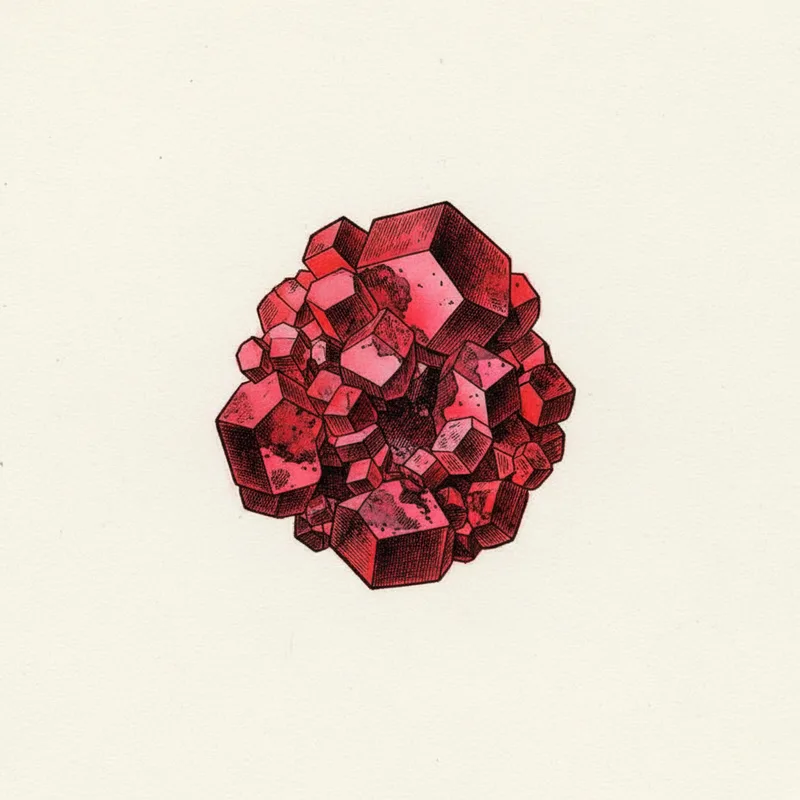
Eudialyte
The Dragon's Blood Stone
Affiliate links. We may earn a commission, at no cost to you.
Quick Facts
Formation & Origin
Eudialyte is a complex sodium calcium zirconium cyclosilicate mineral that forms only in alkaline igneous rocks, valued for its crimson to pink color. Eudialyte forms exclusively in alkaline igneous rocks and their associated pegmatites. It requires very specific geochemistry: high sodium, low silica, and significant concentrations of zirconium, manganese, and rare earth elements. These conditions occur in only a handful of geological settings worldwide.
The mineral's extraordinarily complex formula (one of the longest in mineralogy) reflects its ability to incorporate many different elements into its crystal structure. This complexity makes eudialyte a significant ore of zirconium and rare earth elements in some deposits.
The name comes from the Greek 'eu' (well) and 'dialytos' (decomposable), referring to how easily it dissolves in acid. In Inuit legend from Greenland, the red patches of eudialyte in rock represent the blood of warriors fallen in battle, giving rise to the common name 'Dragon's Blood Stone.'
Identification Guide
Eudialyte is identified by its distinctive crimson to rose-pink color in an igneous rock matrix, typically alongside white or gray nepheline, black aegirine, and other unusual minerals. The color is distinctive and unlike common red minerals like garnet or jasper in this geological context.
Distinguish from rhodonite (metamorphic context, black veins), garnet (different crystal habit and geological setting), and cinnabar (softer, different streak). Eudialyte's association with alkaline igneous rocks and minerals like nepheline and aegirine is a strong contextual identifier.
Spotting Fakes
Eudialyte is not commonly faked, though some sellers apply the 'Dragon's Blood' marketing name to dyed jasper or other red stones. Genuine eudialyte occurs within a distinctive rock matrix of alkaline minerals. It should be associated with white nepheline, black aegirine, or other alkaline igneous companions. Isolated red stones sold as 'eudialyte' without matrix should be viewed with some skepticism.
Some links in this post go to Amazon and Etsy. Crystal Almanac earns a commission from qualifying purchases at no extra cost to you. Tools recommended here are ones we would use ourselves to run the tests described - the recommendation comes first, the link is downstream of it.
Cultural & Metaphysical Traditions
Presented as cultural traditions, not scientific evidence
Eudialyte is considered a stone of vitality and life force in crystal healing, connecting the heart and root chakras. Its blood-red color and Arctic origins connect it to themes of life energy, survival, and passion. Some practitioners use it for opening the heart while maintaining strong grounding. The Inuit blood-of-warriors legend adds associations with courage and sacrifice.
Metaphysical and “healing” associations are cultural traditions, not medical advice or scientific fact. Crystals are not a substitute for professional medical care.
Where It's Found
Type locality, finest specimens
Excellent red crystals in alkaline pegmatites
Classic North American locality
Some commercial material
Price Guide
Good to Know
Scratch test: At hardness 5.5, Eudialyte resists scratching from a knife but can be scratched by quartz. Best for pendants and earrings rather than rings.
Global supply: Found in 4 notable locations worldwide, from Russia to Madagascar.
Heft test: Eudialyte has average mineral density (2.74-2.98). It feels about as heavy as you'd expect from a stone its size.
Common Questions
What is the chemical formula of Eudialyte?
The chemical formula of Eudialyte is Na₁₅Ca₆(Fe²⁺,Mn²⁺)₃Zr₃[Si₂₅O₇₃](O,OH,H₂O)₃(OH,Cl)₂.
What is Eudialyte's Mohs hardness?
Eudialyte has a Mohs hardness of 5.5 on the 1 to 10 Mohs scale, hard enough to scratch glass but softer than quartz.
Is Eudialyte a mineral?
Yes. Eudialyte is a naturally occurring mineral (Silicate Mineral (Cyclosilicate)) with a definite chemical composition and an ordered crystal structure.
Care & Safety
The water, salt, and sunlight questions people actually ask before cleansing or displaying eudialyte, answered from its hardness (Mohs 5.5) and chemistry (Na₁₅Ca₆(Fe²⁺,Mn²⁺)₃Zr₃[Si₂₅O₇₃](O,OH,H₂O)₃(OH,Cl)₂).
Can Eudialyte go in water?
Yes. Eudialyte is not water-soluble and durable enough (Mohs 5.5), so a rinse or a quick wash with mild soap is no problem, cleanse it in water freely if that is your practice. A long soak does nothing for it either way, so skip that, and dry the stone afterward.
Can Eudialyte go in salt water?
Not recommended, even though eudialyte itself is hard and not water-soluble. Salt is both corrosive and mildly abrasive: it can dull a polished surface, attack metal settings, and crystallize inside small fractures as the stone dries. Eudialyte's iron content also makes rust staining likely if salt residue sits on the surface. A quick dip will not destroy eudialyte, but rinse it with fresh water afterward and dry it. For routine cleaning, plain water is the kinder choice.
Sources & References
The mineralogical and gemological data on this page is drawn from and can be cross-checked against these external references.
- WikipediaEudialyte on Wikipedia
- WebmineralEudialyte mineral data (Webmineral)
- Handbook of MineralogyEudialyte (Handbook of Mineralogy, PDF)
Related Minerals
Common companion in alkaline rocks
Black pyroxene found alongside eudialyte
Another feldspathoid from similar environments
Explore More
Save This Stone

Keep this eudialyte reference handy. Save the card to a Pinterest board and the profile is one tap away.
Save to PinterestNewsletter
Something shiny, now and then
A stone worth knowing, or a fake worth spotting, every so often. No spam.