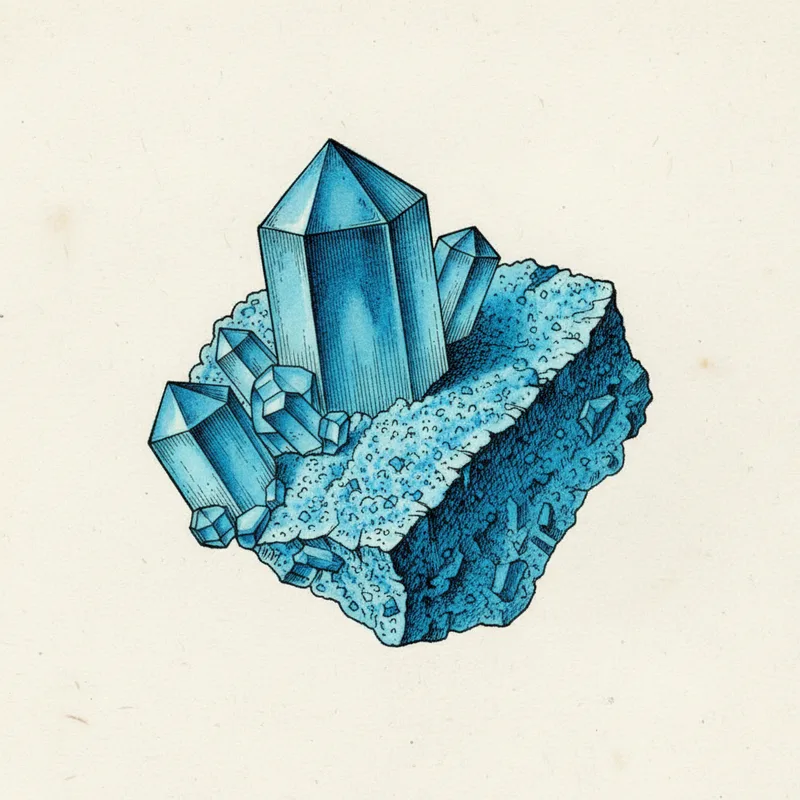
Blue Apatite
The Motivation Mineral
Affiliate links. We may earn a commission, at no cost to you.
Quick Facts
Formation & Origin
Blue apatite is the blue gem variety of apatite, a group of calcium phosphate minerals with the general formula Ca₅(PO₄)₃(F,Cl,OH). Apatite is actually a group of phosphate minerals with the general formula Ca₅(PO₄)₃(F,Cl,OH). The blue variety gets its color from trace amounts of manganese and rare earth elements substituting in the crystal structure. The specific shade depends on which trace elements are present and their concentrations.
Blue apatite forms in a variety of geological settings: in pegmatites, in metamorphic rocks, and as an accessory mineral in igneous rocks. The gem-quality blue crystals from Madagascar form in pegmatites where phosphorus-rich fluids crystallize slowly enough to produce transparent crystals.
Apatite is the same mineral that makes up tooth enamel and bone (as hydroxyapatite), making it the most biologically important mineral on Earth. It's also a key source of phosphorus for fertilizer. The name comes from the Greek 'apatao' meaning 'to deceive,' because apatite's varied colors cause it to be confused with many other gems.
Identification Guide
Blue apatite is identified by its distinctive blue to teal color, hexagonal crystal habit, and moderate hardness of 5 (the defining mineral for Mohs hardness 5). It can be scratched by a steel knife but not by a copper coin.
Distinguish from blue topaz (much harder at 8), aquamarine (harder, different crystal system), tourmaline (harder, trigonal with triangular cross-section), and fluorite (softer, isometric). Apatite's exact Mohs 5 hardness is its most useful diagnostic property.
Spotting Fakes
The neon blue apatite from Madagascar is popular enough to warrant caution. Dyed howlite and blue glass are sometimes sold as apatite. Check hardness: apatite should be scratchable by a knife but not by a coin. Genuine blue apatite often shows slight color zoning and natural inclusions under magnification. Very uniformly colored, flawless stones at low prices may be glass or synthetic. Heat treatment can intensify blue color in natural apatite.
Some links in this post go to Amazon and Etsy. Crystal Almanac earns a commission from qualifying purchases at no extra cost to you. Tools recommended here are ones we would use ourselves to run the tests described - the recommendation comes first, the link is downstream of it.
Cultural & Metaphysical Traditions
Presented as cultural traditions, not scientific evidence
Blue apatite is strongly associated with motivation, goal-setting, and personal power in crystal healing. Practitioners connect it to clarity of communication and overcoming apathy. Its link to bones and teeth (as hydroxyapatite) gives it associations with structural support and personal foundations. Some traditions use it for past-life exploration and lucid dreaming.
Metaphysical and “healing” associations are cultural traditions, not medical advice or scientific fact. Crystals are not a substitute for professional medical care.
Where It's Found
Neon blue crystals, primary gem source
Large crystals, sometimes gem quality
Fine blue-green gem crystals
Classic large crystal specimens
Price Guide
Good to Know
Scratch test: At hardness 5, Blue Apatite resists scratching from a knife but can be scratched by quartz. Best for pendants and earrings rather than rings.
Global supply: Found in 4 notable locations worldwide, from Madagascar to Mexico.
Heft test: Blue Apatite has average mineral density (3.16-3.22). It feels about as heavy as you'd expect from a stone its size.
Common Questions
What is the chemical formula of Blue Apatite?
The chemical formula of Blue Apatite is Ca₅(PO₄)₃(F,Cl,OH).
What is Blue Apatite's Mohs hardness?
Blue Apatite has a Mohs hardness of 5 on the 1 to 10 Mohs scale, which a steel knife will scratch.
Is Blue Apatite a mineral?
Yes. Blue Apatite is a naturally occurring mineral (Phosphate Mineral) with a definite chemical composition and an ordered crystal structure.
Care & Safety
The water, salt, and sunlight questions people actually ask before cleansing or displaying blue apatite, answered from its hardness (Mohs 5) and chemistry (Ca₅(PO₄)₃(F,Cl,OH)).
Can Blue Apatite go in water?
Only briefly. A quick rinse under running water is fine for blue apatite, but do not let it soak or sit submerged. At Mohs 5 it is tough enough for a rinse but not for a long soak. Dry it thoroughly afterward.
Can Blue Apatite go in salt water?
No. Blue Apatite can take a brief fresh-water rinse and nothing more, and salt water is harder on it both ways: corrosive while wet, then abrasive as the salt dries into crystals. If it does meet salt water, rinse it with fresh water and dry it promptly.
Sources & References
The mineralogical and gemological data on this page is drawn from and can be cross-checked against these external references.
- WikipediaApatite on Wikipedia
- WebmineralFluorapatite mineral data (Webmineral)
- Handbook of MineralogyFluorapatite (Handbook of Mineralogy, PDF)
Related Minerals
Most common apatite group member
Fellow phosphate mineral, similar color range
Another blue phosphate mineral
Explore More
Phosphate Minerals
The Communication Collection
Named from the Greek 'to deceive' because it mimics other gems. Associated with motivation, goal clarity, and articulating ambitions - the communication of vision.
The Workplace Collection
Named for the Greek 'to deceive' because it mimics more valuable stones. Associated with motivation, goal-setting, and articulating ambitions clearly. The communication of professional vision.
Best Crystals for Work, Focus, and Your Desk
Mohs Hardness Scale
See where Blue Apatite sits on the scale
Crystal Care Guide
Water safety, sunlight, and handling tips
Save This Stone

Keep this blue apatite reference handy. Save the card to a Pinterest board and the profile is one tap away.
Save to PinterestNewsletter
Something shiny, now and then
A stone worth knowing, or a fake worth spotting, every so often. No spam.