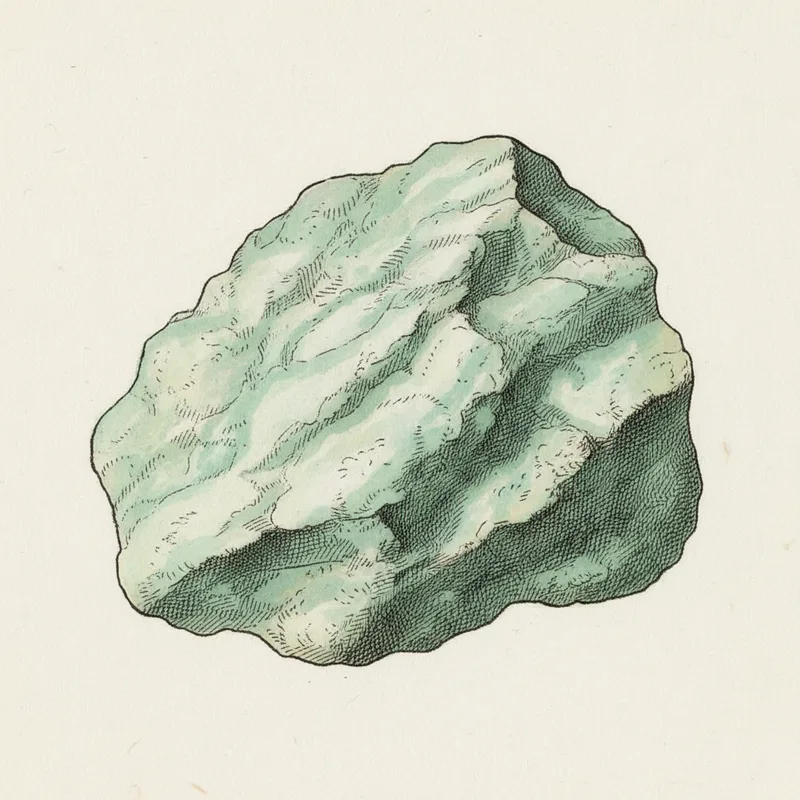
Soapstone
The Carver's Stone
Affiliate links. We may earn a commission, at no cost to you.
Quick Facts
Formation & Origin
Soapstone (also called steatite) is a metamorphic rock composed primarily of talc, the softest mineral on the Mohs scale. It forms when magnesium-rich rocks like serpentinite or dunite undergo hydrothermal alteration, converting original minerals into talc, chlorite, and other soft sheet silicates.
The 'soapy' feel that gives it its name comes from the talc content. This extreme softness makes soapstone the easiest natural stone to carve, which is why it has been used for sculpture, cookware, and decorative objects for thousands of years. Inuit carvings, West African sculptures, Chinese seal stones, and Brazilian artisan work all rely on soapstone's carvability.
Despite its softness, soapstone has remarkable thermal properties. It absorbs heat slowly, holds it for a long time, and releases it gradually. Finnish and Scandinavian soapstone stoves, which store heat from a brief fire and radiate it for hours, have been used since the 1700s. Soapstone is also chemically inert, making it ideal for laboratory countertops and acid-resistant sinks.
Identification Guide
Soapstone is identified by its soapy, greasy feel, extreme softness (easily scratched with a fingernail), and gray-green color. It can be carved with a pocket knife. The surface feels distinctly slippery, almost waxy.
Distinguish from serpentine (harder, doesn't feel soapy), marble (harder, effervesces in acid), and jade (much harder, can't be scratched with a knife).
Spotting Fakes
Soapstone is not commonly faked. The main quality distinction is talc content: higher-talc soapstone is softer and easier to carve but less durable. Architectural-grade soapstone for countertops typically has lower talc and higher chlorite/pyroxene content, making it harder and more resistant. The soapy feel and extreme softness are unmistakable.
Some links in this post go to Amazon and Etsy. Crystal Almanac earns a commission from qualifying purchases at no extra cost to you. Tools recommended here are ones we would use ourselves to run the tests described - the recommendation comes first, the link is downstream of it.
Cultural & Metaphysical Traditions
Presented as cultural traditions, not scientific evidence
Soapstone is associated with gentle nurturing energy, creativity, and warmth. Its use in carvings across cultures connects it to artistic expression. The heat-retention properties reinforce associations with sustained comfort and reliable support. Indigenous carving traditions from the Inuit to the Shona imbue soapstone with deep cultural significance.
Metaphysical and “healing” associations are cultural traditions, not medical advice or scientific fact. Crystals are not a substitute for professional medical care.
Where It's Found
Major source, carving tradition
Extensive deposits, cookware production
Finnish soapstone stoves and fireplace surrounds
Historic quarries
Price Guide
Good to Know
Scratch test: At hardness 1.5, Soapstone can be scratched with a fingernail. This is a display specimen, not a wearable stone.
Global supply: Found in 4 notable locations worldwide, from Brazil to United States.
Heft test: Soapstone has average mineral density (2.7-2.8). It feels about as heavy as you'd expect from a stone its size.
Common Questions
What is the chemical formula of Soapstone?
The chemical formula of Soapstone is Primarily talc (Mg₃Si₄O₁₀(OH)₂) with chlorite, pyroxene.
What is Soapstone's Mohs hardness?
Soapstone has a Mohs hardness of 1.5 on the 1 to 10 Mohs scale, soft enough to scratch with a fingernail.
Is Soapstone a mineral?
Not quite. Soapstone is a rock (a naturally occurring mixture of minerals), not a single mineral species.
Care & Safety
The water, salt, and sunlight questions people actually ask before cleansing or displaying soapstone, answered from its hardness (Mohs 1.5) and chemistry (Primarily talc (Mg₃Si₄O₁₀(OH)₂) with chlorite, pyroxene).
Can Soapstone go in water?
Not recommended. At Mohs 1.5, soapstone is soft enough that water can slowly dull, etch, or wear down the surface, so a water cleanse does more harm than good here. Reach for a dry cloth instead.
Can Soapstone go in salt water?
No. Soapstone is best kept away from water altogether, and salt water is the harsher version of that problem: the dissolved salt is corrosive while the stone is wet, then leaves gritty crystals behind in cracks and crevices as it dries.
Sources & References
The mineralogical and gemological data on this page is drawn from and can be cross-checked against these external references.
- WikipediaSoapstone on Wikipedia
Explore More
Save This Stone

Keep this soapstone reference handy. Save the card to a Pinterest board and the profile is one tap away.
Save to PinterestNewsletter
Something shiny, now and then
A stone worth knowing, or a fake worth spotting, every so often. No spam.