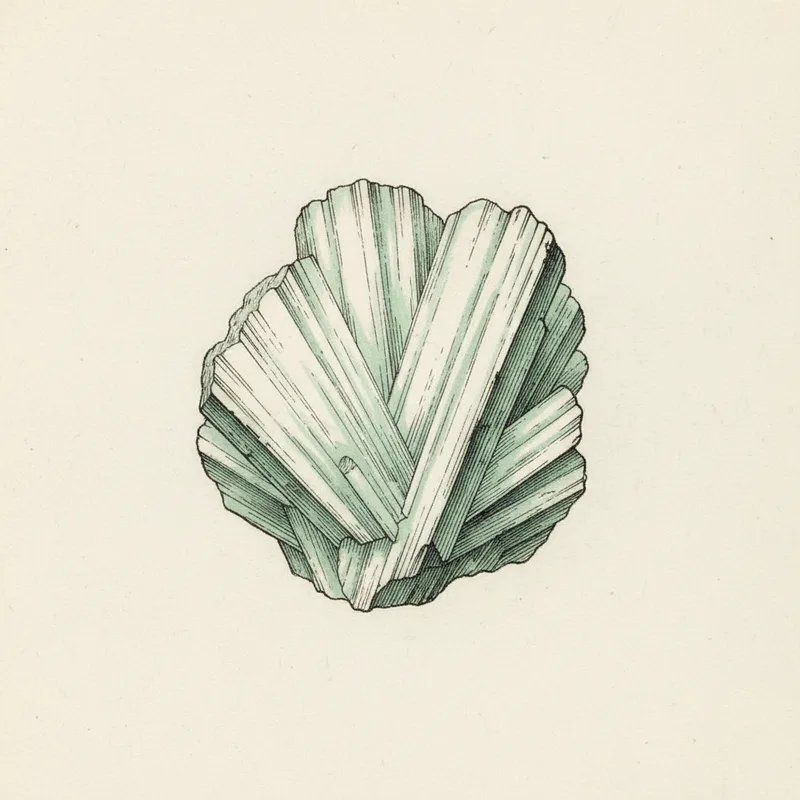
Talc
The Softest Mineral
Affiliate links. We may earn a commission, at no cost to you.
Quick Facts
Formation & Origin
Talc is the softest mineral on Earth, defining position 1 on the Mohs hardness scale. You can scratch it with your fingernail. It forms through the hydrothermal alteration of magnesium-rich rocks, particularly when ultramafic rocks (like peridotite) react with silica-bearing fluids at temperatures below 800°C.
The softness comes from talc's crystal structure: stacked sheets of silica-magnesia-silica connected by only weak van der Waals forces. The sheets slide over each other with minimal effort, creating the characteristic greasy, soapy feel.
Talc is the primary ingredient in talcum powder and a major industrial mineral used in ceramics, paint, paper, plastics, and cosmetics. Soapstone is a rock composed primarily of talc. French chalk (used by tailors), and the chalk used on pool cues are talc products. The mineral is so soft that massive talc can be carved with a fingernail.
Identification Guide
Talc is identified by its extreme softness (Mohs 1, scratched by everything), greasy or soapy feel, pearly luster, and pale green to white color. It can be scratched by a fingernail and leaves a mark on cloth.
Distinguish from gypsum (slightly harder at 2, different crystal habit), chlorite (slightly harder, different feel), and serpentine (harder, not as soft-feeling). Talc's combination of extreme softness and soapy feel is unmistakable.
Spotting Fakes
Nobody fakes talc. It's one of the most abundant and inexpensive minerals on Earth. The main educational point: talc defines Mohs hardness 1, making it the essential reference mineral for the most widely used hardness scale in geology.
Some links in this post go to Amazon and Etsy. Crystal Almanac earns a commission from qualifying purchases at no extra cost to you. Tools recommended here are ones we would use ourselves to run the tests described - the recommendation comes first, the link is downstream of it.
Cultural & Metaphysical Traditions
Presented as cultural traditions, not scientific evidence
Talc is associated with gentleness, humility, and the strength found in softness. Paradoxically, the softest mineral on Earth is one of the most commercially important. Crystal practitioners use this as a metaphor for the power of flexibility and yielding. Its soapy feel is calming to handle.
Metaphysical and “healing” associations are cultural traditions, not medical advice or scientific fact. Crystals are not a substitute for professional medical care.
Where It's Found
Major world producer
Significant production
Important source
Historic mining districts
Price Guide
Good to Know
Scratch test: At hardness 1, Talc can be scratched with a fingernail. This is a display specimen, not a wearable stone.
Global supply: Found in 4 notable locations worldwide, from Brazil to United States.
Heft test: Talc has average mineral density (2.75). It feels about as heavy as you'd expect from a stone its size.
Common Questions
What is the chemical formula of Talc?
The chemical formula of Talc is Mg₃Si₄O₁₀(OH)₂.
What is Talc's Mohs hardness?
Talc has a Mohs hardness of 1 on the 1 to 10 Mohs scale, soft enough to scratch with a fingernail.
Is Talc a mineral?
Yes. Talc is a naturally occurring mineral (Silicate Mineral (Phyllosilicate)) with a definite chemical composition and an ordered crystal structure.
Care & Safety
The water, salt, and sunlight questions people actually ask before cleansing or displaying talc, answered from its hardness (Mohs 1) and chemistry (Mg₃Si₄O₁₀(OH)₂).
Can Talc go in water?
Not recommended. At Mohs 1, talc is soft enough that water can slowly dull, etch, or wear down the surface, so a water cleanse does more harm than good here. Reach for a dry cloth instead.
Can Talc go in salt water?
No. Talc is best kept away from water altogether, and salt water is the harsher version of that problem: the dissolved salt is corrosive while the stone is wet, then leaves gritty crystals behind in cracks and crevices as it dries.
Sources & References
The mineralogical and gemological data on this page is drawn from and can be cross-checked against these external references.
- WikipediaTalc on Wikipedia
- WebmineralTalc mineral data (Webmineral)
- Handbook of MineralogyTalc (Handbook of Mineralogy, PDF)
Explore More
Mica & Sheet Silicates
Selenite vs Satin Spar: What's the Difference?
How to Identify a Crystal by Its Mineral Group
Crystal Hardness Chart: What Mohs Means for You
Mohs Hardness Scale
See where Talc sits on the scale
Crystal Care Guide
Water safety, sunlight, and handling tips
Save This Stone

Keep this talc reference handy. Save the card to a Pinterest board and the profile is one tap away.
Save to PinterestNewsletter
Something shiny, now and then
A stone worth knowing, or a fake worth spotting, every so often. No spam.