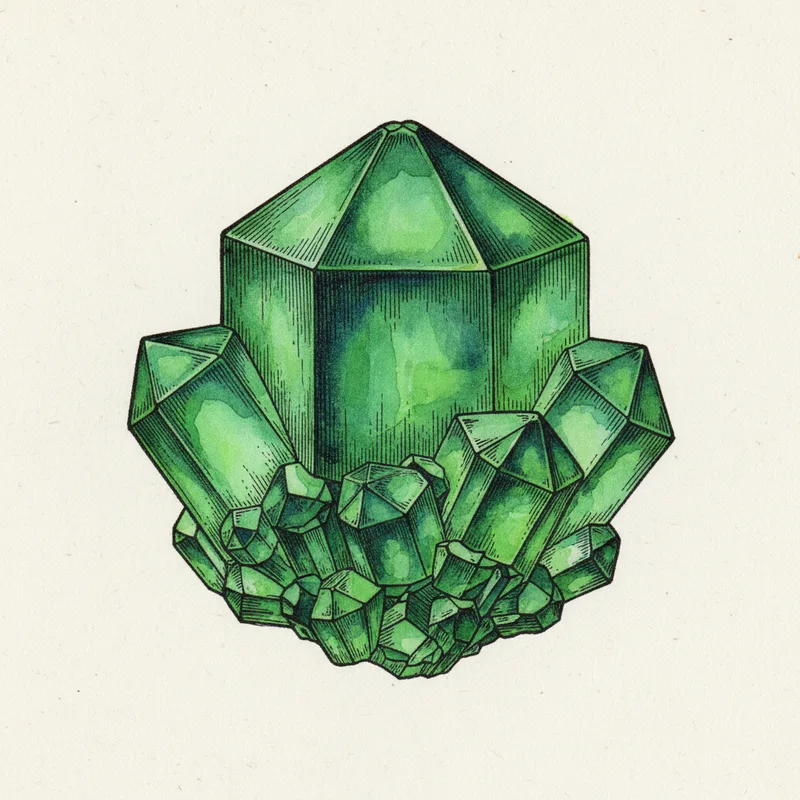
Dioptase
The Emerald Impostor
Affiliate links. We may earn a commission, at no cost to you.
Quick Facts
Formation & Origin
Dioptase is a hydrated copper cyclosilicate that forms in the oxidized zone of copper ore deposits in arid regions. It requires copper-rich groundwater interacting with silica in a relatively dry environment where the mineral can slowly crystallize rather than forming amorphous crusts.
The vivid emerald-green color - among the most saturated greens in the mineral kingdom - comes directly from copper in the crystal structure. When first discovered in Kazakhstan in the 1790s, dioptase was initially mistaken for emerald. The name comes from the Greek words meaning 'to see through,' referring to the internal cleavage planes visible through the transparent crystals.
The finest dioptase specimens came from the legendary Tsumeb Mine in Namibia - a single ore body that produced world-class specimens of over 200 different mineral species before closing. Tsumeb dioptase crystals on white calcite matrix are among the most iconic mineral specimens in collector circles.
Identification Guide
Dioptase is identified by its vivid emerald-green color, small rhombohedral crystal habit, and copper-deposit association. At hardness 5, it's significantly softer than emerald (7.5), which is the simplest distinguishing test.
Distinguish from emerald (much harder, hexagonal crystals), chrome diopside (different crystal system), and brochantite (similar copper green, different crystal form). Dioptase's color is so vivid and saturated that it's immediately recognizable to experienced collectors.
Spotting Fakes
Dioptase is rarely faked because it occupies a specific collector niche. The main concern is misidentification - calling other green copper minerals 'dioptase.' Genuine dioptase has distinctive rhombohedral crystals and the specific vivid green that's unlike any other copper mineral. For Tsumeb specimens (which command premium prices), provenance documentation matters since the mine is closed and no new material is being produced.
Some links in this post go to Amazon and Etsy. Crystal Almanac earns a commission from qualifying purchases at no extra cost to you. Tools recommended here are ones we would use ourselves to run the tests described - the recommendation comes first, the link is downstream of it.
Cultural & Metaphysical Traditions
Presented as cultural traditions, not scientific evidence
Dioptase is a relatively recent addition to crystal healing, having entered the market mainly through Tsumeb Mine production in the 20th century. Practitioners associate its intense green with deep heart healing, forgiveness, and releasing emotional attachments to the past. Its copper content connects it to the Venus tradition shared by other copper minerals. The vividness of its color has led some practitioners to consider it a more powerful heart stone than even emerald.
Metaphysical and “healing” associations are cultural traditions, not medical advice or scientific fact. Crystals are not a substitute for professional medical care.
Where It's Found
World's finest crystals, now closed
Large crystals on matrix
Original discovery locality (1797)
Small but vivid crystals in copper deposits
Price Guide
Good to Know
Scratch test: At hardness 5, Dioptase resists scratching from a knife but can be scratched by quartz. Best for pendants and earrings rather than rings.
Global supply: Found in 4 notable locations worldwide, from Namibia to United States.
Heft test: Dioptase has average mineral density (3.30). It feels about as heavy as you'd expect from a stone its size.
Common Questions
What is the chemical formula of Dioptase?
The chemical formula of Dioptase is CuSiO₂(OH)₂.
What is Dioptase's Mohs hardness?
Dioptase has a Mohs hardness of 5 on the 1 to 10 Mohs scale, which a steel knife will scratch.
Is Dioptase a mineral?
Yes. Dioptase is a naturally occurring mineral (Cyclosilicate Group) with a definite chemical composition and an ordered crystal structure.
Care & Safety
The water, salt, and sunlight questions people actually ask before cleansing or displaying dioptase, answered from its hardness (Mohs 5) and chemistry (CuSiO₂(OH)₂).
Can Dioptase go in water?
Only briefly. A quick rinse under running water is fine for dioptase, but do not let it soak or sit submerged. At Mohs 5 it is tough enough for a rinse but not for a long soak. Dry it thoroughly afterward.
Can Dioptase go in salt water?
No. Dioptase can take a brief fresh-water rinse and nothing more, and salt water is harder on it both ways: corrosive while wet, then abrasive as the salt dries into crystals. Salt also accelerates corrosion of copper-bearing minerals like dioptase. If it does meet salt water, rinse it with fresh water and dry it promptly.
Sources & References
The mineralogical and gemological data on this page is drawn from and can be cross-checked against these external references.
- WikipediaDioptase on Wikipedia
- WebmineralDioptase mineral data (Webmineral)
- Handbook of MineralogyDioptase (Handbook of Mineralogy, PDF)
Related Minerals
Similar vivid green, different mineral, much harder
Another copper silicate, different habit
Copper carbonate, different crystal form
Copper sulfate, similar color, different crystals
Explore More
Save This Stone
%2C%20which%20is%20the%20simplest%20distinguishing%20test.%20Meaning%2C%20properties%20%26%20identification%20at%20Crystal%20Almanac.)
Keep this dioptase reference handy. Save the card to a Pinterest board and the profile is one tap away.
Save to PinterestNewsletter
Something shiny, now and then
A stone worth knowing, or a fake worth spotting, every so often. No spam.