Scheelite
The Ultraviolet Gem
Affiliate links. We may earn a commission, at no cost to you.
Quick Facts
Formation & Origin
Scheelite is calcium tungstate - the primary ore of tungsten, one of the most important industrial metals. Tungsten has the highest melting point of any metal (3,422 degrees Celsius) and is essential for light bulb filaments, cutting tools, armor-piercing ammunition, and high-temperature alloys.
Scheelite's most spectacular property is its fluorescence under shortwave ultraviolet light - it glows an intense, vivid blue-white that's among the brightest fluorescence of any mineral. This fluorescence is so reliable that prospectors use UV lamps at night to locate scheelite deposits in the field. Walking through scheelite-bearing terrain with a UV lamp is one of the most visually dramatic experiences in field geology.
Gem-quality scheelite is faceted into collectors' gems with remarkable fire (dispersion of 0.026, close to diamond's 0.044). Its main limitation is softness (4.5 Mohs) and perfect cleavage, making it impractical for jewelry but spectacular in a collector's display.
Identification Guide
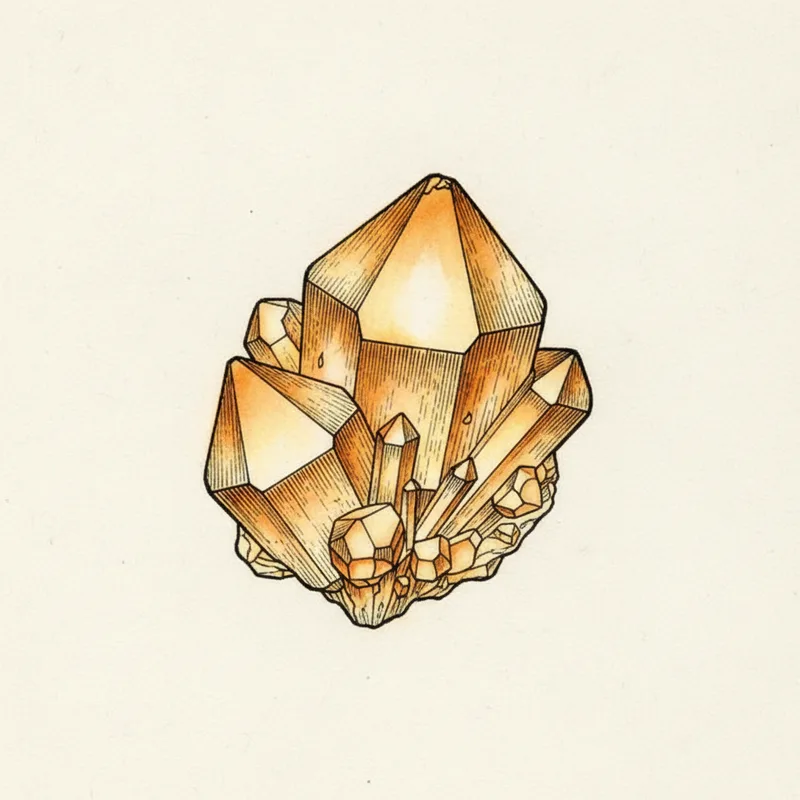
Scheelite is identified by its honey-yellow color, very high density (6.01 - feels extremely heavy), adamantine luster, and diagnostic intense blue-white fluorescence under shortwave UV light. The UV fluorescence is the fastest and most reliable test.
Distinguish from citrine (much lighter weight, no fluorescence), topaz (harder, lighter), and powellite (similar but fluoresces yellow, not blue). The combination of extreme density and vivid UV fluorescence is unique to scheelite.
Spotting Fakes
Scheelite is a specialist mineral not commonly faked. Synthetic scheelite exists for industrial purposes but isn't sold as collector specimens. The UV fluorescence test is essentially foolproof for identification. For gem-quality faceted pieces, the high density and strong UV fluorescence distinguish it from any glass or other simulant.
Some links in this post go to Amazon and Etsy. Crystal Almanac earns a commission from qualifying purchases at no extra cost to you. Tools recommended here are ones we would use ourselves to run the tests described - the recommendation comes first, the link is downstream of it.
Cultural & Metaphysical Traditions
Presented as cultural traditions, not scientific evidence
Scheelite has no traditional metaphysical associations - it's primarily an industrial ore mineral and collector specimen. Modern practitioners who work with it associate the UV fluorescence with revealing hidden truth and accessing energies invisible to normal perception. Its connection to tungsten (the highest melting point metal) links it to endurance and persistence.
Metaphysical and “healing” associations are cultural traditions, not medical advice or scientific fact. Crystals are not a substitute for professional medical care.
Where It's Found
Major world producer, fine crystals
Historical major source
Classic European specimens
Gem-quality material
Price Guide
Good to Know
Scratch test: At hardness 4.5, Scheelite can be scratched with a copper coin. Handle gently and keep away from harder stones in your collection.
Global supply: Found in 4 notable locations worldwide, from China to Brazil.
Heft test: With a specific gravity of 6.01, Scheelite feels surprisingly heavy for its size. This weight is actually a useful identification tool.
Common Questions
What is the chemical formula of Scheelite?
The chemical formula of Scheelite is CaWO₄.
What is Scheelite's Mohs hardness?
Scheelite has a Mohs hardness of 4.5 on the 1 to 10 Mohs scale, which a steel knife will scratch.
Is Scheelite a mineral?
Yes. Scheelite is a naturally occurring mineral (Tungstate Group) with a definite chemical composition and an ordered crystal structure.
Care & Safety
The water, salt, and sunlight questions people actually ask before cleansing or displaying scheelite, answered from its hardness (Mohs 4.5) and chemistry (CaWO₄).
Can Scheelite go in water?
Only briefly. A quick rinse under running water is fine for scheelite, but do not let it soak or sit submerged. At Mohs 4.5 it is tough enough for a rinse but not for a long soak. Dry it thoroughly afterward.
Can Scheelite go in salt water?
No. Scheelite can take a brief fresh-water rinse and nothing more, and salt water is harder on it both ways: corrosive while wet, then abrasive as the salt dries into crystals. If it does meet salt water, rinse it with fresh water and dry it promptly.
Sources & References
The mineralogical and gemological data on this page is drawn from and can be cross-checked against these external references.
- WikipediaScheelite on Wikipedia
- WebmineralScheelite mineral data (Webmineral)
- Handbook of MineralogyScheelite (Handbook of Mineralogy, PDF)
Related Minerals
The other primary tungsten ore mineral
Also famously fluorescent, different chemistry
Similar honey color, different mineral entirely
Calcium molybdate, same crystal structure
Explore More
Save This Stone

Keep this scheelite reference handy. Save the card to a Pinterest board and the profile is one tap away.
Save to PinterestNewsletter
Something shiny, now and then
A stone worth knowing, or a fake worth spotting, every so often. No spam.