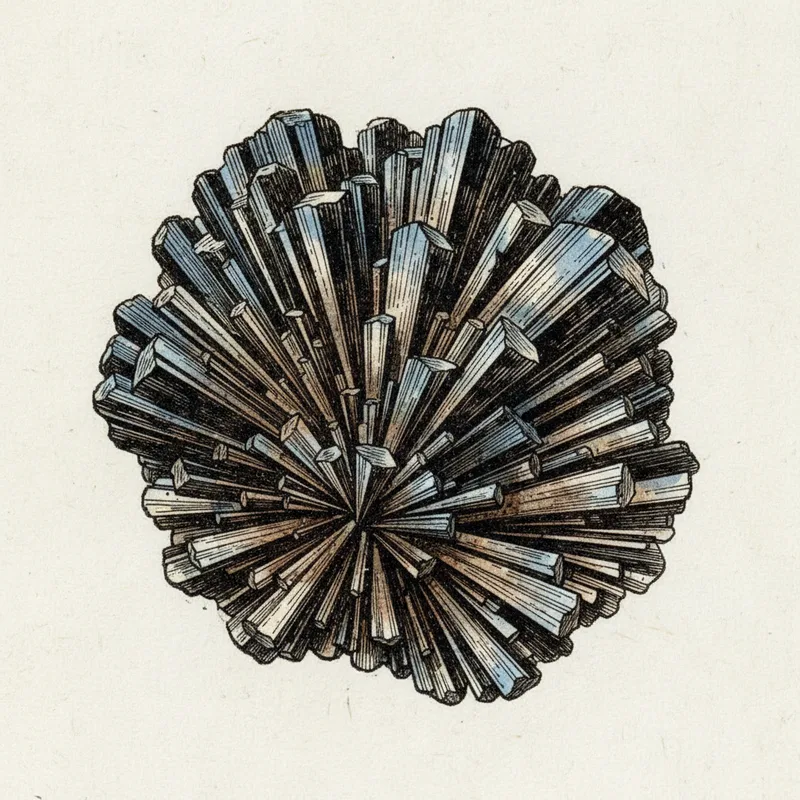
Wolframite
The Tungsten Ore
Affiliate links. We may earn a commission, at no cost to you.
Quick Facts
Formation & Origin
Wolframite is the primary ore of tungsten, the metal with the highest melting point of any element (3,422°C). It forms in high-temperature hydrothermal veins associated with granitic intrusions, often alongside cassiterite (tin ore), quartz, and arsenopyrite.
The mineral is actually a solid solution series between two end members: ferberite (iron-dominant, FeWO₄) and hübnerite (manganese-dominant, MnWO₄). Most specimens contain both iron and manganese and are simply called wolframite.
The name has a colorful etymology. Medieval German tin miners noticed that certain dark, heavy minerals contaminated their tin smelting, causing the tin to foam and reducing yields. They called it 'wolfram' (wolf's froth or wolf's cream) because it 'ate the tin like a wolf.' The element tungsten takes its symbol (W) from this name. 'Tungsten' itself comes from Swedish: 'tung sten' meaning 'heavy stone.'
Identification Guide
Wolframite is identified by its dark brown-black color, submetallic luster, bladed to tabular crystal habit, very high specific gravity (7.0-7.5, remarkably heavy for a non-metallic-looking mineral), and one perfect cleavage direction.
Distinguish from tourmaline (lighter SG, different luster), columbite-tantalite (similar appearance but even heavier), and ilmenite (different streak, trigonal). The extreme heaviness is the most immediate diagnostic clue: wolframite feels much heavier than it looks.
Spotting Fakes
Wolframite is not commonly faked. It's primarily a specimen mineral and industrial ore, with value coming from well-crystallized specimens on quartz matrix. The main collector concern is distinguishing wolframite from scheelite (calcium tungstate), the other major tungsten ore. Scheelite is lighter colored (white to orange) and fluoresces bright blue-white under shortwave UV, while wolframite does not fluoresce.
Some links in this post go to Amazon and Etsy. Crystal Almanac earns a commission from qualifying purchases at no extra cost to you. Tools recommended here are ones we would use ourselves to run the tests described - the recommendation comes first, the link is downstream of it.
Cultural & Metaphysical Traditions
Presented as cultural traditions, not scientific evidence
Wolframite is associated with strength, endurance, and perseverance in crystal healing. The tungsten connection (highest melting point of any metal) reinforces associations with withstanding extreme pressure and maintaining integrity under fire. Some practitioners use it for building determination and completing difficult long-term projects.
Metaphysical and “healing” associations are cultural traditions, not medical advice or scientific fact. Crystals are not a substitute for professional medical care.
Where It's Found
World's dominant tungsten producer (~80% of global supply)
Classic European specimens, operating since 1886
Fine crystal specimens from tin-tungsten veins
Significant African producer, 'conflict mineral' concerns
Price Guide
Good to Know
Scratch test: At hardness 5, Wolframite resists scratching from a knife but can be scratched by quartz. Best for pendants and earrings rather than rings.
Global supply: Found in 4 notable locations worldwide, from China to Rwanda.
Heft test: With a specific gravity of 7.0-7.5, Wolframite feels surprisingly heavy for its size. This weight is actually a useful identification tool.
Common Questions
What is the chemical formula of Wolframite?
The chemical formula of Wolframite is (Fe,Mn)WO₄.
What is Wolframite's Mohs hardness?
Wolframite has a Mohs hardness of 5 on the 1 to 10 Mohs scale, which a steel knife will scratch.
Is Wolframite a mineral?
Yes. Wolframite is a naturally occurring mineral (Tungstate Mineral) with a definite chemical composition and an ordered crystal structure.
Care & Safety
The water, salt, and sunlight questions people actually ask before cleansing or displaying wolframite, answered from its hardness (Mohs 5) and chemistry ((Fe,Mn)WO₄).
Can Wolframite go in water?
Only briefly. A quick rinse under running water is fine for wolframite, but do not let it soak or sit submerged. At Mohs 5 it is tough enough for a rinse but not for a long soak. Dry it thoroughly afterward.
Can Wolframite go in salt water?
No. Wolframite can take a brief fresh-water rinse and nothing more, and salt water is harder on it both ways: corrosive while wet, then abrasive as the salt dries into crystals. Wolframite's iron content also makes rust staining likely if salt residue sits on the surface. If it does meet salt water, rinse it with fresh water and dry it promptly.
Sources & References
The mineralogical and gemological data on this page is drawn from and can be cross-checked against these external references.
- WikipediaWolframite on Wikipedia
Related Minerals
The other tungsten ore, calcium tungstate
Tin ore, frequently found alongside wolframite
Iron-rich end member of the wolframite series
Explore More
Save This Stone

Keep this wolframite reference handy. Save the card to a Pinterest board and the profile is one tap away.
Save to PinterestNewsletter
Something shiny, now and then
A stone worth knowing, or a fake worth spotting, every so often. No spam.