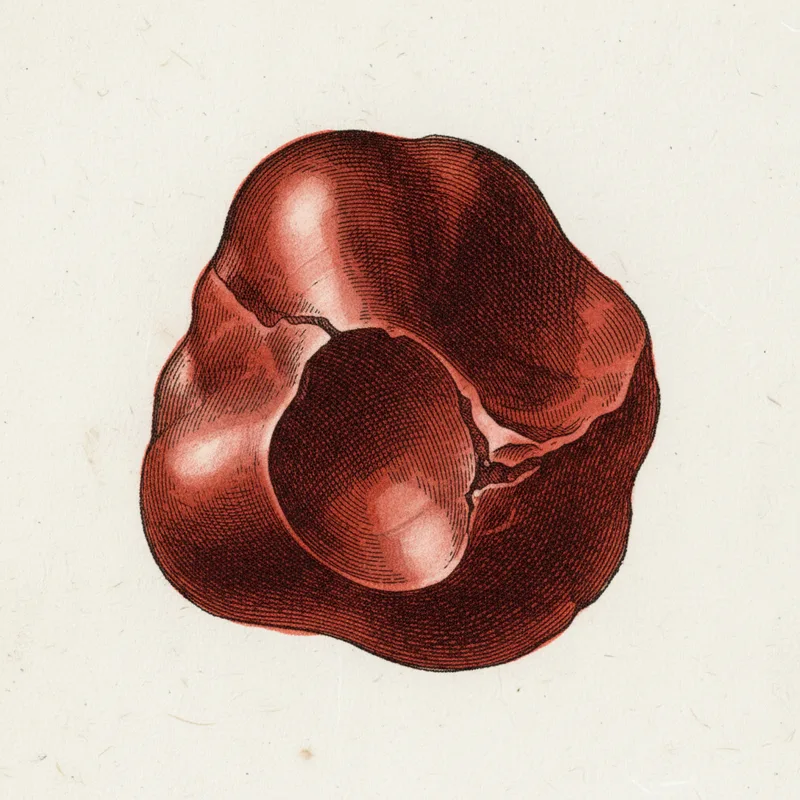
Red Jasper
The Supreme Nurturer
Affiliate links. We may earn a commission, at no cost to you.
Quick Facts
Formation & Origin
Red jasper is one of the most abundant colored gemstones on Earth. It's an opaque variety of chalcedony (microcrystalline quartz) colored deep red by iron oxide (hematite) inclusions dispersed throughout the silica matrix.
It forms in sedimentary, volcanic, and metamorphic environments wherever silica-rich solutions encounter iron. Common formation settings include volcanic flows (where jasper fills vesicles and fractures), sedimentary beds (where silica replaces other minerals), and hydrothermal veins. The ubiquity of both silica and iron in Earth's crust makes red jasper one of the most globally distributed colored minerals.
Humans have used red jasper since prehistory. It was carved into seals, amulets, and tools across ancient Egypt, Mesopotamia, Greece, and Rome. The name 'jasper' comes from the Greek 'iaspis' and the Hebrew 'yashpeh,' and it appears in the Bible as one of the stones in the High Priest's breastplate.
Identification Guide
Red jasper is identified by its opaque deep red color, waxy to vitreous luster, hardness of 7, and conchoidal fracture. It should be uniformly red without translucency (translucent red chalcedony is carnelian, not jasper).
Distinguish from carnelian (translucent, lighter orange-red), red agate (banded, translucent), and bloodstone (green with red spots, opposite pattern). Red jasper's complete opacity and uniform red coloring are its defining features.
Spotting Fakes
Red jasper is too abundant and affordable to be commonly faked. The main concerns are dyed material (cheaper pale jasper dyed deeper red) and mislabeling (different red stones sold as jasper). Natural red jasper has subtle variations in color intensity and may contain slight banding or mottling. Perfectly uniform, intensely saturated red might indicate dyeing. Also, some 'red jasper' from China is actually dyed quartzite.
Some links in this post go to Amazon and Etsy. Crystal Almanac earns a commission from qualifying purchases at no extra cost to you. Tools recommended here are ones we would use ourselves to run the tests described - the recommendation comes first, the link is downstream of it.
Cultural & Metaphysical Traditions
Presented as cultural traditions, not scientific evidence
Red jasper has been called 'the supreme nurturer' and is one of the oldest recorded protective stones. Roman soldiers carried it for courage. Native American traditions used it in rain ceremonies. In crystal healing, it's the quintessential root chakra stone: associated with stability, endurance, physical vitality, and connection to the earth.
Metaphysical and “healing” associations are cultural traditions, not medical advice or scientific fact. Crystals are not a substitute for professional medical care.
Where It's Found
Found on every continent
Major commercial producer
Significant production
Fine specimen-quality material
Price Guide
Good to Know
Scratch test: At hardness 7, Red Jasper can scratch glass and steel. It's durable enough for any type of jewelry.
Global supply: Found in 4 notable locations worldwide, from Worldwide to United States.
Heft test: Red Jasper has average mineral density (2.58-2.91). It feels about as heavy as you'd expect from a stone its size.
Common Questions
What is the chemical formula of Red Jasper?
The chemical formula of Red Jasper is SiO₂ (with iron oxide inclusions).
What is Red Jasper's Mohs hardness?
Red Jasper has a Mohs hardness of 7 on the 1 to 10 Mohs scale, hard enough to scratch glass and stand up to daily wear.
Is Red Jasper a mineral?
Yes. Red Jasper is a naturally occurring mineral (Chalcedony (Quartz Family)) with a definite chemical composition and an ordered crystal structure.
Care & Safety
The water, salt, and sunlight questions people actually ask before cleansing or displaying red jasper, answered from its hardness (Mohs 7) and chemistry (SiO₂ (with iron oxide inclusions)).
Can Red Jasper go in water?
Yes. Red Jasper is hard (Mohs 7) and chemically stable, so a rinse or a quick wash with mild soap is no problem, cleanse it in water freely if that is your practice. A long soak does nothing for it either way, so skip that, and dry the stone afterward.
Can Red Jasper go in salt water?
Not recommended, even though red jasper itself is hard and not water-soluble. Salt is both corrosive and mildly abrasive: it can dull a polished surface, attack metal settings, and crystallize inside small fractures as the stone dries. A quick dip will not destroy red jasper, but rinse it with fresh water afterward and dry it. For routine cleaning, plain water is the kinder choice.
Sources & References
The mineralogical and gemological data on this page is drawn from and can be cross-checked against these external references.
- WikipediaJasper on Wikipedia
Explore More
Quartz & Chalcedony
The Grounding Collection
Called the 'supreme nurturer.' Roman soldiers carried it for endurance. The most universally used grounding stone, with a tradition spanning every culture that had access to it.
The Confidence Collection
The endurance stone. Roman soldiers carried it for stamina in battle. Associated with sustained courage - not the flash of bravado, but the steady confidence that carries through difficulty.
Best Crystals for Grounding and Stability
Red, White, and Blue Crystals: The Real Geology
Best Crystals for Men: A Grounded Introduction
Mohs Hardness Scale
See where Red Jasper sits on the scale
Crystal Care Guide
Water safety, sunlight, and handling tips
Save This Stone

Keep this red jasper reference handy. Save the card to a Pinterest board and the profile is one tap away.
Save to PinterestNewsletter
Something shiny, now and then
A stone worth knowing, or a fake worth spotting, every so often. No spam.