Picture Jasper
Nature's Landscape Painter
Affiliate links. We may earn a commission, at no cost to you.
Quick Facts
Formation & Origin
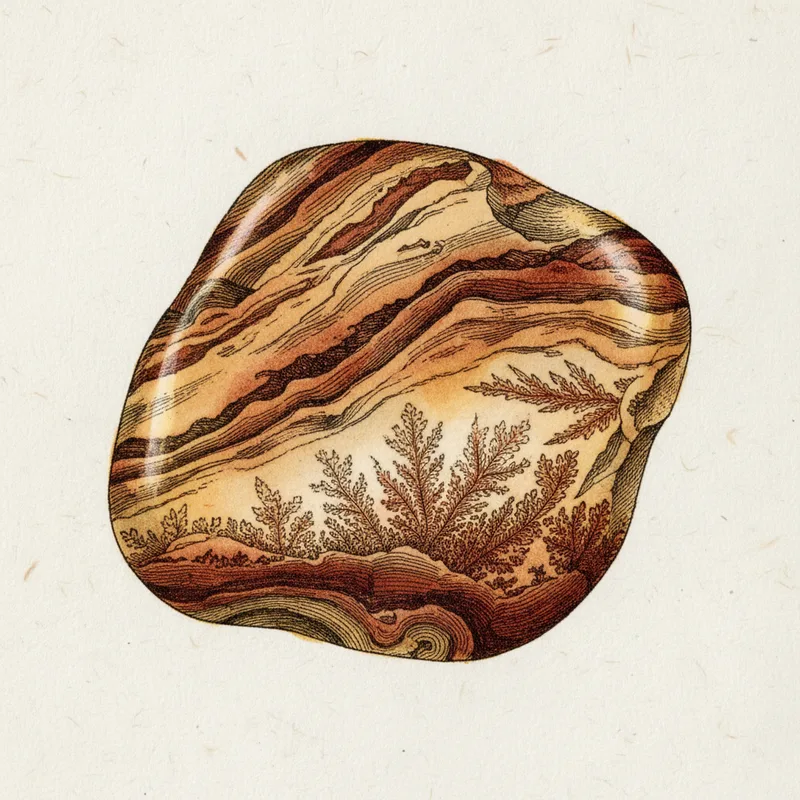
Picture jasper is a variety of chalcedony (microcrystalline quartz) that contains intricate patterns resembling landscapes, mountains, or desert scenes. These patterns form through the deposition of iron oxides and other minerals in sedimentary silica over millions of years.
The 'pictures' are created by chemical weathering and mineral infiltration. As silica-rich solutions flow through porous rock, dissolved iron, manganese, and other elements precipitate in layers and bands that follow the natural contours of cracks and grain boundaries. The result is dendritic (branching) patterns and banded zones that can look remarkably like mountain scenery, river valleys, or desert horizons.
Idaho's picture jasper from the Owyhee region formed in ancient lakebeds and volcanic ash deposits where prolonged weathering created exceptionally detailed patterns. Biggs jasper from Oregon formed in similar volcanic environments along the Columbia River.
Identification Guide
Picture jasper is identified by its scenic, landscape-like patterns in earth tones on an opaque chalcedony base. The patterns look painted or airbrushed rather than crystalline. Hardness around 6.5-7, conchoidal fracture, and waxy to vitreous luster confirm it as jasper.
Distinguish from landscape agate (translucent rather than opaque), tiger iron (metallic hematite bands), and painted stone (check for surface coatings). The patterns in genuine picture jasper penetrate through the stone rather than sitting on the surface.
Spotting Fakes
Picture jasper is abundant and affordable enough that outright fakes are uncommon. The main concern is enhanced material. Some lower-quality jasper is dyed to intensify colors or painted to add 'scenic' effects. Genuine patterns show natural gradients and variations in color intensity. Under magnification, painted patterns will show brush marks or surface coatings. Also be aware that some sellers label generic jasper as 'Biggs jasper' or 'Owyhee jasper' when it actually comes from elsewhere.
Some links in this post go to Amazon and Etsy. Crystal Almanac earns a commission from qualifying purchases at no extra cost to you. Tools recommended here are ones we would use ourselves to run the tests described - the recommendation comes first, the link is downstream of it.
Cultural & Metaphysical Traditions
Presented as cultural traditions, not scientific evidence
Picture jasper is sometimes called the 'Stone of Global Awareness' in crystal healing circles, associated with connecting to the earth and understanding broader ecological or historical perspectives. Its landscape patterns are thought to stimulate creative visualization. Many practitioners use it for grounding and connecting with nature.
Metaphysical and “healing” associations are cultural traditions, not medical advice or scientific fact. Crystals are not a substitute for professional medical care.
Where It's Found
Finest landscape patterns, classic source
Biggs jasper, dramatic scenic patterns
Ancient source of landscape stone
Varied patterns, commercially available
Price Guide
Good to Know
Scratch test: At hardness 6.5, Picture Jasper resists scratching from a knife but can be scratched by quartz. Best for pendants and earrings rather than rings.
Global supply: Found in 4 notable locations worldwide, from United States to Brazil.
Heft test: Picture Jasper has average mineral density (2.58-2.91). It feels about as heavy as you'd expect from a stone its size.
Common Questions
What is the chemical formula of Picture Jasper?
The chemical formula of Picture Jasper is SiO₂ (with iron oxide inclusions).
What is Picture Jasper's Mohs hardness?
Picture Jasper has a Mohs hardness of 6.5 on the 1 to 10 Mohs scale, hard enough to scratch glass but softer than quartz.
Is Picture Jasper a mineral?
Yes. Picture Jasper is a naturally occurring mineral (Chalcedony (Quartz Family)) with a definite chemical composition and an ordered crystal structure.
Care & Safety
The water, salt, and sunlight questions people actually ask before cleansing or displaying picture jasper, answered from its hardness (Mohs 6.5) and chemistry (SiO₂ (with iron oxide inclusions)).
Can Picture Jasper go in water?
Yes. Picture Jasper is not water-soluble and durable enough (Mohs 6.5), so a rinse or a quick wash with mild soap is no problem, cleanse it in water freely if that is your practice. A long soak does nothing for it either way, so skip that, and dry the stone afterward.
Can Picture Jasper go in salt water?
Not recommended, even though picture jasper itself is hard and not water-soluble. Salt is both corrosive and mildly abrasive: it can dull a polished surface, attack metal settings, and crystallize inside small fractures as the stone dries. A quick dip will not destroy picture jasper, but rinse it with fresh water afterward and dry it. For routine cleaning, plain water is the kinder choice.
Sources & References
The mineralogical and gemological data on this page is drawn from and can be cross-checked against these external references.
- WikipediaJasper on Wikipedia
Explore More
Save This Stone

Keep this picture jasper reference handy. Save the card to a Pinterest board and the profile is one tap away.
Save to PinterestNewsletter
Something shiny, now and then
A stone worth knowing, or a fake worth spotting, every so often. No spam.