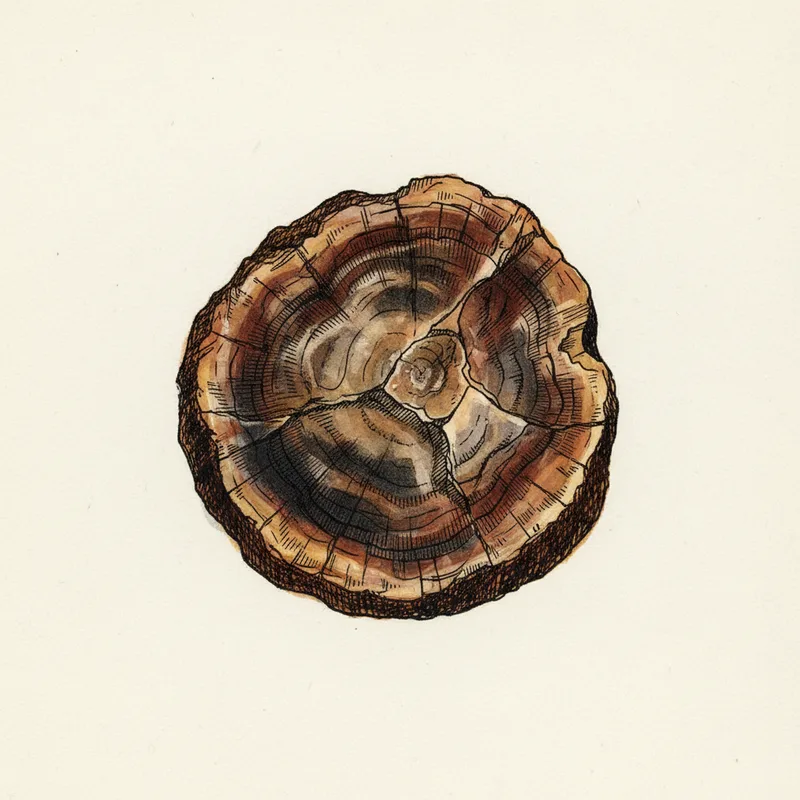
Petrified Wood
Time Written in Stone
Affiliate links. We may earn a commission, at no cost to you.
Quick Facts
Formation & Origin
Petrified wood is a fossil formed when buried wood is replaced by silica, chiefly microcrystalline quartz and chalcedony (SiO₂), preserving the original cellular structure in stone. Petrified wood forms through permineralization, a process where organic wood tissue is gradually replaced by minerals (typically silica) while preserving the original cellular structure. When a tree is buried rapidly by volcanic ash, sediment, or flooding, it enters an oxygen-poor environment that prevents normal decay.
Mineral-rich groundwater then percolates through the wood, depositing silica (and sometimes other minerals) in the cellular spaces. Over thousands to millions of years, the organic material is entirely replaced, cell by cell, by quartz, chalcedony, or opal. The replacement is so precise that tree rings, bark texture, and even individual cell walls can be preserved in exquisite detail.
Different minerals create different colors: iron oxides produce reds and browns, manganese creates pink and black, copper creates green and blue, and chromium can create vivid greens. Arizona's Petrified Forest specimens are roughly 225 million years old (Late Triassic), preserving ancient Araucarioxylon trees.
Identification Guide
Petrified wood is identified by its stone composition combined with preserved wood grain, tree rings, and bark texture. It looks like wood but feels like rock, with the weight and hardness of quartz. Under magnification, you can often see preserved cellular structure.
Distinguish from natural wood (petrified wood is far heavier and cold to the touch), agatized coral (different growth patterns), and other fossils. A simple test: it won't burn, scratches glass, and shows conchoidal fracture on fresh breaks rather than fibrous wood fracture.
Spotting Fakes
Some 'petrified wood' sold online is simply painted or dyed rock shaped to resemble wood. Genuine specimens show authentic wood grain that penetrates through the entire piece. Under magnification, real petrified wood reveals cellular structure. Extremely vivid, uniform colors may indicate enhancement or dyeing. Specimens from protected areas like Arizona's Petrified Forest National Park are illegal to collect, so legitimate dealers source from private land or legal collecting sites.
Some links in this post go to Amazon and Etsy. Crystal Almanac earns a commission from qualifying purchases at no extra cost to you. Tools recommended here are ones we would use ourselves to run the tests described - the recommendation comes first, the link is downstream of it.
Cultural & Metaphysical Traditions
Presented as cultural traditions, not scientific evidence
Petrified wood is valued in crystal healing as a symbol of patience, transformation, and connection to ancient wisdom. Practitioners associate it with accessing ancestral knowledge and understanding deep time. Its transformation from organic to mineral mirrors themes of personal evolution. Many traditions consider it a grounding stone that helps connect present-day awareness with earth's deep history.
Metaphysical and “healing” associations are cultural traditions, not medical advice or scientific fact. Crystals are not a substitute for professional medical care.
Where It's Found
Triassic specimens, 225 million years old, vibrant colors
Excellent preservation, wide color range
Large specimens, often used for furniture
Massive fossilized logs, some of the largest known
Price Guide
Good to Know
Scratch test: At hardness 7, Petrified Wood can scratch glass and steel. It's durable enough for any type of jewelry.
Global supply: Found in 4 notable locations worldwide, from United States to Argentina.
Heft test: Petrified Wood has average mineral density (2.58-2.91). It feels about as heavy as you'd expect from a stone its size.
Common Questions
What is the chemical formula of Petrified Wood?
The chemical formula of Petrified Wood is SiO₂ (replacing original wood structure).
What is Petrified Wood's Mohs hardness?
Petrified Wood has a Mohs hardness of 7 on the 1 to 10 Mohs scale, hard enough to scratch glass and stand up to daily wear.
Is Petrified Wood a mineral?
No. Petrified Wood is an organic gem, not a mineral, because it forms from once-living material rather than purely geological crystallization.
Care & Safety
The water, salt, and sunlight questions people actually ask before cleansing or displaying petrified wood, answered from its hardness (Mohs 7) and chemistry (SiO₂ (replacing original wood structure)).
Can Petrified Wood go in water?
Yes. Petrified Wood is hard (Mohs 7) and chemically stable, so a rinse or a quick wash with mild soap is no problem, cleanse it in water freely if that is your practice. A long soak does nothing for it either way, so skip that, and dry the stone afterward.
Can Petrified Wood go in salt water?
Not recommended, even though petrified wood itself is hard and not water-soluble. Salt is both corrosive and mildly abrasive: it can dull a polished surface, attack metal settings, and crystallize inside small fractures as the stone dries. A quick dip will not destroy petrified wood, but rinse it with fresh water afterward and dry it. For routine cleaning, plain water is the kinder choice.
Sources & References
The mineralogical and gemological data on this page is drawn from and can be cross-checked against these external references.
- WikipediaPetrified wood on Wikipedia
Explore More
Organic & Biogenic Gems
The Grounding Collection
Ancient trees turned to stone over millions of years. The ultimate symbol of patience, deep time, and earth's transformative power. Holding 225-million-year-old wood grounds you in geological time.
How Crystals Form: Pegmatite, Hydrothermal, Sedimentary
Crystals for Your Home: A Room-by-Room Guide
Mohs Hardness Scale
See where Petrified Wood sits on the scale
Crystal Care Guide
Water safety, sunlight, and handling tips
Save This Stone

Keep this petrified wood reference handy. Save the card to a Pinterest board and the profile is one tap away.
Save to PinterestNewsletter
Something shiny, now and then
A stone worth knowing, or a fake worth spotting, every so often. No spam.