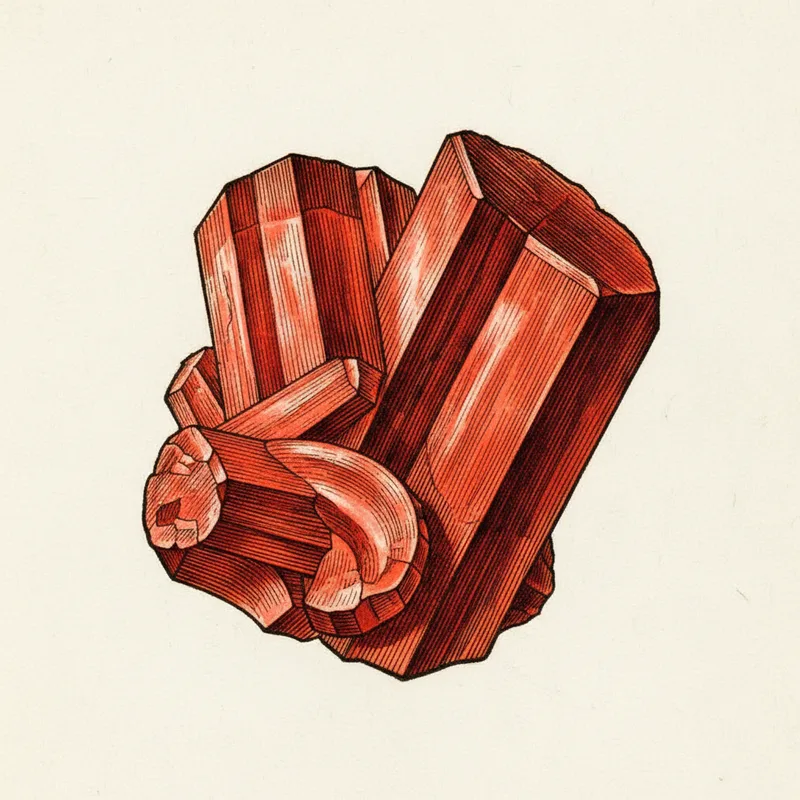
Realgar
The Ruby of Arsenic
Affiliate links. We may earn a commission, at no cost to you.
Quick Facts
Formation & Origin
Realgar is an arsenic sulfide mineral (As₄S₄), prized for its vivid crimson-red color and one of the softest gem materials known. Realgar forms in low-temperature hydrothermal veins, hot spring deposits, and as a volcanic sublimate. It often occurs alongside its yellow cousin orpiment (As₂S₃), with which it shares many geological environments. Both are arsenic sulfide minerals.
Fine crystals from China's Hunan Province reach several centimeters and display a stunning crimson color with resinous to adamantine luster. These form in hydrothermal veins within carbonate host rocks where arsenic-rich fluids deposited their mineral load as temperatures dropped.
Realgar is light-sensitive. Prolonged exposure to sunlight causes it to slowly decompose into paraealgar, a yellow powdery mineral, through a light-induced structural rearrangement. Museum specimens must be stored in darkness to preserve their vivid red color. This instability is why ancient realgar pigments in artwork have often turned yellow or orange over centuries.
Identification Guide
Realgar is identified by its vivid crimson-red color, very low hardness (1.5, easily scratched), and orange-red streak. The resinous luster and monoclinic crystal habit (short prismatic crystals) are additional features.
Distinguish from cinnabar (higher SG, trigonal, red streak), crocoite (lead chromate, different streak), and red glass. Realgar's extreme softness and light sensitivity are key identifiers. SAFETY NOTE: Realgar contains arsenic. Wash hands after handling and don't store with other minerals.
Spotting Fakes
Realgar is not commonly faked because it's a niche collector mineral. The main concern is degradation: specimens exposed to light may have partially converted to yellow paraealgar. Check that the red color is vivid and unaltered. Brown, yellow, or powdery surfaces indicate light damage. Well-preserved specimens with intact red crystals command premium prices. Always ask about storage history.
Some links in this post go to Amazon and Etsy. Crystal Almanac earns a commission from qualifying purchases at no extra cost to you. Tools recommended here are ones we would use ourselves to run the tests described - the recommendation comes first, the link is downstream of it.
Cultural & Metaphysical Traditions
Presented as cultural traditions, not scientific evidence
In Chinese alchemy, realgar was considered a powerful protective substance used during the Dragon Boat Festival to ward off evil spirits and illness. Crystal healing practitioners approach realgar cautiously due to its arsenic content. It is considered a stone of energy, passion, and transformation. IMPORTANT: Handle with care. Do not make gem elixirs or breathe in dust. Contains arsenic.
Metaphysical and “healing” associations are cultural traditions, not medical advice or scientific fact. Crystals are not a substitute for professional medical care.
Where It's Found
Spectacular crystal specimens
Classic European specimens
Fine crystal groups on pyrite matrix
Associated with hot springs and volcanic activity
Price Guide
Good to Know
Scratch test: At hardness 1.5, Realgar can be scratched with a fingernail. This is a display specimen, not a wearable stone.
Global supply: Found in 4 notable locations worldwide, from China to United States.
Heft test: Realgar has a specific gravity of 3.56 - noticeably heavier than quartz. You'll feel the density when you pick it up.
Common Questions
What is the chemical formula of Realgar?
The chemical formula of Realgar is As₄S₄.
What is Realgar's Mohs hardness?
Realgar has a Mohs hardness of 1.5 on the 1 to 10 Mohs scale, soft enough to scratch with a fingernail.
Is Realgar a mineral?
Yes. Realgar is a naturally occurring mineral (Sulfide Mineral) with a definite chemical composition and an ordered crystal structure.
Care & Safety
The water, salt, and sunlight questions people actually ask before cleansing or displaying realgar, answered from its hardness (Mohs 1.5) and chemistry (As₄S₄).
Can Realgar go in water?
Not recommended. TOXIC. Arsenic sulfide. Decomposes in light and water. Store in darkness. Handle with extreme caution.
Can Realgar go in salt water?
No. Realgar is best kept away from water altogether, and salt water is the harsher version of that problem: the dissolved salt is corrosive while the stone is wet, then leaves gritty crystals behind in cracks and crevices as it dries.
Is sunlight safe for Realgar?
No. Prolonged light exposure converts realgar (As₄S₄) into pararealgar, a crumbly yellow powder, and the change is irreversible. It is also an arsenic mineral. Store realgar in complete darkness, handle it briefly, and wash your hands afterward.
Sources & References
The mineralogical and gemological data on this page is drawn from and can be cross-checked against these external references.
- WikipediaRealgar on Wikipedia
- WebmineralRealgar mineral data (Webmineral)
- Handbook of MineralogyRealgar (Handbook of Mineralogy, PDF)
Explore More
Sulfide Minerals
Toxic Crystals: The Complete Safety Guide
Best Crystals for Sleep: What to Know & How to Use
Best Crystals for Pregnancy and New Motherhood
Mohs Hardness Scale
See where Realgar sits on the scale
Crystal Care Guide
Water safety, sunlight, and handling tips
Save This Stone

Keep this realgar reference handy. Save the card to a Pinterest board and the profile is one tap away.
Save to PinterestNewsletter
Something shiny, now and then
A stone worth knowing, or a fake worth spotting, every so often. No spam.