Stibnite
The Sword of Shadows
Affiliate links. We may earn a commission, at no cost to you.
Quick Facts
Formation & Origin
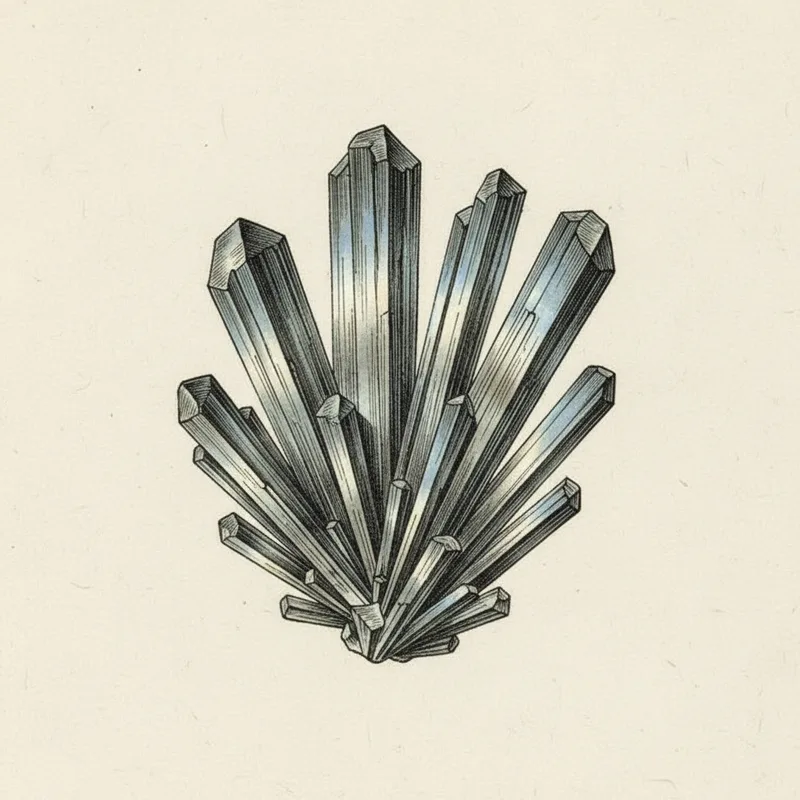
Stibnite is an antimony sulfide mineral (Sb₂S₃) and the principal ore of antimony, prized for its long, striated, steel-gray prismatic crystals. Stibnite crystallizes from low-temperature hydrothermal solutions, typically between 100-300°C. It forms in veins associated with hot springs and volcanic activity, often alongside quartz, calcite, and other sulfide minerals.
The crystals grow in elongated prismatic habits that can reach remarkable sizes. The famous Ichinokawa Mine in Japan produced sword-like crystals exceeding half a meter in length. These dramatic formations develop when antimony-rich fluids flow through fractures in the host rock and conditions remain stable long enough for slow, uninterrupted crystal growth.
Stibnite is the primary ore of antimony, a metalloid used in flame retardants, lead-acid batteries, and alloys. Ancient civilizations ground stibnite into powder for use as kohl eyeliner, a practice dating back to ancient Egypt and Mesopotamia.
Identification Guide
Stibnite's long, striated prismatic crystals with brilliant metallic luster make it one of the most visually distinctive minerals. The crystals are often bent or curved, a result of the mineral's extreme softness (Mohs 2) and perfect cleavage in one direction. You can scratch it with a fingernail.
Distinguish from galena (cubic crystals, higher hardness), bismuthinite (very similar but rarer and slightly harder), and metallic tourmaline (much harder, different crystal habit). Stibnite will melt in a match flame, which is a reliable but destructive test.
Spotting Fakes
Stibnite is rarely faked because it's relatively affordable and abundant. The main concern is damage from cleaning. Many Chinese specimens are cleaned with acids that can leave surfaces dull or pitted. The best specimens retain their natural metallic brilliance. Avoid specimens that look unnaturally uniform or suspiciously shiny, as they may have been coated.
Some links in this post go to Amazon and Etsy. Crystal Almanac earns a commission from qualifying purchases at no extra cost to you. Tools recommended here are ones we would use ourselves to run the tests described - the recommendation comes first, the link is downstream of it.
Cultural & Metaphysical Traditions
Presented as cultural traditions, not scientific evidence
Crystal practitioners associate stibnite with transformation and the ability to navigate dark or uncertain periods. Its sword-like crystal habit has made it a symbol of cutting through illusion. Some traditions use it for meditation on shadow work. Handle with care and wash hands after, as stibnite contains antimony.
Metaphysical and “healing” associations are cultural traditions, not medical advice or scientific fact. Crystals are not a substitute for professional medical care.
Where It's Found
Legendary specimens with blade-like crystals up to 60cm
Major modern source, excellent crystal clusters
Classic European locality with fine crystals
Historic American specimens
Price Guide
Good to Know
Scratch test: At hardness 2, Stibnite can be scratched with a fingernail. This is a display specimen, not a wearable stone.
Global supply: Found in 4 notable locations worldwide, from Japan to United States.
Heft test: Stibnite has a specific gravity of 4.63 - noticeably heavier than quartz. You'll feel the density when you pick it up.
Common Questions
What is the chemical formula of Stibnite?
The chemical formula of Stibnite is Sb₂S₃.
What is Stibnite's Mohs hardness?
Stibnite has a Mohs hardness of 2 on the 1 to 10 Mohs scale, soft enough to scratch with a fingernail.
Is Stibnite a mineral?
Yes. Stibnite is a naturally occurring mineral (Sulfide Mineral) with a definite chemical composition and an ordered crystal structure.
Care & Safety
The water, salt, and sunlight questions people actually ask before cleansing or displaying stibnite, answered from its hardness (Mohs 2) and chemistry (Sb₂S₃).
Can Stibnite go in water?
Not recommended. At Mohs 2, stibnite is soft enough that water can slowly dull, etch, or wear down the surface, so a water cleanse does more harm than good here. Reach for a dry cloth instead. Important: stibnite contains antimony. Never use it for gem elixirs or crystal-infused water, and wash your hands after handling it.
Can Stibnite go in salt water?
No. Stibnite is best kept away from water altogether, and salt water is the harsher version of that problem: the dissolved salt is corrosive while the stone is wet, then leaves gritty crystals behind in cracks and crevices as it dries.
Sources & References
The mineralogical and gemological data on this page is drawn from and can be cross-checked against these external references.
- WikipediaStibnite on Wikipedia
- WebmineralStibnite mineral data (Webmineral)
- Handbook of MineralogyStibnite (Handbook of Mineralogy, PDF)
Related Minerals
Similar metallic sulfide, lead instead of antimony
Antimony replaced by bismuth, same structure
Fellow metallic sulfide, different crystal system
Explore More
Save This Stone

Keep this stibnite reference handy. Save the card to a Pinterest board and the profile is one tap away.
Save to PinterestNewsletter
Something shiny, now and then
A stone worth knowing, or a fake worth spotting, every so often. No spam.