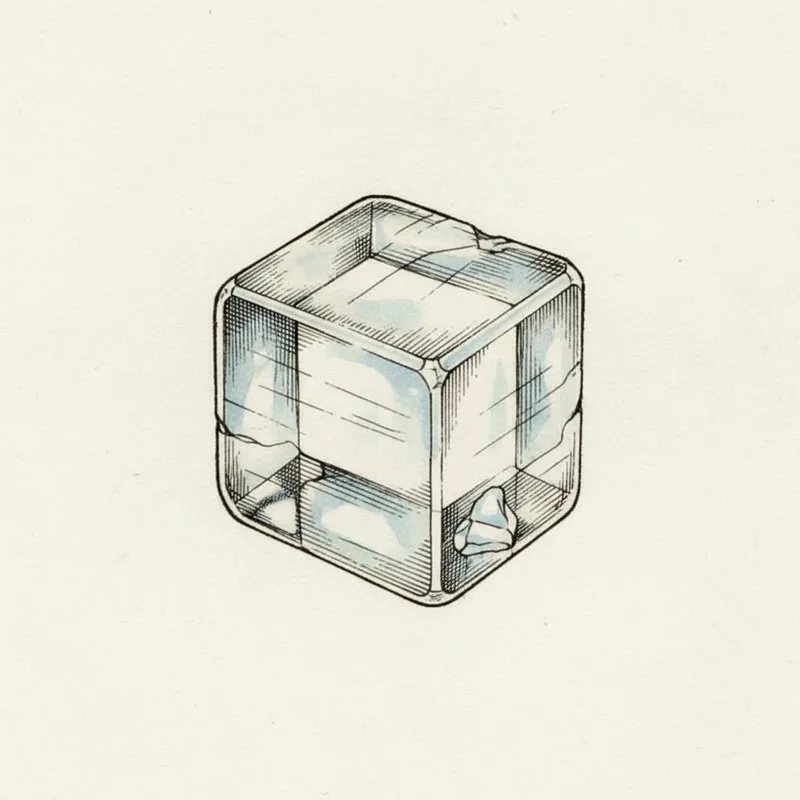
Optical Calcite
The Viking Sunstone
Affiliate links. We may earn a commission, at no cost to you.
Quick Facts
Formation & Origin
Optical calcite, also known as Iceland spar, is an exceptionally clear variety of the calcium carbonate mineral calcite (CaCO₃), famous for the double refraction it produces. Optical calcite, also called Iceland spar, is an exceptionally transparent variety of calcite that displays strong double refraction (birefringence). It forms in hydrothermal veins and cavities where calcium carbonate-rich solutions slowly deposit large, perfectly clear crystals.
The remarkable optical properties arise from calcite's trigonal crystal structure, which bends light differently depending on polarization direction. When light enters the crystal, it splits into two rays traveling at different speeds and directions, producing a visible double image of anything viewed through the crystal.
Historically, Iceland's Helgustaðir mine was the world's primary source. Norse sagas reference a 'sunstone' (sólarsteinn) used for navigation. Modern experiments have confirmed that optical calcite can locate the sun's position even through thick clouds by detecting the polarization of scattered sunlight. This may have allowed Vikings to navigate the North Atlantic on overcast days.
Identification Guide
Place optical calcite over text or a dot: you'll see a clear double image. This strong birefringence is the definitive test. The rhombohedral crystal shape (like a squashed cube with parallelogram faces) and perfect cleavage in three directions are additional identifiers.
Distinguish from clear quartz (no double refraction, much harder), fluorite (isotropic, no double refraction), and glass (no double refraction, no cleavage). Optical calcite also effervesces readily in dilute hydrochloric acid.
Spotting Fakes
Optical calcite is not commonly faked, but quality varies enormously. True optical-grade Iceland spar is completely clear with no veils, fractures, or inclusions. Lower-quality pieces may show double refraction but lack the clarity for scientific use. Some dealers sell clear calcite as 'Iceland spar' regardless of origin. Provenance from the historic Helgustaðir mine adds significant collector value but is difficult to verify.
Some links in this post go to Amazon and Etsy. Crystal Almanac earns a commission from qualifying purchases at no extra cost to you. Tools recommended here are ones we would use ourselves to run the tests described - the recommendation comes first, the link is downstream of it.
Cultural & Metaphysical Traditions
Presented as cultural traditions, not scientific evidence
Optical calcite's double-refraction property has made it a powerful symbol for seeing multiple perspectives and finding hidden truth. Crystal practitioners associate it with clearing mental fog, enhancing perception, and helping distinguish between illusion and reality. The Viking sunstone connection adds associations with navigation, finding one's path, and clarity of direction.
Metaphysical and “healing” associations are cultural traditions, not medical advice or scientific fact. Crystals are not a substitute for professional medical care.
Where It's Found
Historic source of the finest optical calcite ('Iceland spar')
Large transparent rhombohedra
Commercial optical-grade material
Price Guide
Good to Know
Scratch test: At hardness 3, Optical Calcite can be scratched with a copper coin. Handle gently and keep away from harder stones in your collection.
Global supply: Found in 3 notable locations worldwide, from Iceland to China.
Heft test: Optical Calcite has average mineral density (2.71). It feels about as heavy as you'd expect from a stone its size.
Common Questions
What is the chemical formula of Optical Calcite?
The chemical formula of Optical Calcite is CaCO₃.
What is Optical Calcite's Mohs hardness?
Optical Calcite has a Mohs hardness of 3 on the 1 to 10 Mohs scale, soft enough to scratch with a copper coin.
Is Optical Calcite a mineral?
Yes. Optical Calcite is a naturally occurring mineral (Carbonate Mineral) with a definite chemical composition and an ordered crystal structure.
Care & Safety
The water, salt, and sunlight questions people actually ask before cleansing or displaying optical calcite, answered from its hardness (Mohs 3) and chemistry (CaCO₃).
Can Optical Calcite go in water?
Not recommended. At Mohs 3, optical calcite is soft enough that water can slowly dull, etch, or wear down the surface, so a water cleanse does more harm than good here. Reach for a dry cloth instead.
Can Optical Calcite go in salt water?
No. Optical Calcite is best kept away from water altogether, and salt water is the harsher version of that problem: the dissolved salt is corrosive while the stone is wet, then leaves gritty crystals behind in cracks and crevices as it dries.
Sources & References
The mineralogical and gemological data on this page is drawn from and can be cross-checked against these external references.
- WikipediaIceland spar on Wikipedia
- WebmineralCalcite mineral data (Webmineral)
- Handbook of MineralogyCalcite (Handbook of Mineralogy, PDF)
Explore More
Carbonate Minerals
The Meditation Collection
Viking sunstone with double refraction. Place it over text and see two images - a meditation on perception, duality, and seeing beyond the obvious.
Best Crystals for Confidence and Self-Esteem
Mohs Hardness Scale
See where Optical Calcite sits on the scale
Crystal Care Guide
Water safety, sunlight, and handling tips
Save This Stone

Keep this optical calcite reference handy. Save the card to a Pinterest board and the profile is one tap away.
Save to PinterestNewsletter
Something shiny, now and then
A stone worth knowing, or a fake worth spotting, every so often. No spam.