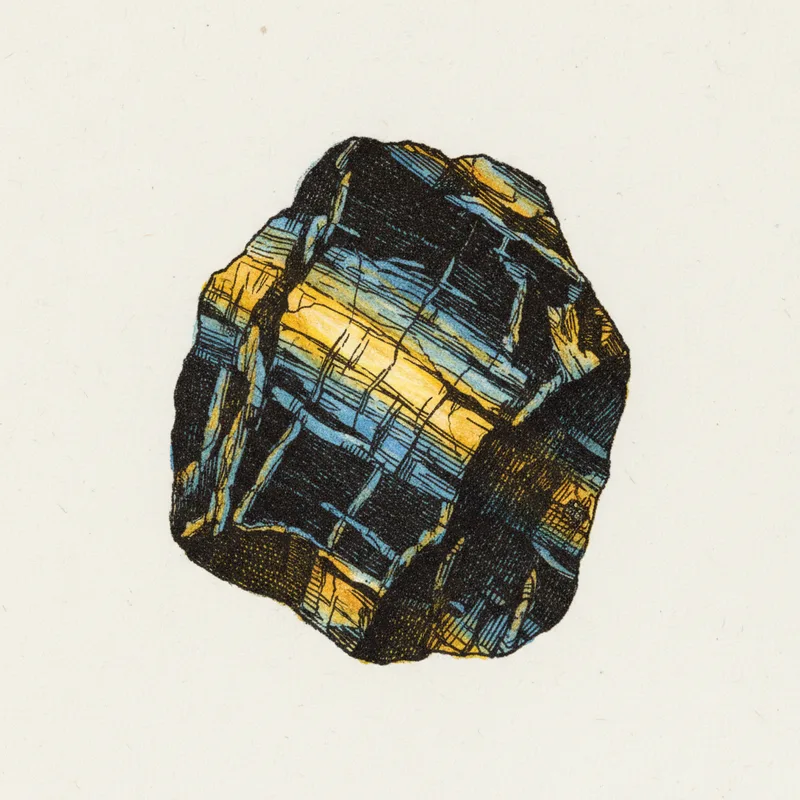
Nuummite
The Sorcerer's Stone
Affiliate links. We may earn a commission, at no cost to you.
Quick Facts
Formation & Origin
Nuummite is a metamorphic rock composed primarily of two amphibole minerals - gedrite and anthophyllite - that formed approximately 3 billion years ago in what is now Greenland, making it one of the oldest rocks used as a gemstone. The name comes from Nuuk, Greenland's capital.
The characteristic iridescent flashes that make nuummite visually striking are caused by lamellar intergrowths of the two amphibole minerals. As the rock underwent metamorphism, thin layers of gedrite and anthophyllite formed in alternating sheets. Light reflecting between these thin layers produces golden, bronze, blue, green, and occasionally violet flashes through thin-film interference.
Nuummite's remote Arctic source - accessible only during Greenland's brief summer and requiring difficult overland travel to reach the deposit - severely limits supply. This genuine scarcity, combined with its impressive visual properties and ancient age, has made it a premium collector's stone.
Identification Guide
Nuummite is identified by its black base color with distinctive iridescent flashes that appear when the stone is rotated. The flashes are typically golden to bronze but can include blue and green. The effect is similar to labradorite but from a completely different mineral assemblage.
Distinguish from labradorite (feldspar, blue-dominant flash, different rock type), black opal (silica, different iridescence mechanism), and arfvedsonite (similar black with flash but single mineral). Nuummite's golden-bronze flash on a dark amphibole matrix is distinctive.
Spotting Fakes
Genuine nuummite is expensive enough to warrant caution. Some black stones with surface treatments or metallic coatings are sold as nuummite. Genuine nuummite's flashes come from within the stone - not from surface effects. Arfvedsonite and astrophyllite (other black minerals with flashes) are sometimes sold as nuummite but are different rocks. True nuummite comes only from Greenland; any claim of nuummite from other localities should be verified.
Some links in this post go to Amazon and Etsy. Crystal Almanac earns a commission from qualifying purchases at no extra cost to you. Tools recommended here are ones we would use ourselves to run the tests described - the recommendation comes first, the link is downstream of it.
Cultural & Metaphysical Traditions
Presented as cultural traditions, not scientific evidence
In Inuit tradition, iridescent stones are associated with the Northern Lights and considered to contain trapped aurora energy. Nuummite's modern metaphysical reputation centers on 'deep magic' and sorcery - it's often called the sorcerer's stone or the magician's stone. Practitioners associate it with accessing ancestral wisdom, shadow work, and personal power. Its extreme age (3 billion years) reinforces associations with ancient Earth energy.
Metaphysical and “healing” associations are cultural traditions, not medical advice or scientific fact. Crystals are not a substitute for professional medical care.
Where It's Found
The only known source of gem-quality material
Price Guide
Good to Know
Scratch test: At hardness 6, Nuummite resists scratching from a knife but can be scratched by quartz. Best for pendants and earrings rather than rings.
Global supply: Found at only one location on Earth - Greenland. Supply is inherently limited.
Heft test: Nuummite has average mineral density (3.00-3.40). It feels about as heavy as you'd expect from a stone its size.
Common Questions
What is the chemical formula of Nuummite?
The chemical formula of Nuummite is Variable (Mg,Fe)₇Si₈O₂₂(OH)₂ amphiboles.
What is Nuummite's Mohs hardness?
Nuummite has a Mohs hardness of 6 on the 1 to 10 Mohs scale, hard enough to scratch glass but softer than quartz.
Is Nuummite a mineral?
Not quite. Nuummite is a rock (a naturally occurring mixture of minerals), not a single mineral species.
Care & Safety
The water, salt, and sunlight questions people actually ask before cleansing or displaying nuummite, answered from its hardness (Mohs 6) and chemistry (Variable (Mg,Fe)₇Si₈O₂₂(OH)₂ amphiboles).
Can Nuummite go in water?
Yes. Nuummite is not water-soluble and durable enough (Mohs 6), so a rinse or a quick wash with mild soap is no problem, cleanse it in water freely if that is your practice. A long soak does nothing for it either way, so skip that, and dry the stone afterward.
Can Nuummite go in salt water?
Not recommended, even though nuummite itself is hard and not water-soluble. Salt is both corrosive and mildly abrasive: it can dull a polished surface, attack metal settings, and crystallize inside small fractures as the stone dries. Nuummite's iron content also makes rust staining likely if salt residue sits on the surface. A quick dip will not destroy nuummite, but rinse it with fresh water afterward and dry it. For routine cleaning, plain water is the kinder choice.
Sources & References
The mineralogical and gemological data on this page is drawn from and can be cross-checked against these external references.
- WikipediaNuummite on Wikipedia
Related Minerals
Different mineral, similar iridescent flash
Black mineral with blue flash, sometimes confused
Star-shaped golden inclusions in black matrix
Finnish labradorite with full spectrum flash
Explore More
Save This Stone

Keep this nuummite reference handy. Save the card to a Pinterest board and the profile is one tap away.
Save to PinterestNewsletter
Something shiny, now and then
A stone worth knowing, or a fake worth spotting, every so often. No spam.