Astrophyllite
The Star Leaf
Affiliate links. We may earn a commission, at no cost to you.
Quick Facts
Formation & Origin
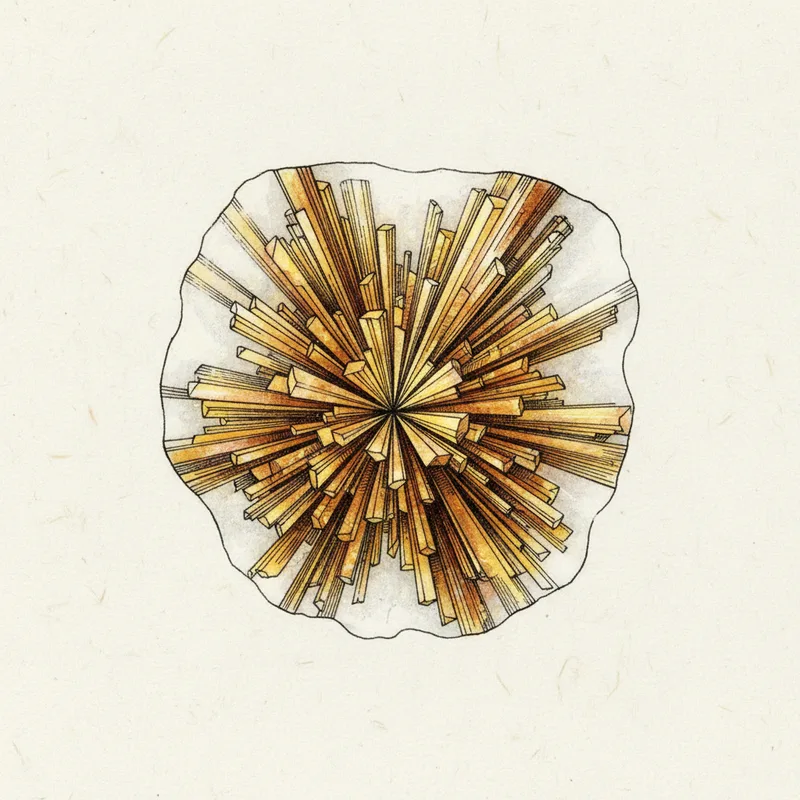
Astrophyllite is a rare potassium-iron titanium silicate of the phyllosilicate class, recognized by its radiating, bronze-gold blade-like crystals. Astrophyllite forms exclusively in alkaline igneous rocks and their associated pegmatites, the same rare geological environment that produces eudialyte, hackmanite, and other unusual minerals. The name comes from the Greek 'astron' (star) and 'phyllon' (leaf), describing its radiating blade-like crystal habit.
The mineral grows as golden-bronze bladed crystals that radiate outward from a central point, creating starburst patterns within dark nepheline syenite or other alkaline rock matrix. These radiating sprays can range from a few millimeters to several centimeters across.
Astrophyllite's complex formula reflects the unusual geochemistry of alkaline igneous systems: potassium, sodium, iron, manganese, titanium, and fluorine all combining in a single mineral. This complexity is why astrophyllite is found in only a handful of geological settings worldwide.
Identification Guide
Astrophyllite is identified by its golden-bronze radiating blade-like crystals in a dark matrix of alkaline rock. The metallic to pearly luster on crystal faces, softness (Mohs 3), and starburst growth habit are diagnostic.
Distinguish from arfvedsonite (black, fibrous), biotite (darker, more flexible), and enstatite (different context). The starburst radiating habit in an alkaline rock matrix is uniquely astrophyllite.
Spotting Fakes
Astrophyllite is not commonly faked. The main concern is quality. The most desirable specimens show well-defined golden starburst patterns with bright metallic luster against a contrasting dark matrix. Lower-quality pieces may have sparse, poorly defined blades. The alkaline rock matrix should be visible, confirming the correct geological context.
Some links in this post go to Amazon and Etsy. Crystal Almanac earns a commission from qualifying purchases at no extra cost to you. Tools recommended here are ones we would use ourselves to run the tests described - the recommendation comes first, the link is downstream of it.
Cultural & Metaphysical Traditions
Presented as cultural traditions, not scientific evidence
Astrophyllite is associated with illuminating one's true purpose and navigating major life transitions. The radiating star pattern is interpreted as light expanding outward from the soul's center. Practitioners use it for recognizing patterns in life experience, releasing outdated habits, and finding the courage to pursue authentic paths. Its rarity adds to its mystical reputation.
Metaphysical and “healing” associations are cultural traditions, not medical advice or scientific fact. Crystals are not a substitute for professional medical care.
Where It's Found
Type locality, finest specimens
Classic European locality
Fine specimens from alkaline complex
Associated with rare alkaline minerals
Price Guide
Good to Know
Scratch test: At hardness 3, Astrophyllite can be scratched with a copper coin. Handle gently and keep away from harder stones in your collection.
Global supply: Found in 4 notable locations worldwide, from Russia to Greenland.
Heft test: Astrophyllite has average mineral density (3.2-3.4). It feels about as heavy as you'd expect from a stone its size.
Common Questions
What is the chemical formula of Astrophyllite?
The chemical formula of Astrophyllite is (K,Na)₃(Fe,Mn)₇Ti₂(Si₄O₁₂)₂(O,OH,F)₇.
What is Astrophyllite's Mohs hardness?
Astrophyllite has a Mohs hardness of 3 on the 1 to 10 Mohs scale, soft enough to scratch with a copper coin.
Is Astrophyllite a mineral?
Yes. Astrophyllite is a naturally occurring mineral (Silicate Mineral (Phyllosilicate)) with a definite chemical composition and an ordered crystal structure.
Care & Safety
The water, salt, and sunlight questions people actually ask before cleansing or displaying astrophyllite, answered from its hardness (Mohs 3) and chemistry ((K,Na)₃(Fe,Mn)₇Ti₂(Si₄O₁₂)₂(O,OH,F)₇).
Can Astrophyllite go in water?
Not recommended. At Mohs 3, astrophyllite is soft enough that water can slowly dull, etch, or wear down the surface, so a water cleanse does more harm than good here. Reach for a dry cloth instead.
Can Astrophyllite go in salt water?
No. Astrophyllite is best kept away from water altogether, and salt water is the harsher version of that problem: the dissolved salt is corrosive while the stone is wet, then leaves gritty crystals behind in cracks and crevices as it dries. Astrophyllite's iron content also makes rust staining likely if salt residue sits on the surface.
Sources & References
The mineralogical and gemological data on this page is drawn from and can be cross-checked against these external references.
- WikipediaAstrophyllite on Wikipedia
- WebmineralAstrophyllite mineral data (Webmineral)
- Handbook of MineralogyAstrophyllite (Handbook of Mineralogy, PDF)
Related Minerals
Fellow rare alkaline mineral from same environments
Black amphibole often found alongside
Another rare titanium-bearing silicate
Explore More
Save This Stone

Keep this astrophyllite reference handy. Save the card to a Pinterest board and the profile is one tap away.
Save to PinterestNewsletter
Something shiny, now and then
A stone worth knowing, or a fake worth spotting, every so often. No spam.