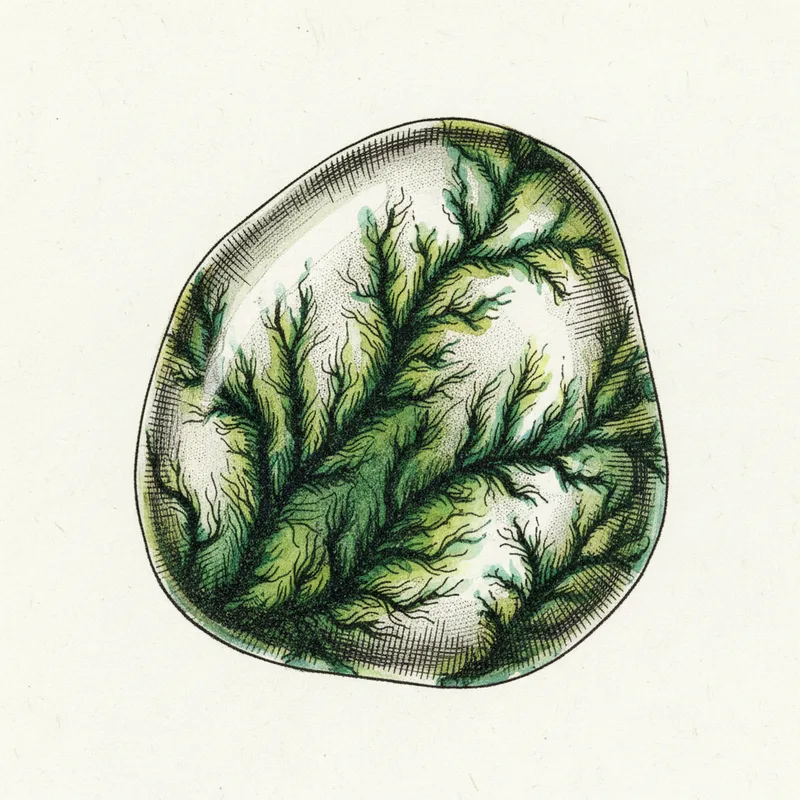
Moss Agate
The Gardener's Stone
Affiliate links. We may earn a commission, at no cost to you.
Quick Facts
Formation & Origin
Moss agate is a translucent variety of chalcedony, the microcrystalline form of quartz, named for the moss-like mineral inclusions suspended within it rather than for any banding. Moss agate isn't technically an agate (it lacks the banding that defines true agate) - it's translucent chalcedony with green filamentous inclusions of chlorite, hornblende, or iron oxide minerals that resemble moss, ferns, or tree branches growing inside the stone.
These inclusions form when mineral-rich fluids infiltrate silica gel during the chalcedony's formation in volcanic rock cavities. The green minerals crystallize within the gel in branching patterns influenced by diffusion physics - the same processes that create dendritic agate's tree patterns, but with three-dimensional green mineral growths rather than flat manganese oxide deposits.
The result is a stone that genuinely looks like it contains tiny fossilized plants - a visual coincidence that has made moss agate one of the most popular semiprecious stones for thousands of years. The best specimens show vivid green inclusions suspended in clear to translucent chalcedony, creating a miniature landscape effect.
Identification Guide
Moss agate is identified by its translucent chalcedony host containing green, filamentous inclusions that resemble moss or lichen. At hardness 7, it's durable and takes a good polish.
Distinguish from dendritic agate (flat black/brown dendrites vs three-dimensional green filaments), tree agate (opaque white with green spots, not translucent), and serpentine (uniform green, no inclusions in clear host). The green inclusions in moss agate have depth and dimension visible when the stone is rotated.
Spotting Fakes
Moss agate is common and inexpensive, making faking rare. Glass imitations with embedded green material exist but lack the natural randomness of genuine inclusions. Dyed green agate may be sold as moss agate but lacks the characteristic filamentous inclusion pattern. Genuine moss agate's green inclusions follow natural crystal growth patterns visible under magnification.
Some links in this post go to Amazon and Etsy. Crystal Almanac earns a commission from qualifying purchases at no extra cost to you. Tools recommended here are ones we would use ourselves to run the tests described - the recommendation comes first, the link is downstream of it.
Cultural & Metaphysical Traditions
Presented as cultural traditions, not scientific evidence
European farmers historically placed moss agate in fields and hung it from trees to ensure successful harvests and protect livestock. It was considered the most powerful agricultural talisman. In Indian tradition, moss agate is associated with nature spirits. Modern crystal practitioners call it the gardener's stone, associating it with abundance, new beginnings, and connection to nature. It's popular among people who work with plants or spend time outdoors.
Metaphysical and “healing” associations are cultural traditions, not medical advice or scientific fact. Crystals are not a substitute for professional medical care.
Where It's Found
Major commercial source, wide variety
Fine translucent material
Scenic specimens with vivid inclusions
Good quality agate with moss inclusions
Price Guide
Good to Know
Scratch test: At hardness 7, Moss Agate can scratch glass and steel. It's durable enough for any type of jewelry.
Global supply: Found in 4 notable locations worldwide, from India to Uruguay.
Heft test: Moss Agate has average mineral density (2.60). It feels about as heavy as you'd expect from a stone its size.
Common Questions
What is the chemical formula of Moss Agate?
The chemical formula of Moss Agate is SiO₂ with chlorite/hornblende inclusions.
What is Moss Agate's Mohs hardness?
Moss Agate has a Mohs hardness of 7 on the 1 to 10 Mohs scale, hard enough to scratch glass and stand up to daily wear.
Is Moss Agate a mineral?
Yes. Moss Agate is a naturally occurring mineral (Quartz Family (Chalcedony)) with a definite chemical composition and an ordered crystal structure.
Care & Safety
The water, salt, and sunlight questions people actually ask before cleansing or displaying moss agate, answered from its hardness (Mohs 7) and chemistry (SiO₂ with chlorite/hornblende inclusions).
Can Moss Agate go in water?
Yes. Moss Agate is hard (Mohs 7) and chemically stable, so a rinse or a quick wash with mild soap is no problem, cleanse it in water freely if that is your practice. A long soak does nothing for it either way, so skip that, and dry the stone afterward.
Can Moss Agate go in salt water?
Not recommended, even though moss agate itself is hard and not water-soluble. Salt is both corrosive and mildly abrasive: it can dull a polished surface, attack metal settings, and crystallize inside small fractures as the stone dries. A quick dip will not destroy moss agate, but rinse it with fresh water afterward and dry it. For routine cleaning, plain water is the kinder choice.
Sources & References
The mineralogical and gemological data on this page is drawn from and can be cross-checked against these external references.
- WikipediaMoss agate on Wikipedia
- WebmineralQuartz mineral data (Webmineral)
- Handbook of MineralogyQuartz (Handbook of Mineralogy, PDF)
Explore More
Quartz & Chalcedony
The Abundance Collection
European farmers placed moss agate in fields for abundant harvests. The oldest agricultural prosperity stone tradition in Western culture.
Virgo Season Crystals 2026: Stones for Clarity
Leo Season Crystals 2026: Stones for Confidence
Gemini Season Crystals 2026: Six Stones for Clarity
Mohs Hardness Scale
See where Moss Agate sits on the scale
Crystal Care Guide
Water safety, sunlight, and handling tips
Save This Stone

Keep this moss agate reference handy. Save the card to a Pinterest board and the profile is one tap away.
Save to PinterestNewsletter
Something shiny, now and then
A stone worth knowing, or a fake worth spotting, every so often. No spam.