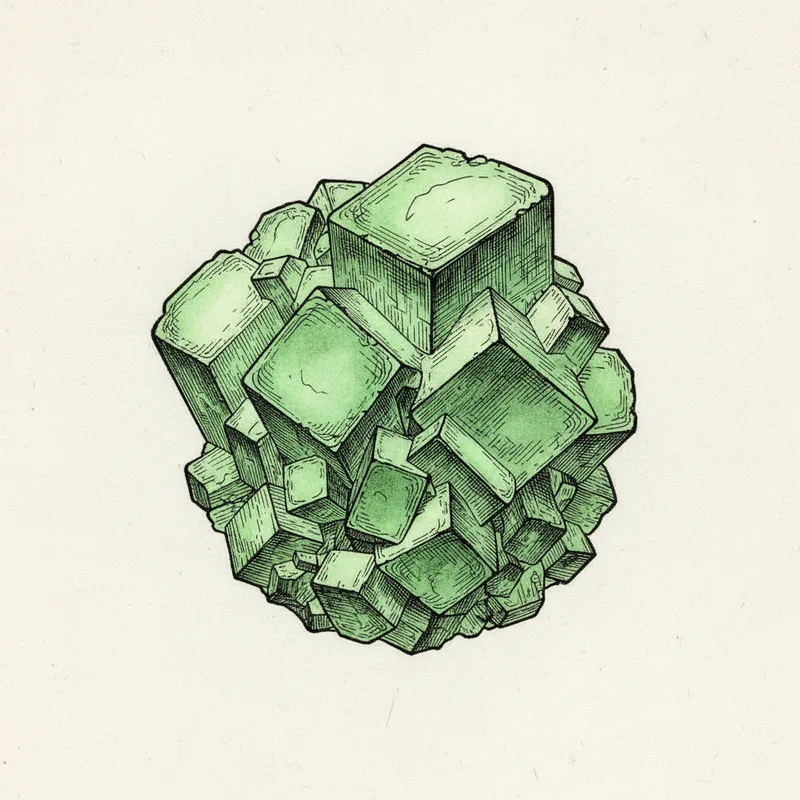
Green Calcite
The Heart Cleanser
Affiliate links. We may earn a commission, at no cost to you.
Quick Facts
Formation & Origin
Green calcite is the green-tinted variety of calcite, the most common calcium carbonate mineral (CaCO₃), colored by trace inclusions such as chlorite or actinolite. Green calcite gets its color from trace amounts of chlorite, actinolite, or other green minerals incorporated during crystal growth. It forms in the same geological environments as other calcite varieties: hydrothermal veins, sedimentary carbonates, and metamorphic marbles.
The intensity of green depends on the concentration and type of inclusion. Bright mint-green specimens typically contain finely dispersed chlorite particles. Darker green specimens may contain actinolite or epidote inclusions. Some pale green calcite achieves its color through minor nickel substitution.
Large, gem-quality green calcite rhombohedra from Mexico and Brazil can be strikingly beautiful, with a translucent minty glow. Like all calcite, green calcite has perfect rhombohedral cleavage and will effervesce readily in dilute hydrochloric acid.
Identification Guide
Green calcite is identified by its green color, low hardness (Mohs 3, scratchable with a copper coin), perfect rhombohedral cleavage, and vigorous effervescence in dilute HCl. Double refraction is visible in transparent specimens.
Distinguish from prehnite (harder, different crystal system), green fluorite (harder, cubic cleavage), and chrysoprase (much harder, quartz family). The acid test (fizzing) immediately confirms any calcite variety.
Spotting Fakes
Green calcite is common and affordable enough that outright fakes are rare. Some dyed calcite exists but is uncommon. The main confusion is with green fluorite (which won't effervesce in acid and has cubic rather than rhombohedral cleavage). Green calcite from Mexico is sometimes heated or treated to intensify color, but this is unusual.
Some links in this post go to Amazon and Etsy. Crystal Almanac earns a commission from qualifying purchases at no extra cost to you. Tools recommended here are ones we would use ourselves to run the tests described - the recommendation comes first, the link is downstream of it.
Cultural & Metaphysical Traditions
Presented as cultural traditions, not scientific evidence
Green calcite is considered one of the most accessible heart-chakra stones in crystal healing. Its soft green color and gentle energy connect it to emotional release, compassion, and opening the heart to new experiences. Practitioners use it for releasing rigid emotional patterns and for finding the courage to love after loss.
Metaphysical and “healing” associations are cultural traditions, not medical advice or scientific fact. Crystals are not a substitute for professional medical care.
Where It's Found
Major source of mint-green massive specimens
Large rhombohedral crystals
Fine crystallized specimens
Common in many geological settings
Price Guide
Good to Know
Scratch test: At hardness 3, Green Calcite can be scratched with a copper coin. Handle gently and keep away from harder stones in your collection.
Global supply: Found in 4 notable locations worldwide, from Mexico to United States.
Heft test: Green Calcite has average mineral density (2.71). It feels about as heavy as you'd expect from a stone its size.
Common Questions
What is the chemical formula of Green Calcite?
The chemical formula of Green Calcite is CaCO₃ (with trace chlorite/actinolite).
What is Green Calcite's Mohs hardness?
Green Calcite has a Mohs hardness of 3 on the 1 to 10 Mohs scale, soft enough to scratch with a copper coin.
Is Green Calcite a mineral?
Yes. Green Calcite is a naturally occurring mineral (Carbonate Mineral) with a definite chemical composition and an ordered crystal structure.
Care & Safety
The water, salt, and sunlight questions people actually ask before cleansing or displaying green calcite, answered from its hardness (Mohs 3) and chemistry (CaCO₃ (with trace chlorite/actinolite)).
Can Green Calcite go in water?
Not recommended. At Mohs 3, green calcite is soft enough that water can slowly dull, etch, or wear down the surface, so a water cleanse does more harm than good here. Reach for a dry cloth instead.
Can Green Calcite go in salt water?
No. Green Calcite is best kept away from water altogether, and salt water is the harsher version of that problem: the dissolved salt is corrosive while the stone is wet, then leaves gritty crystals behind in cracks and crevices as it dries.
Sources & References
The mineralogical and gemological data on this page is drawn from and can be cross-checked against these external references.
- WikipediaCalcite on Wikipedia
- WebmineralCalcite mineral data (Webmineral)
- Handbook of MineralogyCalcite (Handbook of Mineralogy, PDF)
Explore More
Save This Stone

Keep this green calcite reference handy. Save the card to a Pinterest board and the profile is one tap away.
Save to PinterestNewsletter
Something shiny, now and then
A stone worth knowing, or a fake worth spotting, every so often. No spam.