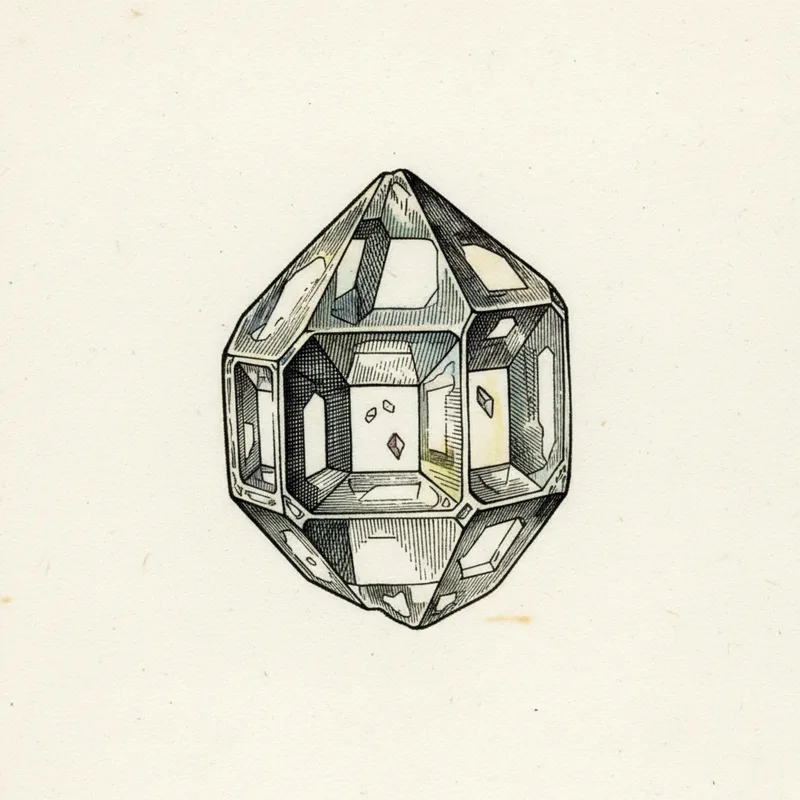
Fenster Quartz
Window quartz with etch pits
Affiliate links. We may earn a commission, at no cost to you.
Quick Facts
Formation & Origin
Fenster quartz, also called window or skeletal quartz, is a variety of quartz (SiO₂) whose faces are recessed into window-like depressions by selective dissolution. Fenster quartz forms through a two-stage process that begins with normal crystal growth and ends with selective chemical dissolution. Initial crystals develop in pegmatite pockets or hydrothermal veins under standard conditions, producing typical prismatic quartz terminated by rhombohedral faces. The defining window texture emerges later, when groundwater rich in alkaline compounds or fluorine migrates through the host rock and contacts the quartz surface. These fluids preferentially attack certain crystallographic directions, with rhombohedral growth faces dissolving substantially faster than prism faces. The result is rhombohedral depressions etched into prism faces, creating the geometric windows that give the variety its German name. The process operates over millions of years of geologic time. In some deposits, later hydrothermal events deposit new quartz onto the etched surfaces, producing stepped or layered windows that record multiple dissolution and regrowth cycles. The mechanism is identical in principle to skeletal growth seen in some halite crystals, but in quartz the etching is always post-growth dissolution rather than primary skeletal crystallization.
Identification Guide
Look for deep geometric depressions on prism faces that conform to rhombohedral symmetry, with the windows showing smooth glossy interior surfaces rather than frosted or rough textures. Genuine fenster quartz retains hardness 7 throughout, and the etched areas still show the conchoidal fracture characteristic of quartz. Under a 10x loupe, natural windows display subtle growth steps and occasionally secondary quartz regrowth. Specific gravity remains 2.65 regardless of etching depth. The geometric conformity to trigonal symmetry is the strongest diagnostic.
Spotting Fakes
Acid-etched modern fakes produced by hydrofluoric acid treatment of clean quartz crystals show unnaturally uniform sharpness across all windows and often retain a frosted white residue inside the depressions. Genuine fenster has variable window depths and glossy interior surfaces. Carved or mechanically ground windows show tool marks under a 10x loupe, with rotary abrasion scratches or chisel facets visible at window edges. Sandblasted imitations produce uniformly frosted surfaces lacking the rhombohedral symmetry of true etching. Authentic fenster quartz respects the crystal's trigonal symmetry, with windows oriented consistently relative to the c-axis, while fakes often show random orientations. Check for natural inclusions or phantom growth lines in the crystal body, which confirm geologic origin.
Some links in this post go to Amazon and Etsy. Crystal Almanac earns a commission from qualifying purchases at no extra cost to you. Tools recommended here are ones we would use ourselves to run the tests described - the recommendation comes first, the link is downstream of it.
Cultural & Metaphysical Traditions
Presented as cultural traditions, not scientific evidence
Contemporary metaphysical tradition treats fenster quartz as a stone of insight and perspective, with the geometric windows symbolizing doorways between states of awareness. Crystal workers associate it with past-life recall and self-examination, viewing the etched surfaces as metaphors for uncovering hidden layers. Less established in historical tradition than common quartz, it entered the metaphysical market in the late twentieth century alongside other specialty growth habits. These are cultural associations rather than verified properties.
Metaphysical and “healing” associations are cultural traditions, not medical advice or scientific fact. Crystals are not a substitute for professional medical care.
Where It's Found
Primary source for distinctive fenster specimens with deep rhombohedral windows, often showing secondary regrowth creating stepped internal structures
Produces fenster quartz with complex multi-generation etching, some specimens showing smoky coloration from radiation exposure
Smaller but well-formed fenster crystals, typically clear with sharp rhombohedral window geometry
Occasional fenster-habit specimens from the Ouachita Mountains hydrothermal veins
Price Guide
Good to Know
Scratch test: At hardness 7, Fenster Quartz can scratch glass and steel. It's durable enough for any type of jewelry.
Global supply: Found in 4 notable locations worldwide, from Minas Gerais to Arkansas.
Heft test: Fenster Quartz has average mineral density (2.65). It feels about as heavy as you'd expect from a stone its size.
Common Questions
What is the chemical formula of Fenster Quartz?
The chemical formula of Fenster Quartz is SiO₂.
What is Fenster Quartz's Mohs hardness?
Fenster Quartz has a Mohs hardness of 7 on the 1 to 10 Mohs scale, hard enough to scratch glass and stand up to daily wear.
Is Fenster Quartz a mineral?
Yes. Fenster Quartz is a naturally occurring mineral (Quartz Variety (Growth Habit)) with a definite chemical composition and an ordered crystal structure.
Care & Safety
The water, salt, and sunlight questions people actually ask before cleansing or displaying fenster quartz, answered from its hardness (Mohs 7) and chemistry (SiO₂).
Can Fenster Quartz go in water?
Yes. Fenster Quartz is hard (Mohs 7) and chemically stable, so a rinse or a quick wash with mild soap is no problem, cleanse it in water freely if that is your practice. A long soak does nothing for it either way, so skip that, and dry the stone afterward.
Can Fenster Quartz go in salt water?
Not recommended, even though fenster quartz itself is hard and not water-soluble. Salt is both corrosive and mildly abrasive: it can dull a polished surface, attack metal settings, and crystallize inside small fractures as the stone dries. A quick dip will not destroy fenster quartz, but rinse it with fresh water afterward and dry it. For routine cleaning, plain water is the kinder choice.
Sources & References
The mineralogical and gemological data on this page is drawn from and can be cross-checked against these external references.
- WikipediaQuartz on Wikipedia
- WebmineralQuartz mineral data (Webmineral)
- Handbook of MineralogyQuartz (Handbook of Mineralogy, PDF)
Related Minerals
Another etched/skeletal quartz habit, distinguished by terminated layered growth rather than rhombohedral windows
Often used interchangeably with fenster, though some collectors reserve skeletal for primary hopper-style growth
Tabular quartz with healed fracture line, another specialty growth habit from similar geologic settings
Shares the layered-growth recording of geologic history, but inclusions mark growth pauses rather than dissolution
Explore More
Save This Stone

Keep this fenster quartz reference handy. Save the card to a Pinterest board and the profile is one tap away.
Save to PinterestNewsletter
Something shiny, now and then
A stone worth knowing, or a fake worth spotting, every so often. No spam.