Phantom Quartz
The Ghost Crystal
Affiliate links. We may earn a commission, at no cost to you.
Quick Facts
Formation & Origin
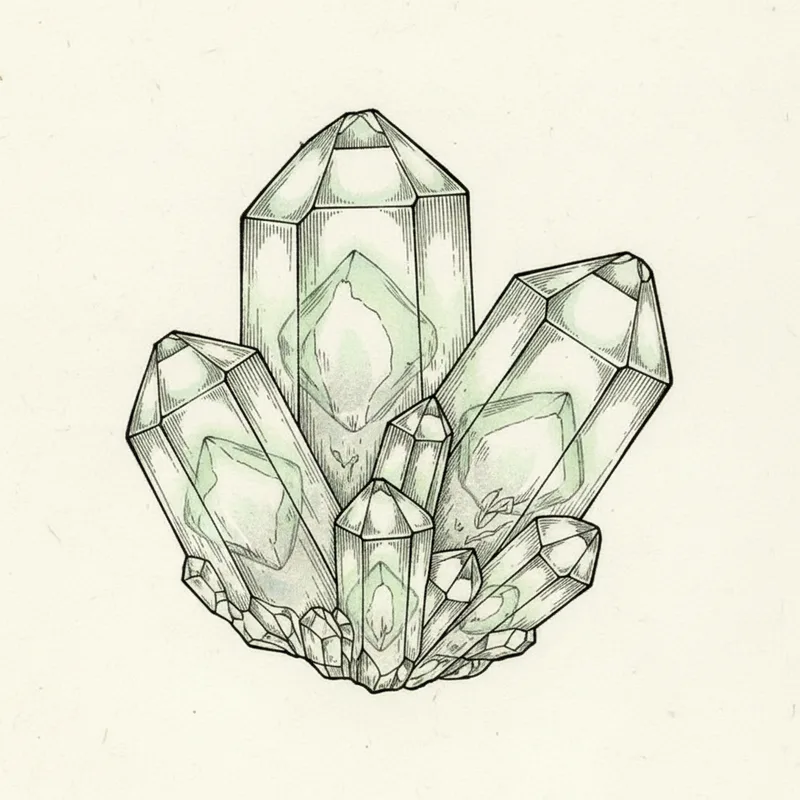
Phantom quartz is a variety of quartz (SiO₂) in which a thin layer of included minerals records the outline of an earlier growth stage, leaving a ghostly crystal-within-a-crystal. Phantom quartz contains a visible 'ghost' of an earlier, smaller crystal preserved inside the current crystal - a geological time capsule recording interrupted growth. The phantom forms when a quartz crystal stops growing (due to changes in temperature, pressure, or fluid supply), and a thin layer of another mineral (chlorite, iron oxide, clay) deposits on its surface. When growth resumes, new quartz crystallizes over the coated surface, trapping the mineral layer inside as a phantom outline.
The phantom precisely mirrors the shape of the crystal's termination at the moment growth paused - a perfect smaller crystal frozen within the larger one. Some specimens contain multiple phantoms recording multiple growth interruptions, creating nested ghost crystals like geological Russian dolls.
Green phantoms (chlorite inclusions) are the most sought after. White phantoms (clay or feldspar) and red/orange phantoms (iron oxide/hematite) are also common. The clarity of the phantom and the contrast between it and the surrounding clear quartz determine the specimen's desirability.
Identification Guide
Phantom quartz is identified by the visible outline of an earlier crystal termination preserved inside the crystal. The phantom should conform to the hexagonal habit of quartz and be visible as a distinct layer within the crystal.
Distinguish from included quartz (random inclusions, not conforming to crystal shape), lodolite/garden quartz (dense irregular inclusions), and artificially coated quartz (surface treatment, not internal). Genuine phantoms follow the geometry of the crystal's growth faces precisely.
Spotting Fakes
Phantom quartz is natural and relatively common in quartz-producing regions, so outright faking is rare. Some sellers polish crystals heavily to make faint phantoms more visible - this is cosmetic but should be disclosed. Artificial phantoms created by coating a crystal and then growing synthetic quartz over it are theoretically possible but not commercially viable. The main issue is quality grading - sharp, well-defined phantoms in clear quartz are worth much more than faint, blurry ones.
Some links in this post go to Amazon and Etsy. Crystal Almanac earns a commission from qualifying purchases at no extra cost to you. Tools recommended here are ones we would use ourselves to run the tests described - the recommendation comes first, the link is downstream of it.
Cultural & Metaphysical Traditions
Presented as cultural traditions, not scientific evidence
Phantom quartz's visible growth history makes it a natural symbol of evolution, growth through difficulty, and learning from the past. Modern practitioners use it for meditation on personal history, accessing past lives, and understanding cyclical patterns. The multiple-phantom variety (nested ghosts) is associated with many lifetimes of wisdom. Green phantoms specifically are connected to nature healing and abundance.
Metaphysical and “healing” associations are cultural traditions, not medical advice or scientific fact. Crystals are not a substitute for professional medical care.
Where It's Found
Major source of all phantom varieties
Fine green and clear phantoms
Classic American quartz locality
Historic alpine phantom crystals
Price Guide
Good to Know
Scratch test: At hardness 7, Phantom Quartz can scratch glass and steel. It's durable enough for any type of jewelry.
Global supply: Found in 4 notable locations worldwide, from Brazil to Austria.
Heft test: Phantom Quartz has average mineral density (2.65). It feels about as heavy as you'd expect from a stone its size.
Common Questions
What is the chemical formula of Phantom Quartz?
The chemical formula of Phantom Quartz is SiO₂ (with mineral inclusion layers).
What is Phantom Quartz's Mohs hardness?
Phantom Quartz has a Mohs hardness of 7 on the 1 to 10 Mohs scale, hard enough to scratch glass and stand up to daily wear.
Is Phantom Quartz a mineral?
Yes. Phantom Quartz is a naturally occurring mineral (Quartz Family) with a definite chemical composition and an ordered crystal structure.
Care & Safety
The water, salt, and sunlight questions people actually ask before cleansing or displaying phantom quartz, answered from its hardness (Mohs 7) and chemistry (SiO₂ (with mineral inclusion layers)).
Can Phantom Quartz go in water?
Yes. Phantom Quartz is hard (Mohs 7) and chemically stable, so a rinse or a quick wash with mild soap is no problem, cleanse it in water freely if that is your practice. A long soak does nothing for it either way, so skip that, and dry the stone afterward.
Can Phantom Quartz go in salt water?
Not recommended, even though phantom quartz itself is hard and not water-soluble. Salt is both corrosive and mildly abrasive: it can dull a polished surface, attack metal settings, and crystallize inside small fractures as the stone dries. A quick dip will not destroy phantom quartz, but rinse it with fresh water afterward and dry it. For routine cleaning, plain water is the kinder choice.
Sources & References
The mineralogical and gemological data on this page is drawn from and can be cross-checked against these external references.
- WikipediaQuartz on Wikipedia
- WebmineralQuartz mineral data (Webmineral)
- Handbook of MineralogyQuartz (Handbook of Mineralogy, PDF)
Related Minerals
The host crystal without phantom inclusions
Green mineral that creates green phantoms
Heavily included quartz, denser than phantoms
Can contain dark phantoms
Explore More
Quartz & Chalcedony
The Meditation Collection
The visible 'ghost' crystal inside provides a meditation focus on growth, layers, and the passage of time.
Best Crystals for Meditation: A Science-First Guide
Phantom Quartz: The Complete Guide to Ghost Crystals
Best Crystals for 2026: Match Stones to Your Goals
Mohs Hardness Scale
See where Phantom Quartz sits on the scale
Crystal Care Guide
Water safety, sunlight, and handling tips
Save This Stone

Keep this phantom quartz reference handy. Save the card to a Pinterest board and the profile is one tap away.
Save to PinterestNewsletter
Something shiny, now and then
A stone worth knowing, or a fake worth spotting, every so often. No spam.