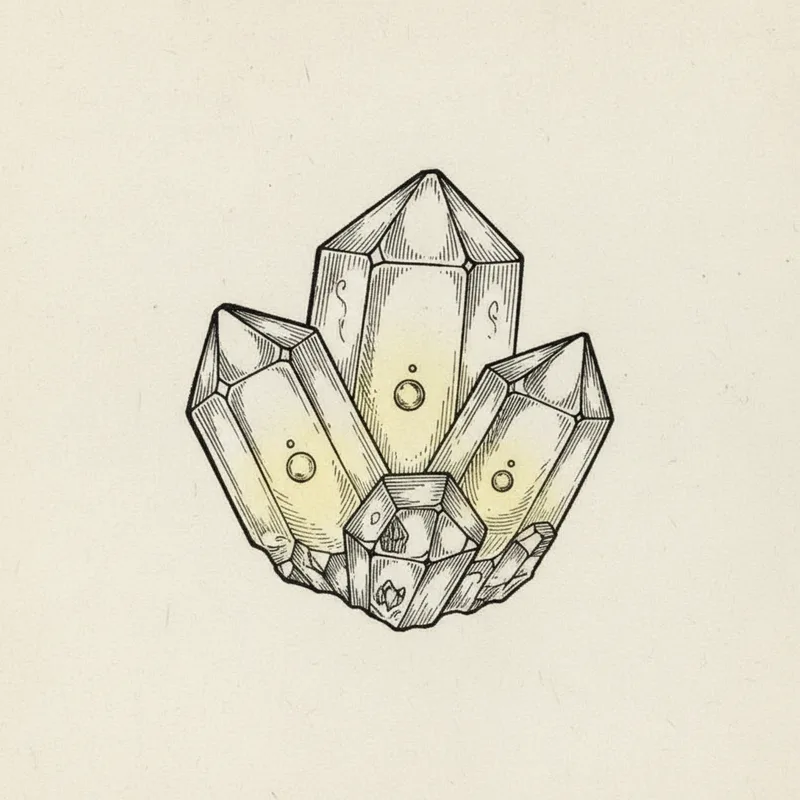
Enhydro Quartz
The Water Bearer
Affiliate links. We may earn a commission, at no cost to you.
Quick Facts
Formation & Origin
Enhydro quartz is ordinary quartz (SiO₂) distinguished by a sealed cavity of trapped fluid, usually water, left over from the crystal's growth. Enhydro quartz contains actual ancient water trapped inside the crystal during formation - visible as a moving bubble that slides when the crystal is tilted. This water has been sealed inside the crystal for millions to hundreds of millions of years, making it some of the oldest preserved water on Earth.
The water gets trapped when a growing quartz crystal develops a cavity (through interrupted growth, dissolution, or irregular formation) that later gets sealed as the crystal continues to grow. The trapped fluid is a time capsule of the original hydrothermal solution from which the crystal formed - it may contain dissolved minerals, gases, and even microscopic organisms from the deep geological past.
Geologists study fluid inclusions (including those in enhydro quartz) to understand ancient temperature, pressure, and fluid chemistry conditions. The composition of trapped fluids reveals the temperature at which the crystal grew and the chemistry of the circulating groundwater at that time. These tiny water pockets are genuine windows into deep geological history.
Identification Guide
Enhydro quartz is identified by the visible presence of a fluid-filled cavity inside the crystal, typically containing a movable air bubble. Tilt the crystal and watch the bubble slide - this confirms liquid water inside.
Distinguish from quartz with solid inclusions (don't move), quartz with air-only cavities (no visible fluid movement), and artificially drilled crystals (check for drill holes or plug marks). In genuine enhydro quartz, the cavity is completely sealed within natural crystal, with no evidence of human modification.
Spotting Fakes
Some sellers drill into quartz, inject water, and seal the hole to create fake enhydro crystals. Check carefully for any drill holes, plugs, or unnatural flat spots on the crystal. In genuine enhydro quartz, the water cavity is surrounded by natural crystal growth on all sides. The bubble should move freely and the cavity should be completely enclosed in crystal with no path to the surface. Also, handle with care - extreme temperature changes can cause the fluid to expand and fracture the crystal.
Some links in this post go to Amazon and Etsy. Crystal Almanac earns a commission from qualifying purchases at no extra cost to you. Tools recommended here are ones we would use ourselves to run the tests described - the recommendation comes first, the link is downstream of it.
Cultural & Metaphysical Traditions
Presented as cultural traditions, not scientific evidence
Enhydro quartz holds a special place in crystal healing as a stone containing the 'water of life' - ancient water sealed for millions of years. Practitioners associate it with emotional fluidity, accessing ancient wisdom, and connecting to the primordial elements. The fact that the water actually IS ancient gives this metaphysical association an unusual grounding in geological reality. Some practitioners use enhydro quartz specifically for past-life work, interpreting the ancient water as a literal connection to deep time.
Metaphysical and “healing” associations are cultural traditions, not medical advice or scientific fact. Crystals are not a substitute for professional medical care.
Where It's Found
Primary source of quality enhydro quartz
Some material with visible water
Interesting specimens
Price Guide
Good to Know
Scratch test: At hardness 7, Enhydro Quartz can scratch glass and steel. It's durable enough for any type of jewelry.
Global supply: Found in 3 notable locations worldwide, from Brazil to Namibia.
Heft test: Enhydro Quartz has average mineral density (2.65). It feels about as heavy as you'd expect from a stone its size.
Common Questions
What is the chemical formula of Enhydro Quartz?
The chemical formula of Enhydro Quartz is SiO₂ (with H₂O trapped inside).
What is Enhydro Quartz's Mohs hardness?
Enhydro Quartz has a Mohs hardness of 7 on the 1 to 10 Mohs scale, hard enough to scratch glass and stand up to daily wear.
Is Enhydro Quartz a mineral?
Yes. Enhydro Quartz is a naturally occurring mineral (Quartz Family) with a definite chemical composition and an ordered crystal structure.
Care & Safety
The water, salt, and sunlight questions people actually ask before cleansing or displaying enhydro quartz, answered from its hardness (Mohs 7) and chemistry (SiO₂ (with H₂O trapped inside)).
Can Enhydro Quartz go in water?
Yes. Enhydro Quartz is hard (Mohs 7) and chemically stable, so a rinse or a quick wash with mild soap is no problem, cleanse it in water freely if that is your practice. A long soak does nothing for it either way, so skip that, and dry the stone afterward.
Can Enhydro Quartz go in salt water?
Not recommended, even though enhydro quartz itself is hard and not water-soluble. Salt is both corrosive and mildly abrasive: it can dull a polished surface, attack metal settings, and crystallize inside small fractures as the stone dries. A quick dip will not destroy enhydro quartz, but rinse it with fresh water afterward and dry it. For routine cleaning, plain water is the kinder choice.
Sources & References
The mineralogical and gemological data on this page is drawn from and can be cross-checked against these external references.
- WikipediaQuartz on Wikipedia
- WebmineralQuartz mineral data (Webmineral)
- Handbook of MineralogyQuartz (Handbook of Mineralogy, PDF)
Related Minerals
Same mineral without fluid inclusions
Another growth-feature quartz variety
Clear doubly-terminated quartz, sometimes enhydro
Quartz with trapped petroleum that fluoresces
Explore More
Save This Stone

Keep this enhydro quartz reference handy. Save the card to a Pinterest board and the profile is one tap away.
Save to PinterestNewsletter
Something shiny, now and then
A stone worth knowing, or a fake worth spotting, every so often. No spam.