Dragon Blood Jasper
The Stone of Courage
Affiliate links. We may earn a commission, at no cost to you.
Quick Facts
Formation & Origin
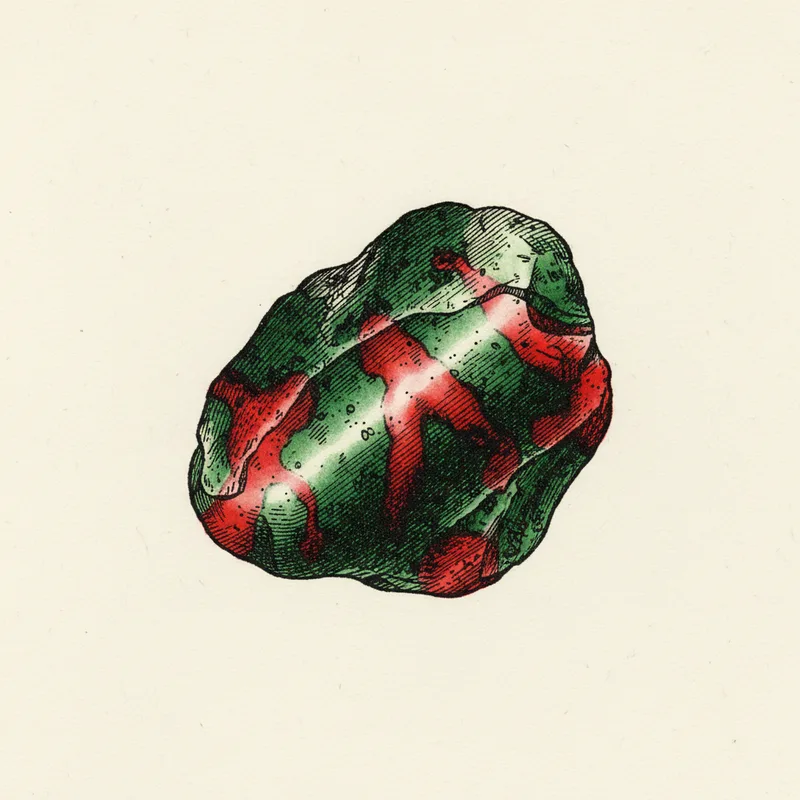
Dragon blood jasper is not a true jasper but a rock composed chiefly of green epidote with red piemontite, a manganese-rich epidote variety, plus minor quartz. Dragon blood jasper (also called dragon stone or dragon blood stone) is technically not a jasper either - it's a metamorphic rock composed primarily of green epidote with red piemontite (a manganese-rich epidote variety) and sometimes minor quartz. The green provides the 'dragon scale' base color while the red creates the 'dragon blood' spots and veins.
Both epidote and piemontite form during regional metamorphism of iron and manganese-bearing rocks. The specific conditions that produce vivid green epidote alongside vivid red piemontite require both iron and manganese in the original rock, plus metamorphic conditions that separate these elements into distinct mineral phases.
The 'dragon blood' trade name is marketing, but effective marketing - the deep green with scattered red genuinely resembles a mythological creature's scales spotted with blood. The stone is distinct from bloodstone/heliotrope (which is green chalcedony with red jasper spots - a completely different mineral assemblage).
Identification Guide
Dragon blood jasper is identified by its dark green color with scattered red spots and veins. At hardness 6.5-7 (depending on composition), it's moderately hard and takes a good polish. The green is typically deeper and darker than bloodstone.
Distinguish from bloodstone (green chalcedony with red spots - lighter green, waxy luster, different composition), ruby in zoisite (vivid red ruby crystals in green zoisite - brighter colors, visible crystal faces), and unakite (pink rather than red, pistachio rather than forest green). Dragon blood jasper's epidote-piemontite composition gives it a denser feel than chalcedony-based stones.
Spotting Fakes
Dragon blood jasper is affordable and its distinctive color combination is hard to replicate, so faking is rare. The main confusion is with bloodstone, which is a completely different stone that happens to also be green with red. If the green is light, translucent, and waxy (chalcedony), it's bloodstone. If the green is dark, opaque, and slightly dense-feeling, it's likely dragon blood jasper. Some material sold as 'dragon blood' may be dyed or enhanced.
Some links in this post go to Amazon and Etsy. Crystal Almanac earns a commission from qualifying purchases at no extra cost to you. Tools recommended here are ones we would use ourselves to run the tests described - the recommendation comes first, the link is downstream of it.
Cultural & Metaphysical Traditions
Presented as cultural traditions, not scientific evidence
The dragon imagery drives this stone's metaphysical associations - courage, strength, and power. In South African tradition, green and red stones are associated with the land and vitality. Modern crystal practitioners use dragon blood jasper for self-confidence, overcoming obstacles, and connecting to personal power. It's popular in men's crystal jewelry. The epidote component is independently associated with increase and growth in crystal healing traditions.
Metaphysical and “healing” associations are cultural traditions, not medical advice or scientific fact. Crystals are not a substitute for professional medical care.
Where It's Found
Primary commercial source
Some material marketed under this name
Price Guide
Good to Know
Scratch test: At hardness 7, Dragon Blood Jasper can scratch glass and steel. It's durable enough for any type of jewelry.
Global supply: Found in 2 notable locations worldwide, from South Africa to Australia.
Heft test: Dragon Blood Jasper has average mineral density (3.20-3.40). It feels about as heavy as you'd expect from a stone its size.
Common Questions
What is the chemical formula of Dragon Blood Jasper?
The chemical formula of Dragon Blood Jasper is Variable (epidote + piemontite + quartz).
What is Dragon Blood Jasper's Mohs hardness?
Dragon Blood Jasper has a Mohs hardness of 7 on the 1 to 10 Mohs scale, hard enough to scratch glass and stand up to daily wear.
Is Dragon Blood Jasper a mineral?
Not quite. Dragon Blood Jasper is a rock (a naturally occurring mixture of minerals), not a single mineral species.
Care & Safety
The water, salt, and sunlight questions people actually ask before cleansing or displaying dragon blood jasper, answered from its hardness (Mohs 7) and chemistry (Variable (epidote + piemontite + quartz)).
Can Dragon Blood Jasper go in water?
Yes. Dragon Blood Jasper is hard (Mohs 7) and chemically stable, so a rinse or a quick wash with mild soap is no problem, cleanse it in water freely if that is your practice. A long soak does nothing for it either way, so skip that, and dry the stone afterward.
Can Dragon Blood Jasper go in salt water?
Not recommended, even though dragon blood jasper itself is hard and not water-soluble. Salt is both corrosive and mildly abrasive: it can dull a polished surface, attack metal settings, and crystallize inside small fractures as the stone dries. A quick dip will not destroy dragon blood jasper, but rinse it with fresh water afterward and dry it. For routine cleaning, plain water is the kinder choice.
Sources & References
The mineralogical and gemological data on this page is drawn from and can be cross-checked against these external references.
- WikipediaEpidote on Wikipedia
Explore More
Save This Stone

Keep this dragon blood jasper reference handy. Save the card to a Pinterest board and the profile is one tap away.
Save to PinterestNewsletter
Something shiny, now and then
A stone worth knowing, or a fake worth spotting, every so often. No spam.