Creedite
The Porcupine Crystal
Affiliate links. We may earn a commission, at no cost to you.
Quick Facts
Formation & Origin
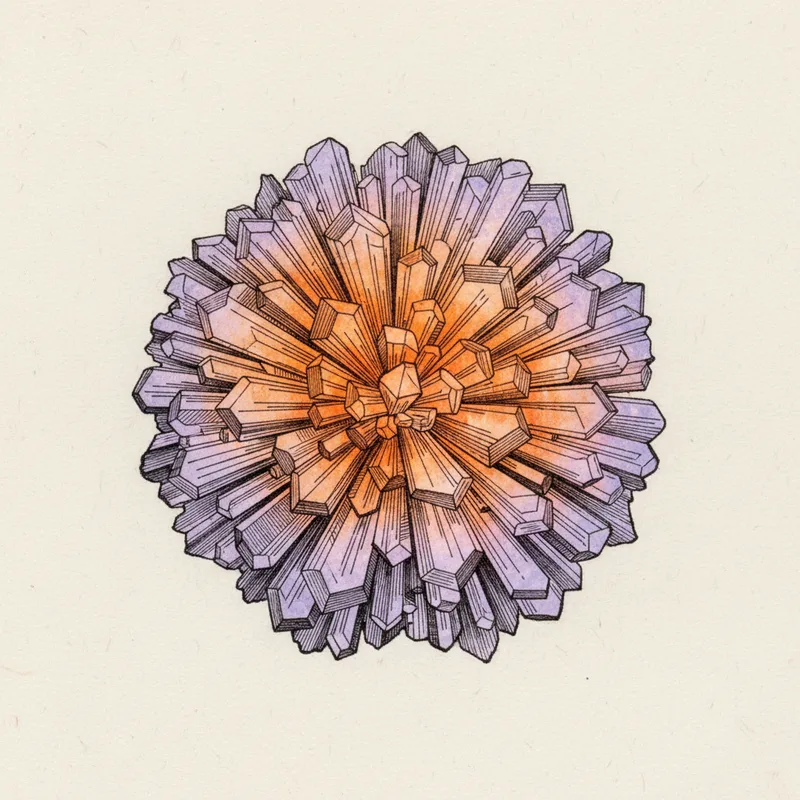
Creedite is a hydrated calcium-aluminum sulfate-fluoride mineral that crystallizes as radiating sprays of needle-like crystals. Creedite forms in oxidized zones of fluorite-bearing mineral deposits, where fluorine-rich solutions react with calcium and aluminum minerals. It crystallizes as radiating sprays of acicular (needle-like) crystals that emerge from a central point like a sea urchin or porcupine.
The finest specimens come from Mexico's Navidad Mine in Durango, where vibrant orange creedite clusters grow on beds of dark fluorite. The orange color comes from iron impurities. Chinese specimens tend toward purple or lavender, colored by different trace elements. Colorado material from the type locality near Creede is typically clear to white.
The mineral was first described in 1916 from the Creede mining district in Colorado and named after the town. Despite being known for over a century, creedite remains a relatively obscure mineral appreciated mainly by specimen collectors.
Identification Guide
Creedite is identified by its radiating sprays of needle-like crystals growing from a central point. The porcupine-like or hedgehog crystal habit is distinctive. Colors range from clear to orange to purple. Hardness 3.5 and vitreous luster on crystal faces.
Distinguish from aragonite (similar radiating habit but different crystal system and association), scolecite (fibrous but forms in basalt cavities), and natrolite (similar needle habit, different chemistry). The association with fluorite deposits and the characteristic burst-like crystal clusters help identify creedite.
Spotting Fakes
Creedite is too obscure and fragile to be commonly faked. The main concern is damage. The delicate needle crystals are extremely fragile, and many specimens arrive with broken tips. The finest Mexican orange specimens with intact crystal sprays command significantly higher prices than damaged ones. Handle with extreme care.
Some links in this post go to Amazon and Etsy. Crystal Almanac earns a commission from qualifying purchases at no extra cost to you. Tools recommended here are ones we would use ourselves to run the tests described - the recommendation comes first, the link is downstream of it.
Cultural & Metaphysical Traditions
Presented as cultural traditions, not scientific evidence
Creedite is associated with expanded consciousness, ancient wisdom, and connecting with higher spiritual guidance. The radiating crystal pattern is interpreted as energy expanding outward in all directions. Practitioners use it for deepening meditation and accessing Akashic records. Its relative rarity gives it a mystical quality among collectors who seek it out.
Metaphysical and “healing” associations are cultural traditions, not medical advice or scientific fact. Crystals are not a substitute for professional medical care.
Where It's Found
World's finest orange crystal clusters
Type locality, original discovery site
Fine purple specimens
Some specimens from tin mines
Price Guide
Good to Know
Scratch test: At hardness 3.5, Creedite can be scratched with a copper coin. Handle gently and keep away from harder stones in your collection.
Global supply: Found in 4 notable locations worldwide, from Mexico to Bolivia.
Heft test: Creedite has average mineral density (2.71). It feels about as heavy as you'd expect from a stone its size.
Common Questions
What is the chemical formula of Creedite?
The chemical formula of Creedite is Ca₃Al₂SO₄(F,OH)₁₀·2H₂O.
What is Creedite's Mohs hardness?
Creedite has a Mohs hardness of 3.5 on the 1 to 10 Mohs scale, soft enough to scratch with a copper coin.
Is Creedite a mineral?
Yes. Creedite is a naturally occurring mineral (Sulfate Mineral) with a definite chemical composition and an ordered crystal structure.
Care & Safety
The water, salt, and sunlight questions people actually ask before cleansing or displaying creedite, answered from its hardness (Mohs 3.5) and chemistry (Ca₃Al₂SO₄(F,OH)₁₀·2H₂O).
Can Creedite go in water?
Not recommended. Creedite can react with water, draw in moisture, or break down when it gets wet, so skip the rinse. Wipe it with a dry or barely damp cloth and dry it right away.
Can Creedite go in salt water?
No. Creedite is best kept away from water altogether, and salt water is the harsher version of that problem: the dissolved salt is corrosive while the stone is wet, then leaves gritty crystals behind in cracks and crevices as it dries.
Sources & References
The mineralogical and gemological data on this page is drawn from and can be cross-checked against these external references.
- WikipediaCreedite on Wikipedia
- WebmineralCreedite mineral data (Webmineral)
- Handbook of MineralogyCreedite (Handbook of Mineralogy, PDF)
Explore More
Save This Stone

Keep this creedite reference handy. Save the card to a Pinterest board and the profile is one tap away.
Save to PinterestNewsletter
Something shiny, now and then
A stone worth knowing, or a fake worth spotting, every so often. No spam.