Chrysanthemum Stone
Nature's Fossil Flower
Affiliate links. We may earn a commission, at no cost to you.
Quick Facts
Formation & Origin
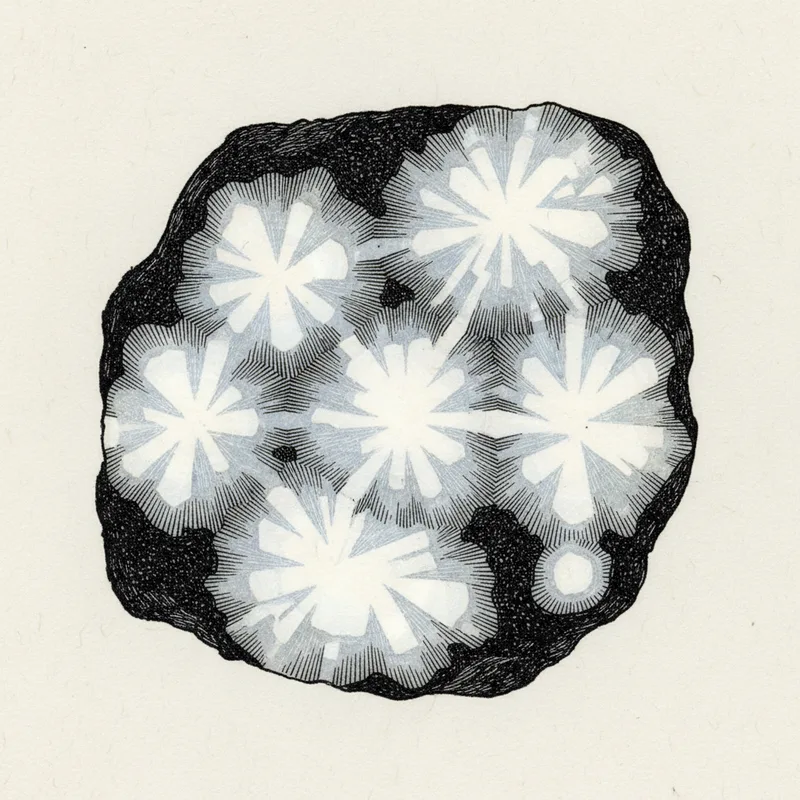
Chrysanthemum stone is a metamorphic rock containing radiating crystal clusters that look remarkably like chrysanthemum flowers. The 'petals' are crystals of celestite (strontium sulfate), calcite (calcium carbonate), or occasionally andalusite that grew in radial patterns within dark mudstone or limestone during metamorphism.
The flower patterns formed when mineral-rich fluids migrated through the host rock and precipitated crystals that grew outward from nucleation points in all directions, creating starburst formations. Over time, the original minerals may have been partially or fully replaced by quartz or calcite through pseudomorphism, preserving the flower pattern.
In China, chrysanthemum stone from the Liuyang area of Hunan Province has been carved into decorative objects and scholars' rocks for centuries. The chrysanthemum is one of the 'Four Gentlemen' in Chinese art, symbolizing autumn and resilience.
Identification Guide
Chrysanthemum stone is identified by its distinctive white flower-like mineral clusters on a dark matrix. The 'flowers' are typically 2-10cm across with radiating 'petals' that closely mimic chrysanthemum blooms. The dark host rock is usually mudstone, slate, or fine-grained limestone.
Distinguish from painted rocks (the flowers should be three-dimensional mineral crystals, not surface paint), fossils (chrysanthemum patterns are mineral, not organic), and artificially enhanced specimens (more below). Under magnification, the 'petals' should show crystal faces or fibrous mineral structure.
Spotting Fakes
Enhanced chrysanthemum stone is common. Some specimens have their flower patterns painted, carved, or enhanced with white pigment to make them more visible. Genuine specimens show natural crystal texture in the flower petals that can be felt with a fingertip. Painted flowers will have a smooth, uniform surface. Some dealers also create artificial flowers by carving the dark matrix away around lighter mineral patches. Premium, natural specimens with prominent, unenhanced flowers command significantly higher prices.
Some links in this post go to Amazon and Etsy. Crystal Almanac earns a commission from qualifying purchases at no extra cost to you. Tools recommended here are ones we would use ourselves to run the tests described - the recommendation comes first, the link is downstream of it.
Cultural & Metaphysical Traditions
Presented as cultural traditions, not scientific evidence
Chrysanthemum stone is associated with finding joy in the present moment and recognizing beauty in unexpected places. In Chinese tradition, the chrysanthemum pattern connects it to themes of longevity, resilience, and graceful aging. Practitioners use it for encouraging personal growth, new beginnings, and overcoming self-doubt.
Metaphysical and “healing” associations are cultural traditions, not medical advice or scientific fact. Crystals are not a substitute for professional medical care.
Where It's Found
Most famous source, celestite flowers in dark limestone
Classic Japanese specimens, important cultural stone
Occasional specimens from different geological settings
Some specimens from metamorphic terrain
Price Guide
Good to Know
Scratch test: At hardness 3, Chrysanthemum Stone can be scratched with a copper coin. Handle gently and keep away from harder stones in your collection.
Global supply: Found in 4 notable locations worldwide, from China to Canada.
Heft test: Chrysanthemum Stone has average mineral density (2.6-3.0). It feels about as heavy as you'd expect from a stone its size.
Common Questions
What is the chemical formula of Chrysanthemum Stone?
The chemical formula of Chrysanthemum Stone is Celestite (SrSO₄) or Calcite (CaCO₃) in mudstone matrix.
What is Chrysanthemum Stone's Mohs hardness?
Chrysanthemum Stone has a Mohs hardness of 3 on the 1 to 10 Mohs scale, soft enough to scratch with a copper coin.
Is Chrysanthemum Stone a mineral?
Not quite. Chrysanthemum Stone is a rock (a naturally occurring mixture of minerals), not a single mineral species.
Care & Safety
The water, salt, and sunlight questions people actually ask before cleansing or displaying chrysanthemum stone, answered from its hardness (Mohs 3) and chemistry (Celestite (SrSO₄) or Calcite (CaCO₃) in mudstone matrix).
Can Chrysanthemum Stone go in water?
Not recommended. At Mohs 3, chrysanthemum stone is soft enough that water can slowly dull, etch, or wear down the surface, so a water cleanse does more harm than good here. Reach for a dry cloth instead.
Can Chrysanthemum Stone go in salt water?
No. Chrysanthemum Stone is best kept away from water altogether, and salt water is the harsher version of that problem: the dissolved salt is corrosive while the stone is wet, then leaves gritty crystals behind in cracks and crevices as it dries.
Sources & References
The mineralogical and gemological data on this page is drawn from and can be cross-checked against these external references.
- WikipediaChrysanthemum stone on Wikipedia
Explore More
Save This Stone

Keep this chrysanthemum stone reference handy. Save the card to a Pinterest board and the profile is one tap away.
Save to PinterestNewsletter
Something shiny, now and then
A stone worth knowing, or a fake worth spotting, every so often. No spam.