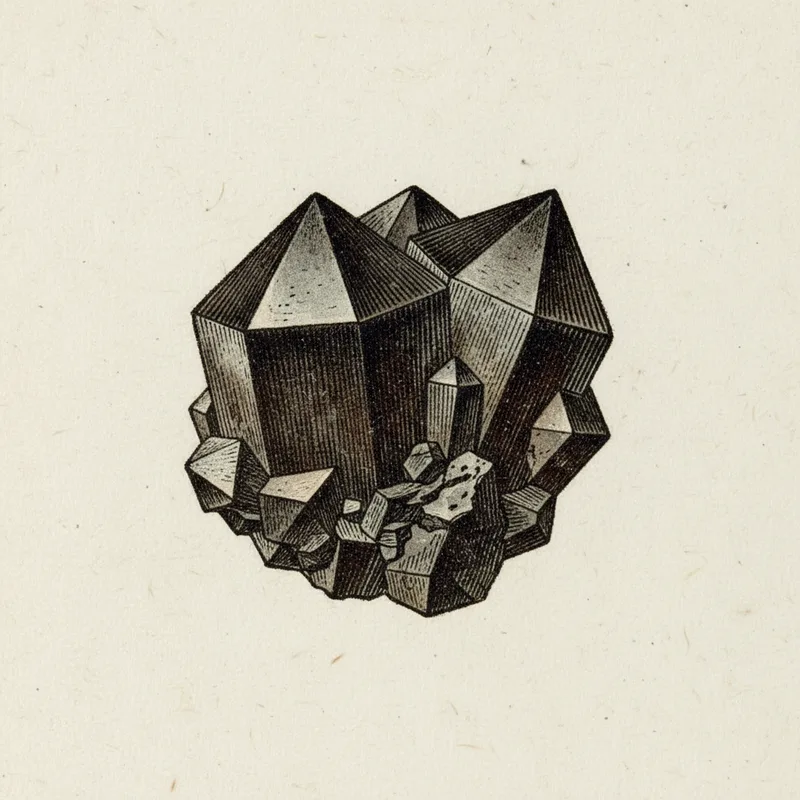
Cassiterite
The Tin Stone
Affiliate links. We may earn a commission, at no cost to you.
Quick Facts
Formation & Origin
Cassiterite is tin oxide - the primary and almost sole ore of tin, one of the first metals smelted by humans. Tin's role in creating bronze (an alloy of copper and tin) makes cassiterite one of the most historically important minerals in human civilization. The Bronze Age (roughly 3300-1200 BCE) was only possible because ancient peoples figured out how to smelt cassiterite.
Cornwall, England, was one of the ancient world's major tin sources. Phoenician traders sailed from the Mediterranean to Cornwall for tin, creating one of the longest trade routes of the ancient world. The 'Cassiterides' (Tin Islands) were mentioned by Greek historians as a mysterious source of tin at the edge of the known world - almost certainly referring to Cornwall or the Isles of Scilly.
Cassiterite forms in high-temperature hydrothermal veins and pegmatites associated with granitic magma. Its extreme density (6.99) causes it to concentrate in alluvial placer deposits, which were the easiest ancient source to exploit.
Identification Guide
Cassiterite is identified by its dark brown to black color, extreme density (6.99 - very heavy), adamantine luster (almost diamond-like shine), and tetragonal crystal habit. The combination of dark color with brilliant adamantine luster is striking.
Distinguish from magnetite (magnetic, slightly less dense), hematite (red-brown streak vs white), and black tourmaline (different luster, striated). Cassiterite's adamantine luster on dark surfaces and extreme heft are its best diagnostic features.
Spotting Fakes
Cassiterite is a specialist collector mineral not commonly faked. The extreme density is the simplest verification - cassiterite feels noticeably heavier than similarly sized dark minerals. Well-crystallized specimens from Bolivia or historical Cornish pieces command premiums based on provenance.
Some links in this post go to Amazon and Etsy. Crystal Almanac earns a commission from qualifying purchases at no extra cost to you. Tools recommended here are ones we would use ourselves to run the tests described - the recommendation comes first, the link is downstream of it.
Cultural & Metaphysical Traditions
Presented as cultural traditions, not scientific evidence
Cassiterite's metaphysical profile is defined by its Bronze Age significance. Practitioners who work with it associate it with innovation, problem-solving, and creating something new from combining different elements (as bronze combines copper and tin). Its connection to some of humanity's earliest metallurgy gives it associations with ancestral knowledge and the roots of civilization.
Metaphysical and “healing” associations are cultural traditions, not medical advice or scientific fact. Crystals are not a substitute for professional medical care.
Where It's Found
Exceptional crystal specimens
Major world producer
Historic alluvial tin source
Historic tin mining for 4,000 years
Price Guide
Good to Know
Scratch test: At hardness 6.5, Cassiterite resists scratching from a knife but can be scratched by quartz. Best for pendants and earrings rather than rings.
Global supply: Found in 4 notable locations worldwide, from Bolivia to Cornwall.
Heft test: With a specific gravity of 6.99, Cassiterite feels surprisingly heavy for its size. This weight is actually a useful identification tool.
Common Questions
What is the chemical formula of Cassiterite?
The chemical formula of Cassiterite is SnO₂.
What is Cassiterite's Mohs hardness?
Cassiterite has a Mohs hardness of 6.5 on the 1 to 10 Mohs scale, hard enough to scratch glass but softer than quartz.
Is Cassiterite a mineral?
Yes. Cassiterite is a naturally occurring mineral (Oxide Group) with a definite chemical composition and an ordered crystal structure.
Care & Safety
The water, salt, and sunlight questions people actually ask before cleansing or displaying cassiterite, answered from its hardness (Mohs 6.5) and chemistry (SnO₂).
Can Cassiterite go in water?
Not recommended. Cassiterite can react with water, draw in moisture, or break down when it gets wet, so skip the rinse. Wipe it with a dry or barely damp cloth and dry it right away.
Can Cassiterite go in salt water?
No. Cassiterite is best kept away from water altogether, and salt water is the harsher version of that problem: the dissolved salt is corrosive while the stone is wet, then leaves gritty crystals behind in cracks and crevices as it dries.
Sources & References
The mineralogical and gemological data on this page is drawn from and can be cross-checked against these external references.
- WikipediaCassiterite on Wikipedia
- WebmineralCassiterite mineral data (Webmineral)
- Handbook of MineralogyCassiterite (Handbook of Mineralogy, PDF)
Explore More
Save This Stone

Keep this cassiterite reference handy. Save the card to a Pinterest board and the profile is one tap away.
Save to PinterestNewsletter
Something shiny, now and then
A stone worth knowing, or a fake worth spotting, every so often. No spam.