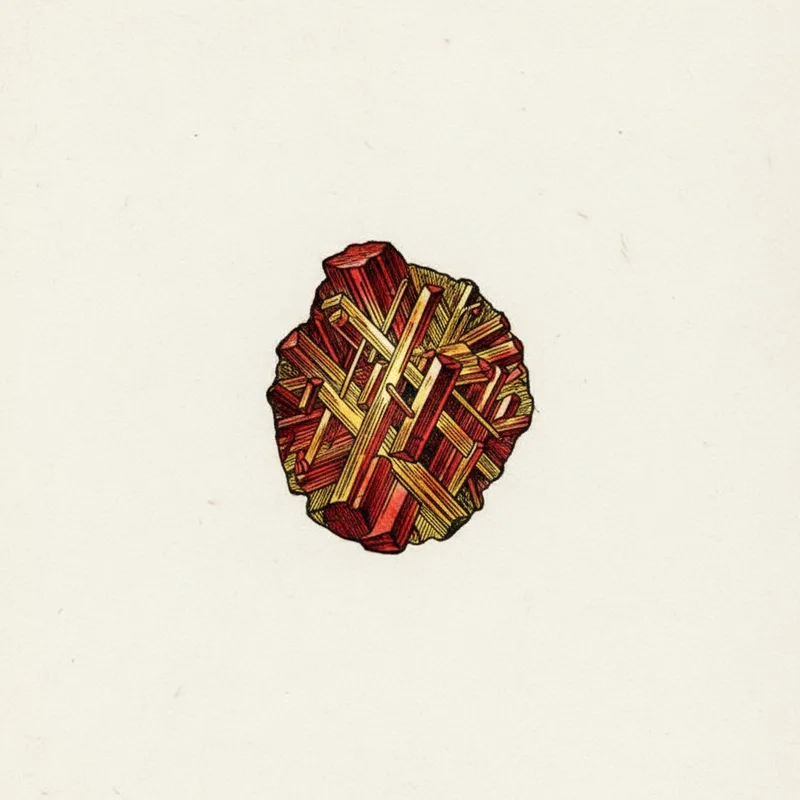
Rutile
The Titanium Needle
Affiliate links. We may earn a commission, at no cost to you.
Quick Facts
Formation & Origin
Rutile is the most common natural form of titanium dioxide, one of the most commercially important minerals on Earth. It's the primary source of titanium metal (used in aerospace, medical implants, and industrial applications) and titanium white pigment (used in paint, paper, and plastics).
As a mineral specimen, rutile is prized for its reticulated (net-like) twin crystals and its occurrence as golden needle-like inclusions within quartz (creating rutilated quartz). The twinning pattern creates geometric lattice structures that look deliberately designed, with crystals crossing at precise 60-degree angles.
Rutile forms as an accessory mineral in igneous and metamorphic rocks across a wide range of temperatures and pressures. The red-brown to golden color comes from iron substituting for titanium. Black rutile (nigrine) contains more iron. Transparent, reddish-brown rutile crystals have been faceted as rare collector gems with exceptional refractive index (2.616-2.903) and dispersion.
Identification Guide
Rutile is identified by its tetragonal prismatic crystals, adamantine luster (among the brightest of any mineral), high specific gravity (4.23), and distinctive reticulated twinning. Individual crystals are often needle-like (acicular).
Distinguish from tourmaline needles (trigonal cross-section, different luster), cassiterite (similar SG but different crystal habit), and hematite (different streak, different crystal system). Rutile's adamantine luster and characteristic twinning are unmistakable.
Spotting Fakes
Rutile specimens are not commonly faked. The main issue is in rutilated quartz: some 'rutilated quartz' actually contains tourmaline, actinolite, or other needle-like inclusions rather than true rutile. Golden, metallic-lustered needles that cross at 60-degree angles are characteristic of rutile. Black, non-metallic needles without geometric crossing patterns are more likely tourmaline.
Some links in this post go to Amazon and Etsy. Crystal Almanac earns a commission from qualifying purchases at no extra cost to you. Tools recommended here are ones we would use ourselves to run the tests described - the recommendation comes first, the link is downstream of it.
Cultural & Metaphysical Traditions
Presented as cultural traditions, not scientific evidence
Rutile is associated with amplification, illumination, and clearing energetic blockages. The needle-like crystal habit is interpreted as piercing through obstacles and dark energy. Within quartz (as rutilated quartz), it's considered one of the most powerful amplification combinations. Practitioners use it for enhancing psychic reception and strengthening the aura.
Metaphysical and “healing” associations are cultural traditions, not medical advice or scientific fact. Crystals are not a substitute for professional medical care.
Where It's Found
Fine twinned crystals and included quartz
Classic alpine needle specimens
Good crystal specimens
Twinned crystal specimens
Price Guide
Good to Know
Scratch test: At hardness 6, Rutile resists scratching from a knife but can be scratched by quartz. Best for pendants and earrings rather than rings.
Global supply: Found in 4 notable locations worldwide, from Brazil to United States.
Heft test: Rutile has a specific gravity of 4.23 - noticeably heavier than quartz. You'll feel the density when you pick it up.
Common Questions
What is the chemical formula of Rutile?
The chemical formula of Rutile is TiO₂.
What is Rutile's Mohs hardness?
Rutile has a Mohs hardness of 6 on the 1 to 10 Mohs scale, hard enough to scratch glass but softer than quartz.
Is Rutile a mineral?
Yes. Rutile is a naturally occurring mineral (Oxide Mineral) with a definite chemical composition and an ordered crystal structure.
Care & Safety
The water, salt, and sunlight questions people actually ask before cleansing or displaying rutile, answered from its hardness (Mohs 6) and chemistry (TiO₂).
Can Rutile go in water?
Yes. Rutile is not water-soluble and durable enough (Mohs 6), so a rinse or a quick wash with mild soap is no problem, cleanse it in water freely if that is your practice. A long soak does nothing for it either way, so skip that, and dry the stone afterward.
Can Rutile go in salt water?
Not recommended, even though rutile itself is hard and not water-soluble. Salt is both corrosive and mildly abrasive: it can dull a polished surface, attack metal settings, and crystallize inside small fractures as the stone dries. A quick dip will not destroy rutile, but rinse it with fresh water afterward and dry it. For routine cleaning, plain water is the kinder choice.
Sources & References
The mineralogical and gemological data on this page is drawn from and can be cross-checked against these external references.
- WikipediaRutile on Wikipedia
- WebmineralRutile mineral data (Webmineral)
- Handbook of MineralogyRutile (Handbook of Mineralogy, PDF)
Related Minerals
Quartz containing rutile needle inclusions
Polymorph of TiO₂, different crystal structure
Another TiO₂ polymorph, orthorhombic
Explore More
Save This Stone
.%20Meaning%2C%20properties%20%26%20identification%20at%20Crystal%20Almanac.)
Keep this rutile reference handy. Save the card to a Pinterest board and the profile is one tap away.
Save to PinterestNewsletter
Something shiny, now and then
A stone worth knowing, or a fake worth spotting, every so often. No spam.