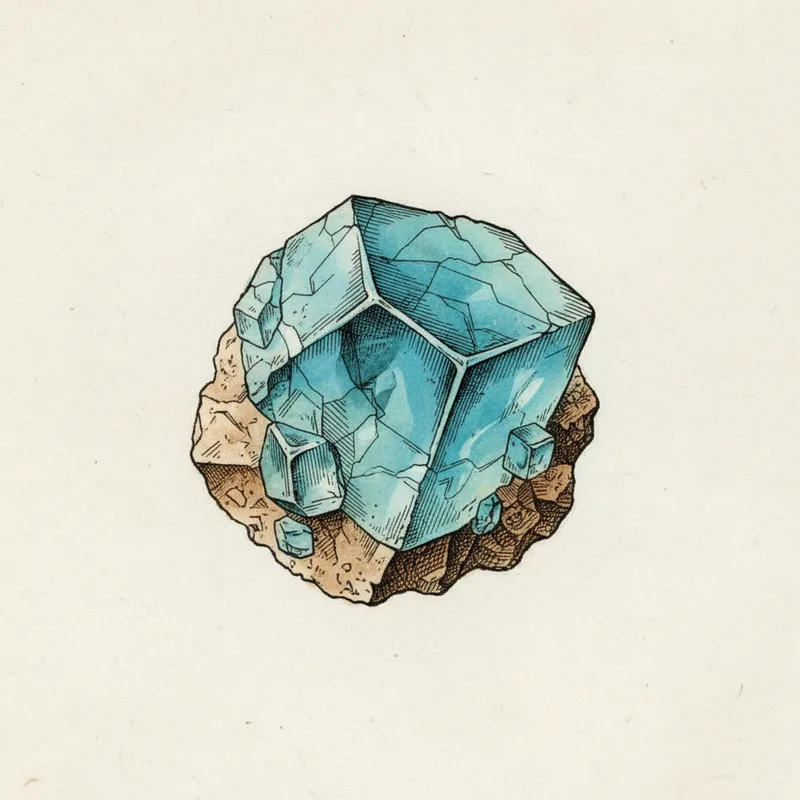
Caribbean Calcite
The Ocean Dream Stone
Affiliate links. We may earn a commission, at no cost to you.
Quick Facts
Formation & Origin
Caribbean calcite is a trade name coined around 2019 for a blue calcite and white-brown aragonite combination found in Pakistan. The material formed in sedimentary limestone environments where blue calcite crystallized alongside white aragonite, creating a swirled blue-and-white pattern that resembles tropical Caribbean waters - hence the name.
The blue color comes from the same cause as blue calcite in general - trace amounts of copper or cobalt incorporated into the calcite structure, or possibly from fine-grained inclusions that scatter blue light. The brown areas are iron-rich aragonite or matrix material.
Caribbean calcite exploded onto the crystal market via Instagram and TikTok around 2019-2020, becoming one of the fastest-rising 'new' minerals in the social media age. Its approachable color, affordable price point, and Instagram-friendly aesthetic made it an instant favorite. Geologically, it's not a new mineral - just a new trade name for a specific blue calcite-aragonite combination from a specific locality.
Identification Guide
Caribbean calcite is identified by its distinctive sky-blue and white swirled pattern with occasional brown matrix. At hardness 3, it's very soft (scratched by a copper coin). It fizzes in dilute acid, confirming its carbonate composition.
Distinguish from larimar (harder, different mineral, pectolite), amazonite (harder at 6, feldspar not carbonate), and blue lace agate (much harder at 7, banded not swirled). The acid test immediately confirms carbonate; the softness confirms calcite over harder blue minerals.
Spotting Fakes
Caribbean calcite is affordable enough that outright faking is uncommon. Some dyed white calcite or marble is sold under the name - genuine Caribbean calcite has natural color variation and the blue is soft, not vivid or uniform. The brown aragonite or matrix areas should be visible on most specimens. At this price point, the bigger risk is overpaying rather than getting fakes.
Some links in this post go to Amazon and Etsy. Crystal Almanac earns a commission from qualifying purchases at no extra cost to you. Tools recommended here are ones we would use ourselves to run the tests described - the recommendation comes first, the link is downstream of it.
Cultural & Metaphysical Traditions
Presented as cultural traditions, not scientific evidence
Caribbean calcite has no traditional history - it entered the market around 2019. Modern practitioners associate its ocean-like appearance with calm, emotional release, and connection to water energy. It's become one of the most popular stones for anxiety and relaxation in the TikTok crystal community. Its softness and water-solubility are important care considerations - never cleanse in water.
Metaphysical and “healing” associations are cultural traditions, not medical advice or scientific fact. Crystals are not a substitute for professional medical care.
Where It's Found
The only known commercial source
Price Guide
Good to Know
Scratch test: At hardness 3, Caribbean Calcite can be scratched with a copper coin. Handle gently and keep away from harder stones in your collection.
Global supply: Found at only one location on Earth - Pakistan. Supply is inherently limited.
Heft test: Caribbean Calcite has average mineral density (2.71). It feels about as heavy as you'd expect from a stone its size.
Common Questions
What is the chemical formula of Caribbean Calcite?
The chemical formula of Caribbean Calcite is CaCO₃ (with aragonite).
What is Caribbean Calcite's Mohs hardness?
Caribbean Calcite has a Mohs hardness of 3 on the 1 to 10 Mohs scale, soft enough to scratch with a copper coin.
Is Caribbean Calcite a mineral?
Yes. Caribbean Calcite is a naturally occurring mineral (Carbonate Group) with a definite chemical composition and an ordered crystal structure.
Care & Safety
The water, salt, and sunlight questions people actually ask before cleansing or displaying caribbean calcite, answered from its hardness (Mohs 3) and chemistry (CaCO₃ (with aragonite)).
Can Caribbean Calcite go in water?
Not recommended. At Mohs 3, caribbean calcite is soft enough that water can slowly dull, etch, or wear down the surface, so a water cleanse does more harm than good here. Reach for a dry cloth instead.
Can Caribbean Calcite go in salt water?
No. Caribbean Calcite is best kept away from water altogether, and salt water is the harsher version of that problem: the dissolved salt is corrosive while the stone is wet, then leaves gritty crystals behind in cracks and crevices as it dries.
Sources & References
The mineralogical and gemological data on this page is drawn from and can be cross-checked against these external references.
- WikipediaCalcite on Wikipedia
- WebmineralCalcite mineral data (Webmineral)
- Handbook of MineralogyCalcite (Handbook of Mineralogy, PDF)
Explore More
Save This Stone

Keep this caribbean calcite reference handy. Save the card to a Pinterest board and the profile is one tap away.
Save to PinterestNewsletter
Something shiny, now and then
A stone worth knowing, or a fake worth spotting, every so often. No spam.