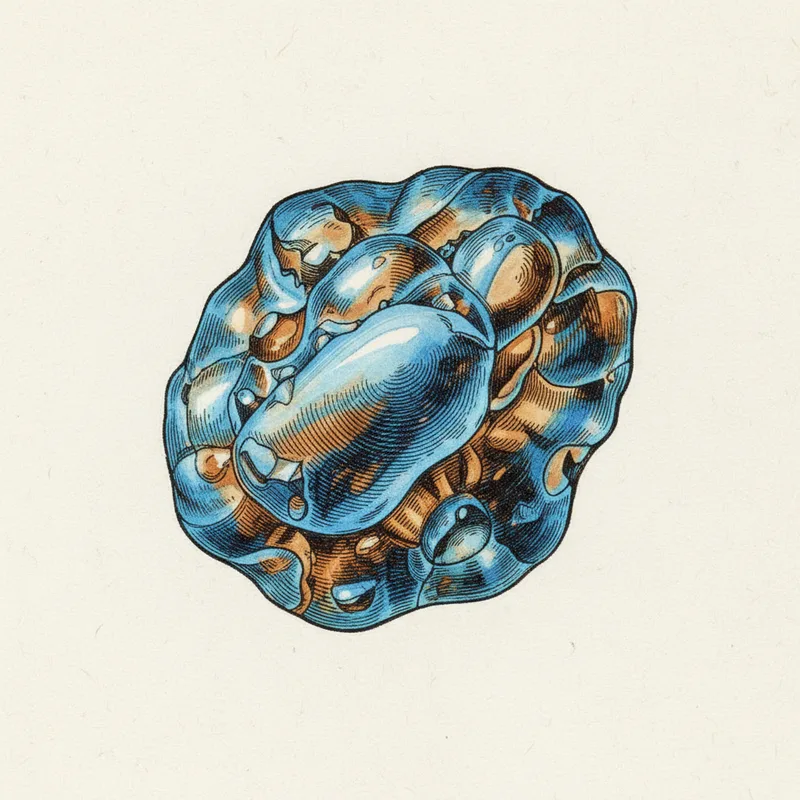
Blue Amber
Dominican amber that glows blue in UV
Affiliate links. We may earn a commission, at no cost to you.
Quick Facts
Formation & Origin
Blue amber is a variety of amber, a fossilized tree resin, that fluoresces blue under ultraviolet light and in sunlight. Dominican Republic amber comes from the extinct Hymenaea protera tree, a legume that produced prolific resin in Caribbean rainforests 25 to 40 million years ago. Resin flowed down trunks, trapped inclusions such as insects and plant matter, was buried in lignite-rich sediments, and polymerized under millions of years of burial heat and pressure. The distinctive blue fluorescence is unique to Dominican amber and occurs because specific anthracene-like hydrocarbon polymers developed under this region's particular burial chemistry. Under direct sunlight or ultraviolet light, the amber absorbs UV photons and re-emits visible blue light through Stokes shift fluorescence. Indonesian blue amber from Sumatra was discovered commercially in the 2010s and shows a similar mechanism, though the parent tree was a dipterocarp species rather than Hymenaea, and the fluorescence is often even stronger.
Identification Guide
Blue amber appears yellow to honey-brown in transmitted light but flashes vivid blue when sunlight or UV strikes the surface, the diagnostic optical signature. Specific gravity of 1.05 to 1.10 means it floats in saturated saltwater (about 25 grams salt per 100 milliliters), a classic field test distinguishing amber from plastic imitations (which sink or float differently). Hardness of 2.5 is low enough that a copper penny will scratch it, but it is marginally harder than young copal resin. Resinous luster and warm feel to touch are characteristic. Genuine amber develops static electricity when rubbed briskly and attracts small paper fragments, a property recognized since antiquity (the Greek word 'elektron' means amber). Under 365 nanometer UV lamp, Dominican blue amber glows neon blue; regular amber glows pale yellow-green.
Spotting Fakes
Plastic imitations dissolve or soften in acetone within seconds, while genuine amber remains unaffected. A hot needle test on an inconspicuous spot produces a pine-like resinous scent from real amber; plastic smells harshly chemical. Copal (young tree resin, 1 to 1,000 years old) is softer than amber, fluoresces weaker under UV, and dissolves in acetone at the surface. Pressed amber (reconstituted fragments fused under heat) shows flow lines and elongated bubbles under 10x magnification. The saltwater float test (25 grams salt per 100 milliliters water) separates amber (floats) from most plastics and glass (sink). Blue amber's diagnostic test: place the stone in direct sunlight on a dark surface and observe the blue sheen on the top face; imitations show no such surface fluorescence. Under 365 nanometer UV, genuine Dominican blue amber glows neon blue, while dyed copal and plastic show weak or absent fluorescence.
Some links in this post go to Amazon and Etsy. Crystal Almanac earns a commission from qualifying purchases at no extra cost to you. Tools recommended here are ones we would use ourselves to run the tests described - the recommendation comes first, the link is downstream of it.
Cultural & Metaphysical Traditions
Presented as cultural traditions, not scientific evidence
Amber has been used ornamentally and ceremonially for at least 13,000 years, with recorded Baltic and Mediterranean trade routes dating to the Bronze Age. Ancient Greeks associated amber with the sun and with preserved time due to trapped inclusions. Dominican Taíno peoples used local amber in jewelry and trade before European contact. Contemporary crystal traditions regard blue amber as a stone of clarity, elevated perspective, and communication, drawing on its rare luminous property. These associations are cultural traditions and not scientifically verified claims.
Metaphysical and “healing” associations are cultural traditions, not medical advice or scientific fact. Crystals are not a substitute for professional medical care.
Where It's Found
Premier source of blue amber; material is 25 to 40 million years old from extinct Hymenaea protera trees
Modern commercial source discovered in the 2010s; dipterocarp parent tree, often stronger blue fluorescence
Occasionally produces blue-fluorescing amber similar in chemistry to Dominican material
Price Guide
Good to Know
Scratch test: At hardness 2.5, Blue Amber can be scratched with a fingernail. This is a display specimen, not a wearable stone.
Global supply: Found in 3 notable locations worldwide, from Dominican Republic to Mexico.
Heft test: With a specific gravity of 1.05 to 1.10, Blue Amber feels lighter than most minerals. This lightness can help identify it.
Common Questions
What is the chemical formula of Blue Amber?
The chemical formula of Blue Amber is C₁₀H₁₆O (approximate).
What is Blue Amber's Mohs hardness?
Blue Amber has a Mohs hardness of 2.5 on the 1 to 10 Mohs scale, soft enough to scratch with a fingernail.
Is Blue Amber a mineral?
No. Blue Amber is an organic gem, not a mineral, because it forms from once-living material rather than purely geological crystallization.
Care & Safety
The water, salt, and sunlight questions people actually ask before cleansing or displaying blue amber, answered from its hardness (Mohs 2.5) and chemistry (C₁₀H₁₆O (approximate)).
Can Blue Amber go in water?
Not recommended. At Mohs 2.5, blue amber is soft enough that water can slowly dull, etch, or wear down the surface, so a water cleanse does more harm than good here. Reach for a dry cloth instead.
Can Blue Amber go in salt water?
No. Blue Amber is best kept away from water altogether, and salt water is the harsher version of that problem: the dissolved salt is corrosive while the stone is wet, then leaves gritty crystals behind in cracks and crevices as it dries.
Is sunlight safe for Blue Amber?
Show it in the sun, store it in the shade. Sunlight is what excites blue amber's famous fluorescence, but like all amber, prolonged sun and heat oxidize and craze the resin surface, which dulls the glow. Brief sunlit viewing is fine; permanent sunny display is not.
Sources & References
The mineralogical and gemological data on this page is drawn from and can be cross-checked against these external references.
- WikipediaBlue amber on Wikipedia
Related Minerals
Succinite from different geography and parent tree (Pinites succinifer)
Young tree resin not fully fossilized, often sold as amber
Another organic gem material (fossilized wood rather than resin)
Same Hymenaea protera source with different fluorescence spectrum
Save This Stone

Keep this blue amber reference handy. Save the card to a Pinterest board and the profile is one tap away.
Save to PinterestNewsletter
Something shiny, now and then
A stone worth knowing, or a fake worth spotting, every so often. No spam.