Bismuth
The Rainbow Staircase
Affiliate links. We may earn a commission, at no cost to you.
Quick Facts
Formation & Origin
Bismuth is a native element - it occurs in its pure metallic form in nature, though natural specimens of any size are extremely rare. Almost all bismuth crystals sold in the mineral market are laboratory-grown from commercially refined bismuth metal.
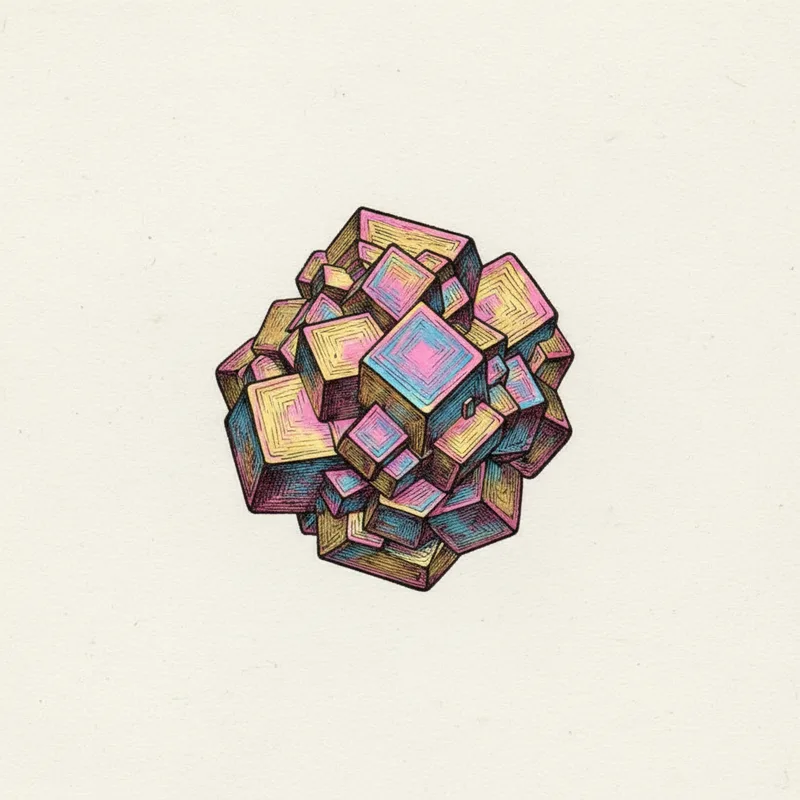
The spectacular rainbow-colored, geometric hopper crystals that have made bismuth a social media sensation are created by melting bismuth metal (melting point: 271 degrees Celsius - low enough for a kitchen stove) and allowing it to cool slowly. As bismuth crystallizes, it forms characteristic staircase-shaped hopper crystals with hollow, geometric step patterns. The rainbow iridescence comes from a thin oxide layer that forms on the surface as the crystal cools in air - similar to how oil on water creates rainbow colors through thin-film interference.
This means bismuth is one of the few collectible crystals that anyone can grow at home with basic equipment and commercially available bismuth ingots. The results are genuinely beautiful and scientifically interesting, even though they're lab-grown rather than natural.
Identification Guide
Lab-grown bismuth is identified by its distinctive staircase hopper crystal form, iridescent rainbow surface colors, and very high density (SG 9.78 - it feels extremely heavy for its size). The geometric step pattern is unique to bismuth among common crystals.
Natural bismuth is extremely rare and typically forms as irregular masses or dendritic (branch-like) shapes without the hopper crystal form. Natural specimens lack the dramatic rainbow iridescence of lab-grown crystals (which develops during controlled cooling). If someone claims a rainbow hopper bismuth crystal is 'natural,' they're either mistaken or dishonest.
Spotting Fakes
The 'fake' question is inverted for bismuth. Nearly all bismuth crystals ARE lab-grown, and this is widely known and accepted. The deception to watch for is sellers claiming lab-grown bismuth is natural, or pricing common lab-grown crystals as if they were rare natural specimens. Lab-grown bismuth is inexpensive because anyone can make it. Natural bismuth specimens (which look very different - silver-gray, no rainbow, no hopper form) are actually rarer and more valuable to serious mineral collectors.
Some links in this post go to Amazon and Etsy. Crystal Almanac earns a commission from qualifying purchases at no extra cost to you. Tools recommended here are ones we would use ourselves to run the tests described - the recommendation comes first, the link is downstream of it.
Cultural & Metaphysical Traditions
Presented as cultural traditions, not scientific evidence
Bismuth has no traditional metaphysical history because rainbow hopper crystals only became widely available in recent decades. Modern crystal practitioners have adopted it enthusiastically, associating the rainbow colors with all chakras and the geometric form with order and transformation. Some practitioners specifically value that bismuth is lab-grown, viewing the controlled crystallization as a metaphor for intentional personal transformation.
Metaphysical and “healing” associations are cultural traditions, not medical advice or scientific fact. Crystals are not a substitute for professional medical care.
Where It's Found
Most specimens are lab-grown from bismuth metal
Historic mining source, natural specimens rare
Associated with tin and tungsten mining
Minor natural occurrences
Price Guide
Good to Know
Scratch test: At hardness 2.5, Bismuth can be scratched with a fingernail. This is a display specimen, not a wearable stone.
Global supply: Found in 4 notable locations worldwide, from Laboratory to Australia.
Heft test: With a specific gravity of 9.78, Bismuth feels surprisingly heavy for its size. This weight is actually a useful identification tool.
Common Questions
What is the chemical formula of Bismuth?
The chemical formula of Bismuth is Bi.
What is Bismuth's Mohs hardness?
Bismuth has a Mohs hardness of 2.5 on the 1 to 10 Mohs scale, soft enough to scratch with a fingernail.
Is Bismuth a mineral?
Yes. Bismuth is a naturally occurring mineral (Native Element) with a definite chemical composition and an ordered crystal structure.
Care & Safety
The water, salt, and sunlight questions people actually ask before cleansing or displaying bismuth, answered from its hardness (Mohs 2.5) and chemistry (Bi).
Can Bismuth go in water?
Not recommended. At Mohs 2.5, bismuth is soft enough that water can slowly dull, etch, or wear down the surface, so a water cleanse does more harm than good here. Reach for a dry cloth instead.
Can Bismuth go in salt water?
No. Bismuth is best kept away from water altogether, and salt water is the harsher version of that problem: the dissolved salt is corrosive while the stone is wet, then leaves gritty crystals behind in cracks and crevices as it dries.
Sources & References
The mineralogical and gemological data on this page is drawn from and can be cross-checked against these external references.
- WikipediaBismuth on Wikipedia
- WebmineralBismuth mineral data (Webmineral)
- Handbook of MineralogyBismuth (Handbook of Mineralogy, PDF)
Related Minerals
Bismuth sulfide, a natural bismuth ore mineral
Another native element collected in pure form
Another native element, similar iridescence on surface
Another heavy metallic mineral
Explore More
Save This Stone

Keep this bismuth reference handy. Save the card to a Pinterest board and the profile is one tap away.
Save to PinterestNewsletter
Something shiny, now and then
A stone worth knowing, or a fake worth spotting, every so often. No spam.