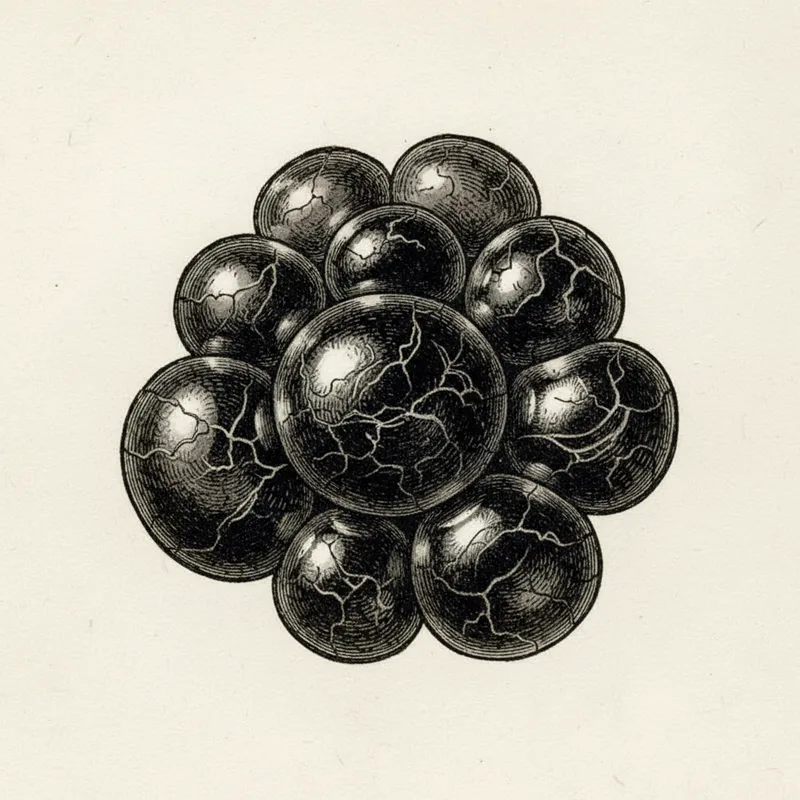
Apache Tear
The Grief Stone
Affiliate links. We may earn a commission, at no cost to you.
Quick Facts
Formation & Origin
Apache tear is a variety of obsidian, a natural volcanic glass, occurring as small rounded translucent nodules that weather out of the surrounding hydrated glass. Apache tears are small, rounded obsidian nodules found weathering out of perlite - a type of volcanic glass that has absorbed water and expanded. When rhyolitic lava cooled rapidly, some areas formed as dense, anhydrous obsidian while the surrounding glass hydrated over time into perlite (a white, popcorn-textured rock). The obsidian cores resist weathering better than the surrounding perlite, eventually popping free as smooth, rounded nodules.
What distinguishes Apache tears from regular obsidian is their translucency. Hold one up to a strong light and it transforms from opaque black to a beautiful smoky translucent brown - you can see light passing through the edges. This translucency comes from their relatively low iron content and small size (most are 1-5 cm).
The name comes from an Apache legend: when a band of Apache warriors was trapped by U.S. cavalry at a cliff in Arizona, they chose to ride their horses over the edge rather than surrender. The tears of their families, falling to the ground, turned to stone. The specific site is Apache Leap near Superior, Arizona.
Identification Guide
Apache tears are identified as small, rounded, translucent obsidian nodules. The translucency test is diagnostic - hold the stone to a bright light and the edges should glow with a smoky brown translucent quality. If it's completely opaque, it's regular obsidian, not an Apache tear.
Distinguish from regular obsidian (opaque, often larger, angular fractures), black onyx (much harder, no translucency), and smoky quartz (crystalline structure visible, harder). Apache tears are always small, rounded, and translucent at the edges.
Spotting Fakes
Apache tears are abundant and very inexpensive, so faking is unnecessary. The main issue is sellers marketing any small black stone as an Apache tear. The translucency test is definitive - genuine Apache tears glow brown when held to light. Black glass, onyx, and tourmaline don't show this specific translucent quality. Tumbled black obsidian is sometimes sold as Apache tears but lacks the natural rounded form and degree of translucency.
Some links in this post go to Amazon and Etsy. Crystal Almanac earns a commission from qualifying purchases at no extra cost to you. Tools recommended here are ones we would use ourselves to run the tests described - the recommendation comes first, the link is downstream of it.
Cultural & Metaphysical Traditions
Presented as cultural traditions, not scientific evidence
The Apache legend behind these stones makes them one of the most emotionally powerful minerals in the crystal healing tradition. Practitioners associate them with grief processing, comfort during loss, and gentle emotional healing. The story says that anyone who carries an Apache tear will never need to cry again, because the Apache women already shed those tears. This origin narrative - whether historically accurate or not - gives Apache tears a unique emotional weight among collector and healing stones.
Metaphysical and “healing” associations are cultural traditions, not medical advice or scientific fact. Crystals are not a substitute for professional medical care.
Where It's Found
Primary source, volcanic regions of the American Southwest
Price Guide
Good to Know
Scratch test: At hardness 5.5, Apache Tear resists scratching from a knife but can be scratched by quartz. Best for pendants and earrings rather than rings.
Global supply: Found at only one location on Earth - United States. Supply is inherently limited.
Heft test: With a specific gravity of 2.35, Apache Tear feels lighter than most minerals. This lightness can help identify it.
Common Questions
What is the chemical formula of Apache Tear?
The chemical formula of Apache Tear is SiO₂ (amorphous).
What is Apache Tear's Mohs hardness?
Apache Tear has a Mohs hardness of 5.5 on the 1 to 10 Mohs scale, hard enough to scratch glass but softer than quartz.
Is Apache Tear a mineral?
No. Apache Tear is a natural glass (a mineraloid), not a true mineral, because it cooled too fast to develop the ordered crystal structure that defines a mineral.
Care & Safety
The water, salt, and sunlight questions people actually ask before cleansing or displaying apache tear, answered from its hardness (Mohs 5.5) and chemistry (SiO₂ (amorphous)).
Can Apache Tear go in water?
Yes. Apache Tear is not water-soluble and durable enough (Mohs 5.5), so a rinse or a quick wash with mild soap is no problem, cleanse it in water freely if that is your practice. A long soak does nothing for it either way, so skip that, and dry the stone afterward.
Can Apache Tear go in salt water?
Not recommended, even though apache tear itself is hard and not water-soluble. Salt is both corrosive and mildly abrasive: it can dull a polished surface, attack metal settings, and crystallize inside small fractures as the stone dries. A quick dip will not destroy apache tear, but rinse it with fresh water afterward and dry it. For routine cleaning, plain water is the kinder choice.
Sources & References
The mineralogical and gemological data on this page is drawn from and can be cross-checked against these external references.
- WikipediaObsidian on Wikipedia
Related Minerals
The parent volcanic glass, Apache tears are nodules within perlite
Obsidian with cristobalite, not translucent
Similar translucent dark color, different mineral
The hydrated volcanic glass Apache tears weather from
Explore More
Volcanic & Impact Glass
The Protection Collection
Carried for comfort during grief and loss. The Apache warrior legend makes it one of the most emotionally resonant protection stones.
The Healing Collection
Obsidian nodules associated with grief healing in Apache tradition. The legend of warriors turned to stone by their people's tears makes it one of the most emotionally resonant healing stones.
The Grief Collection
The grief stone by tradition. Legend holds that Apache women wept for 70 warriors lost in battle, and their tears became these obsidian nodules. Each teardrop-shaped stone is translucent when held to light - a quality unique to this obsidian variety.
Best Crystals for Grief and Loss
Mohs Hardness Scale
See where Apache Tear sits on the scale
Crystal Care Guide
Water safety, sunlight, and handling tips
Save This Stone

Keep this apache tear reference handy. Save the card to a Pinterest board and the profile is one tap away.
Save to PinterestNewsletter
Something shiny, now and then
A stone worth knowing, or a fake worth spotting, every so often. No spam.