Snowflake Obsidian
The Stone of Balance
Affiliate links. We may earn a commission, at no cost to you.
Quick Facts
Formation & Origin
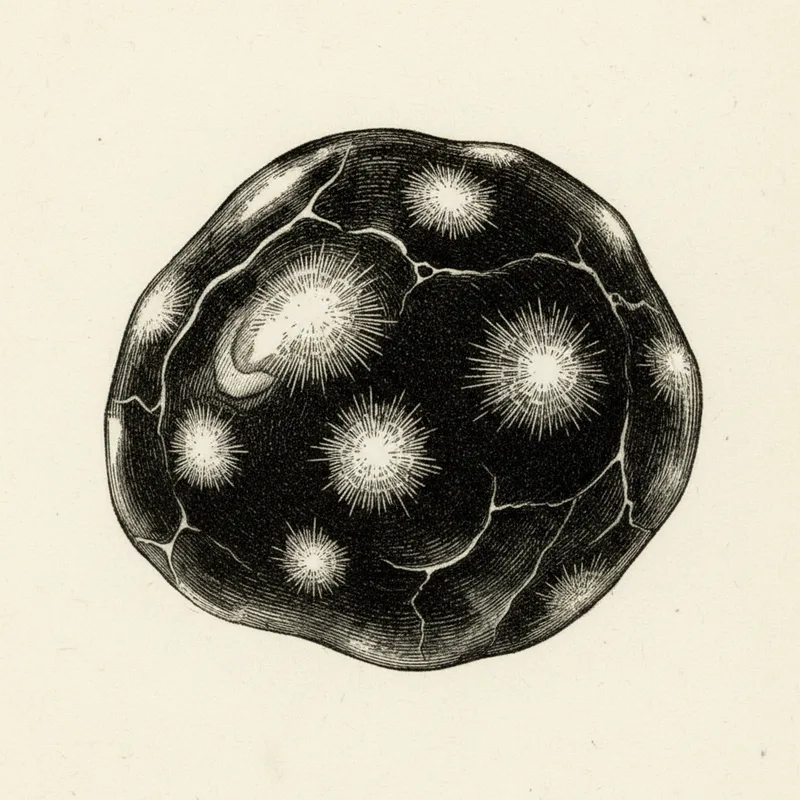
Snowflake obsidian is black volcanic glass containing white spherulitic inclusions of cristobalite - a high-temperature polymorph of quartz. These white 'snowflake' patterns form through a process called devitrification, where the amorphous glass slowly begins to crystallize over time.
When obsidian first forms from rapidly cooling lava, it's entirely glass - no crystal structure. But glass is thermodynamically unstable. Over thousands to millions of years, parts of the glass begin to reorganize into crystalline forms. Cristobalite nucleates at points within the glass and grows outward in radial patterns, creating the characteristic snowflake or flower-like shapes.
This means snowflake obsidian represents obsidian caught in the act of transforming from glass to crystal. Given enough time (millions of years), all obsidian would eventually devitrify completely. Snowflake obsidian is the midpoint of that process - a geological time-lapse frozen in stone.
Identification Guide
Snowflake obsidian is one of the easiest stones to identify - the stark contrast of white cristobalite patterns on jet-black glass is unmistakable. At hardness 5-5.5, it's softer than quartz. The glass matrix has a conchoidal fracture and vitreous luster.
Distinguish from dalmatian stone (white feldspar with black tourmaline spots - reversed color pattern), porphyritic basalt (white crystals in dark rock, but not glassy), and painted/printed imitations (patterns lack three-dimensional depth).
Spotting Fakes
Snowflake obsidian is abundant and inexpensive, so outright faking is rare. Some imitations use black glass or ceramic with white paint or applied patterns - genuine snowflake obsidian's cristobalite clusters are three-dimensional and visible at different depths within the glass. The snowflake patterns should appear naturally random, not stamped or repetitive. The glass matrix should show conchoidal fracture on any chipped edges.
Some links in this post go to Amazon and Etsy. Crystal Almanac earns a commission from qualifying purchases at no extra cost to you. Tools recommended here are ones we would use ourselves to run the tests described - the recommendation comes first, the link is downstream of it.
Cultural & Metaphysical Traditions
Presented as cultural traditions, not scientific evidence
Snowflake obsidian inherits obsidian's general metaphysical tradition (grounding, protection, truth-revealing) with the addition of balance symbolism from the black-and-white contrast. Modern practitioners associate it with recognizing patterns in behavior, releasing stagnation, and finding balance between opposing forces. The devitrification process - glass transforming into crystal - is interpreted as a metaphor for personal transformation from chaos to order.
Metaphysical and “healing” associations are cultural traditions, not medical advice or scientific fact. Crystals are not a substitute for professional medical care.
Where It's Found
Major source of quality material
Commercial quantities
Volcanic terrain produces various obsidian types
Price Guide
Good to Know
Scratch test: At hardness 5.5, Snowflake Obsidian resists scratching from a knife but can be scratched by quartz. Best for pendants and earrings rather than rings.
Global supply: Found in 3 notable locations worldwide, from United States to Iceland.
Heft test: With a specific gravity of 2.40, Snowflake Obsidian feels lighter than most minerals. This lightness can help identify it.
Common Questions
What is the chemical formula of Snowflake Obsidian?
The chemical formula of Snowflake Obsidian is SiO₂ (with cristobalite inclusions).
What is Snowflake Obsidian's Mohs hardness?
Snowflake Obsidian has a Mohs hardness of 5.5 on the 1 to 10 Mohs scale, hard enough to scratch glass but softer than quartz.
Is Snowflake Obsidian a mineral?
No. Snowflake Obsidian is a natural glass (a mineraloid), not a true mineral, because it cooled too fast to develop the ordered crystal structure that defines a mineral.
Care & Safety
The water, salt, and sunlight questions people actually ask before cleansing or displaying snowflake obsidian, answered from its hardness (Mohs 5.5) and chemistry (SiO₂ (with cristobalite inclusions)).
Can Snowflake Obsidian go in water?
Yes. Snowflake Obsidian is not water-soluble and durable enough (Mohs 5.5), so a rinse or a quick wash with mild soap is no problem, cleanse it in water freely if that is your practice. A long soak does nothing for it either way, so skip that, and dry the stone afterward.
Can Snowflake Obsidian go in salt water?
Not recommended, even though snowflake obsidian itself is hard and not water-soluble. Salt is both corrosive and mildly abrasive: it can dull a polished surface, attack metal settings, and crystallize inside small fractures as the stone dries. A quick dip will not destroy snowflake obsidian, but rinse it with fresh water afterward and dry it. For routine cleaning, plain water is the kinder choice.
Sources & References
The mineralogical and gemological data on this page is drawn from and can be cross-checked against these external references.
- WikipediaObsidian on Wikipedia
Related Minerals
The parent volcanic glass before devitrification
The white mineral forming the snowflake patterns
Rounded, translucent obsidian nodules
Obsidian with iron oxide instead of cristobalite
Explore More
Volcanic & Impact Glass
Obsidian vs Black Tourmaline: Volcanic Glass vs Crystal
12 Best Crystals for Beginners: Science-First Guide
Protection Crystals Explained by Science
Mohs Hardness Scale
See where Snowflake Obsidian sits on the scale
Crystal Care Guide
Water safety, sunlight, and handling tips
Save This Stone

Keep this snowflake obsidian reference handy. Save the card to a Pinterest board and the profile is one tap away.
Save to PinterestNewsletter
Something shiny, now and then
A stone worth knowing, or a fake worth spotting, every so often. No spam.