Ammolite
The Seven Color Gem
Affiliate links. We may earn a commission, at no cost to you.
Quick Facts
Formation & Origin
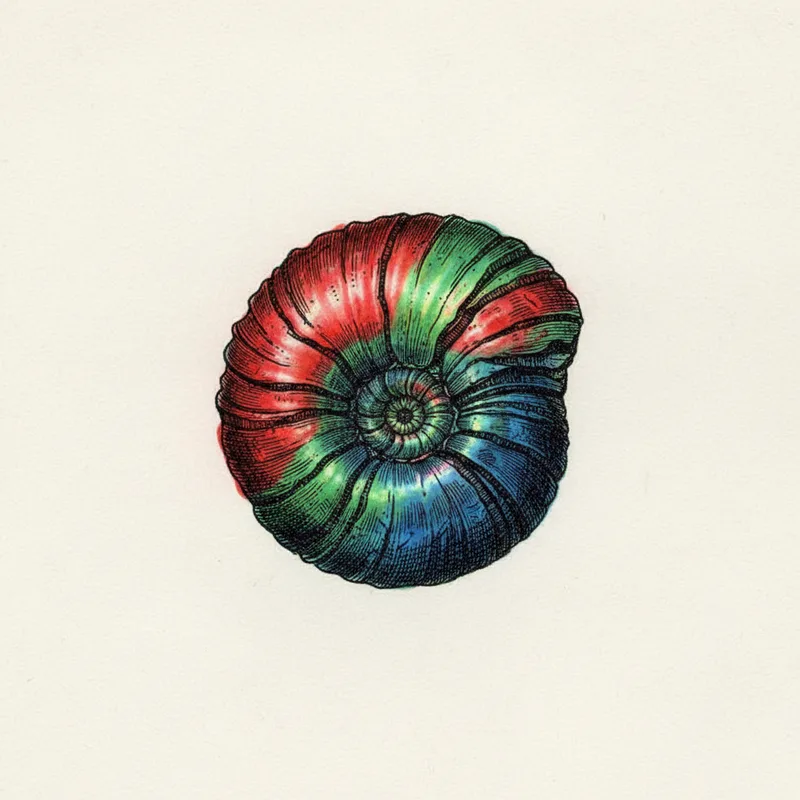
Ammolite is the iridescent fossilized shell of ammonites - extinct cephalopods related to nautilus that lived 71-75 million years ago during the Late Cretaceous period. The gem material comes almost exclusively from the Bearpaw Formation in southern Alberta, Canada, where ammonite shells were preserved in marine sediment under specific conditions that maintained the aragonite shell structure.
The rainbow iridescence is caused by thin-film interference in the layered aragonite structure of the fossil shell. Light reflecting between microscopic aragonite layers creates spectral colors similar to the mechanism in opal, but more vivid and with a more metallic quality. The specific colors depend on the thickness of the aragonite layers - thinner layers produce blue and violet, thicker layers produce red and green.
Ammolite was granted official gemstone status in 1981 by CIBJO (the World Jewellery Confederation). The primary mining company, Korite International, holds claims along the St. Mary River in Alberta. The gem layer is typically very thin (0.5-8mm), so most ammolite jewelry uses doublets or triplets with a protective cap.
Identification Guide
Ammolite is identified by its distinctive iridescent play of color on what is clearly fossilized shell material. The colors shift and move as the stone is rotated, similar to opal but with a more metallic, directional quality. The underlying fossil structure (shell growth lines) may be visible.
Distinguish from labradorite (silicate mineral, different iridescence mechanism), opal (amorphous silica, different structure), and abalone shell (modern, not fossilized, different pattern). Ammolite's iridescence is more vivid and directional than most other iridescent natural materials.
Spotting Fakes
Because ammolite is thin and fragile, most jewelry uses assembled stones (doublets and triplets with quartz or spinel caps). This is standard and should be disclosed. Complete fabrication is rare because the fossilized shell structure is difficult to replicate. Enhanced ammolite (where colors are intensified by coatings) exists and should be disclosed. For significant purchases, Korite provides certificates of authenticity.
Some links in this post go to Amazon and Etsy. Crystal Almanac earns a commission from qualifying purchases at no extra cost to you. Tools recommended here are ones we would use ourselves to run the tests described - the recommendation comes first, the link is downstream of it.
Cultural & Metaphysical Traditions
Presented as cultural traditions, not scientific evidence
The Blackfoot people of Alberta call ammolite 'iniskim' (buffalo stone) and have used it in ceremony for centuries. According to Blackfoot tradition, iniskim helped call the buffalo and bring good fortune. In Feng Shui, ammolite is considered one of the most powerful stones due to its full spectrum of colors, each associated with different types of prosperity and well-being.
Metaphysical and “healing” associations are cultural traditions, not medical advice or scientific fact. Crystals are not a substitute for professional medical care.
Where It's Found
The primary commercial source, virtually the only source
Price Guide
Good to Know
Scratch test: At hardness 4, Ammolite can be scratched with a copper coin. Handle gently and keep away from harder stones in your collection.
Global supply: Found at only one location on Earth - Canada. Supply is inherently limited.
Heft test: Ammolite has average mineral density (2.75). It feels about as heavy as you'd expect from a stone its size.
Common Questions
What is the chemical formula of Ammolite?
The chemical formula of Ammolite is CaCO₃ (aragonite, fossilized).
What is Ammolite's Mohs hardness?
Ammolite has a Mohs hardness of 4 on the 1 to 10 Mohs scale, which a steel knife will scratch.
Is Ammolite a mineral?
No. Ammolite is an organic gem, not a mineral, because it forms from once-living material rather than purely geological crystallization.
Care & Safety
The water, salt, and sunlight questions people actually ask before cleansing or displaying ammolite, answered from its hardness (Mohs 4) and chemistry (CaCO₃ (aragonite, fossilized)).
Can Ammolite go in water?
Only briefly. A quick rinse under running water is fine for ammolite, but do not let it soak or sit submerged. At Mohs 4 it is tough enough for a rinse but not for a long soak. Dry it thoroughly afterward.
Can Ammolite go in salt water?
No. Ammolite can take a brief fresh-water rinse and nothing more, and salt water is harder on it both ways: corrosive while wet, then abrasive as the salt dries into crystals. If it does meet salt water, rinse it with fresh water and dry it promptly.
Sources & References
The mineralogical and gemological data on this page is drawn from and can be cross-checked against these external references.
- WikipediaAmmolite on Wikipedia
Related Minerals
The mineral composing ammolite's shell layers
Similar play of color, different mechanism
Another iridescent mineral, different source
The fossil itself without gem-quality iridescence
Explore More
Save This Stone
%20exists%20and%20should%20be%20disclosed.%20Meaning%2C%20properties%20%26%20how%20to%20spot%20fakes%20at%20Crystal%20Almanac.)
Keep this ammolite reference handy. Save the card to a Pinterest board and the profile is one tap away.
Save to PinterestNewsletter
Something shiny, now and then
A stone worth knowing, or a fake worth spotting, every so often. No spam.