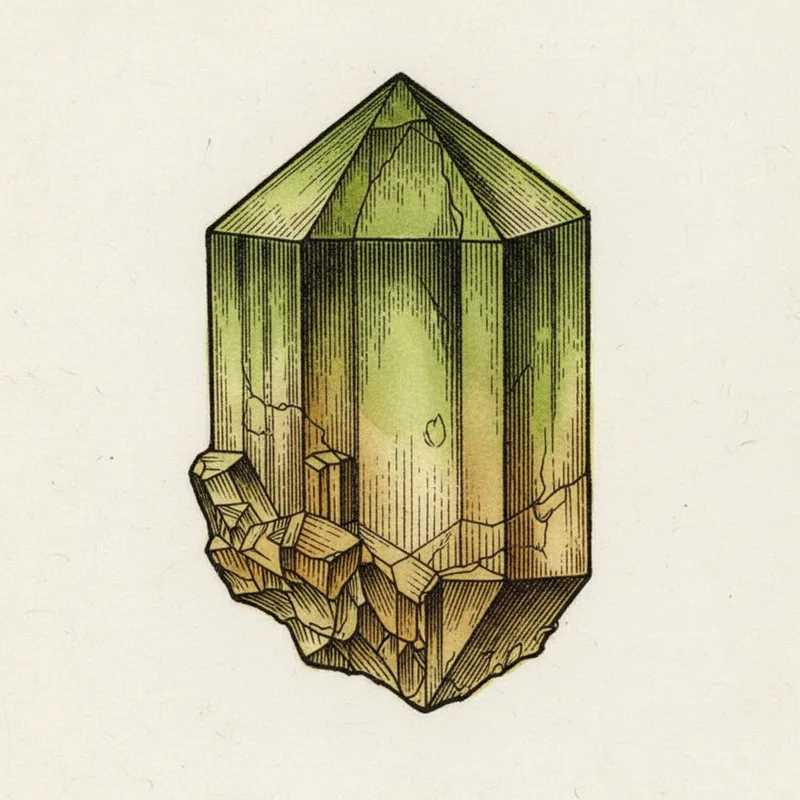
Vesuvianite
The Volcano's Gemstone
Affiliate links. We may earn a commission, at no cost to you.
Quick Facts
Formation & Origin
Vesuvianite, also called idocrase, is a calcium aluminum sorosilicate mineral first described from Mount Vesuvius. Vesuvianite (also known as idocrase) forms through contact metamorphism when limestone or dolostone is heated by nearby igneous intrusions. The calcium-rich host rock reacts with silicon, aluminum, and other elements from circulating fluids to produce vesuvianite along with other calc-silicate minerals like grossular garnet and diopside.
It was first identified in limestone blocks ejected from Mount Vesuvius, giving it its name. The complex formula reflects its ability to incorporate many different elements, resulting in a wide color range. Green varieties are colored by iron and chromium, brown by iron, and the rare purple cyprine variety contains copper.
Californite is a massive, jade-like variety of vesuvianite found in California that was once marketed as 'California jade.' Transparent, gem-quality crystals suitable for faceting are quite rare and come primarily from Quebec, Kenya, and Pakistan.
Identification Guide
Vesuvianite typically forms short prismatic to blocky tetragonal crystals, sometimes with a square cross-section. Green to yellow-green colors, vitreous luster, and hardness of 6.5 are key identifiers. Crystal faces often show vertical striations.
Distinguish from tourmaline (trigonal, no square cross-section), epidote (monoclinic, usually more yellow-green), grossular garnet (isometric, no crystal striations), and zircon (higher specific gravity). Vesuvianite's tetragonal symmetry and association with contact metamorphic rocks help narrow identification.
Spotting Fakes
Gem-quality vesuvianite is rare enough that fakes are uncommon in the collector market. The massive californite variety is sometimes confused with nephrite jade, but vesuvianite has a slightly lower hardness and different fracture. In the gem trade, green vesuvianite could be confused with demantoid garnet or tourmaline but has different optical properties. Check refractive index (1.712-1.721) and specific gravity for confirmation.
Some links in this post go to Amazon and Etsy. Crystal Almanac earns a commission from qualifying purchases at no extra cost to you. Tools recommended here are ones we would use ourselves to run the tests described - the recommendation comes first, the link is downstream of it.
Cultural & Metaphysical Traditions
Presented as cultural traditions, not scientific evidence
Vesuvianite is sometimes called the 'stone of cooperation' in crystal healing, associated with bringing together diverse groups or healing rifts. Its volcanic origin connects it to transformation through intense experience. Practitioners use it for releasing anger, finding creative solutions to conflicts, and connecting with nature.
Metaphysical and “healing” associations are cultural traditions, not medical advice or scientific fact. Crystals are not a substitute for professional medical care.
Where It's Found
Type locality, first described in 1795
Excellent transparent green crystals (californite)
Californite variety, massive green material
Rare purple cyprine variety with copper
Price Guide
Good to Know
Scratch test: At hardness 6.5, Vesuvianite resists scratching from a knife but can be scratched by quartz. Best for pendants and earrings rather than rings.
Global supply: Found in 4 notable locations worldwide, from Italy to Norway.
Heft test: Vesuvianite has average mineral density (3.33-3.43). It feels about as heavy as you'd expect from a stone its size.
Common Questions
What is the chemical formula of Vesuvianite?
The chemical formula of Vesuvianite is Ca₁₀(Mg,Fe)₂Al₄(SiO₄)₅(Si₂O₇)₂(OH,F)₄.
What is Vesuvianite's Mohs hardness?
Vesuvianite has a Mohs hardness of 6.5 on the 1 to 10 Mohs scale, hard enough to scratch glass but softer than quartz.
Is Vesuvianite a mineral?
Yes. Vesuvianite is a naturally occurring mineral (Silicate Mineral (Sorosilicate)) with a definite chemical composition and an ordered crystal structure.
Care & Safety
The water, salt, and sunlight questions people actually ask before cleansing or displaying vesuvianite, answered from its hardness (Mohs 6.5) and chemistry (Ca₁₀(Mg,Fe)₂Al₄(SiO₄)₅(Si₂O₇)₂(OH,F)₄).
Can Vesuvianite go in water?
Yes. Vesuvianite is not water-soluble and durable enough (Mohs 6.5), so a rinse or a quick wash with mild soap is no problem, cleanse it in water freely if that is your practice. A long soak does nothing for it either way, so skip that, and dry the stone afterward.
Can Vesuvianite go in salt water?
Not recommended, even though vesuvianite itself is hard and not water-soluble. Salt is both corrosive and mildly abrasive: it can dull a polished surface, attack metal settings, and crystallize inside small fractures as the stone dries. Vesuvianite's iron content also makes rust staining likely if salt residue sits on the surface. A quick dip will not destroy vesuvianite, but rinse it with fresh water afterward and dry it. For routine cleaning, plain water is the kinder choice.
Sources & References
The mineralogical and gemological data on this page is drawn from and can be cross-checked against these external references.
- WikipediaVesuvianite on Wikipedia
- WebmineralVesuvianite mineral data (Webmineral)
- Handbook of MineralogyVesuvianite (Handbook of Mineralogy, PDF)
Explore More
Save This Stone

Keep this vesuvianite reference handy. Save the card to a Pinterest board and the profile is one tap away.
Save to PinterestNewsletter
Something shiny, now and then
A stone worth knowing, or a fake worth spotting, every so often. No spam.