Tiffany Stone
The Purple Passion
Affiliate links. We may earn a commission, at no cost to you.
Quick Facts
Formation & Origin
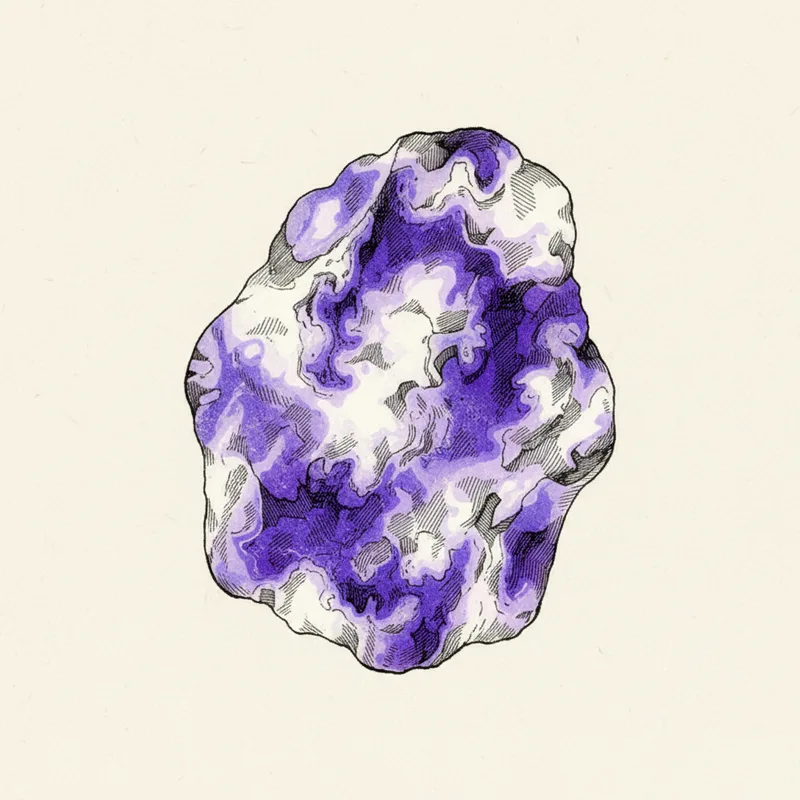
Tiffany stone is a rare, multi-mineral rock composed primarily of opalized fluorite with bertrandite, chalcedony, quartz, and sometimes dolomite and manganese oxides. It's found at a single location - the Brush Wellman beryllium mine at Spor Mountain, Utah.
The material formed through a complex sequence of volcanic and hydrothermal events that deposited fluorite, opal, and other minerals in swirled, flowing patterns within volcanic tuff. The purple color comes from fluorite and manganese, while the white and cream areas are opal and chalcedony.
Tiffany stone's rarity is extreme - it comes from one mine that primarily produces beryllium ore, not gemstones. The Tiffany stone is essentially a beautiful byproduct. Most material was historically discarded or crushed for beryllium processing. Only material rescued from the waste stream reaches the collector market, making supply limited and unpredictable. The mine's eventual closure will make Tiffany stone a finite, non-renewable resource.
Identification Guide
Tiffany stone is identified by its distinctive swirled purple-and-white pattern, waxy to vitreous luster, and mixed-mineral composition. The purple is typically softer and more lavender than amethyst. Under UV light, the fluorite component may fluoresce.
Distinguish from charoite (fibrous swirl pattern, different mineral composition), lepidolite (flaky mica texture), and dyed agate (too uniform, dye in cracks). Tiffany stone's swirled, flowing multi-mineral pattern has a distinctive organic quality.
Spotting Fakes
Tiffany stone's rarity and distinctive appearance make faking uncommon. Some purple-dyed agate or fluorite is marketed as Tiffany stone - genuine material shows a natural, organic swirl of multiple distinct minerals (not uniform dyed color). The mixed-mineral composition means different areas of a specimen may have different hardness and luster, which dyed single-mineral material doesn't show. Provenance from Spor Mountain, Utah, is the ultimate verification.
Some links in this post go to Amazon and Etsy. Crystal Almanac earns a commission from qualifying purchases at no extra cost to you. Tools recommended here are ones we would use ourselves to run the tests described - the recommendation comes first, the link is downstream of it.
Cultural & Metaphysical Traditions
Presented as cultural traditions, not scientific evidence
Tiffany stone has no ancient traditions due to its single-source rarity and recent discovery. Modern practitioners associate it with psychic development, spiritual communication, and creative expression. The blend of multiple minerals is interpreted as representing the integration of different spiritual energies. Its extreme rarity gives it a 'chosen' quality among practitioners - the idea that finding or owning Tiffany stone is itself meaningful.
Metaphysical and “healing” associations are cultural traditions, not medical advice or scientific fact. Crystals are not a substitute for professional medical care.
Where It's Found
The only known source
Price Guide
Good to Know
Scratch test: At hardness 5.5, Tiffany Stone resists scratching from a knife but can be scratched by quartz. Best for pendants and earrings rather than rings.
Global supply: Found at only one location on Earth - United States. Supply is inherently limited.
Heft test: Tiffany Stone has average mineral density (2.50-3.00). It feels about as heavy as you'd expect from a stone its size.
Common Questions
What is the chemical formula of Tiffany Stone?
The chemical formula of Tiffany Stone is Variable (fluorite + opal + bertrandite + chalcedony).
What is Tiffany Stone's Mohs hardness?
Tiffany Stone has a Mohs hardness of 5.5 on the 1 to 10 Mohs scale, hard enough to scratch glass but softer than quartz.
Is Tiffany Stone a mineral?
Not quite. Tiffany Stone is a rock (a naturally occurring mixture of minerals), not a single mineral species.
Care & Safety
The water, salt, and sunlight questions people actually ask before cleansing or displaying tiffany stone, answered from its hardness (Mohs 5.5) and chemistry (Variable (fluorite + opal + bertrandite + chalcedony)).
Can Tiffany Stone go in water?
Yes. Tiffany Stone is not water-soluble and durable enough (Mohs 5.5), so a rinse or a quick wash with mild soap is no problem, cleanse it in water freely if that is your practice. A long soak does nothing for it either way, so skip that, and dry the stone afterward.
Can Tiffany Stone go in salt water?
Not recommended, even though tiffany stone itself is hard and not water-soluble. Salt is both corrosive and mildly abrasive: it can dull a polished surface, attack metal settings, and crystallize inside small fractures as the stone dries. A quick dip will not destroy tiffany stone, but rinse it with fresh water afterward and dry it. For routine cleaning, plain water is the kinder choice.
Sources & References
The mineralogical and gemological data on this page is drawn from and can be cross-checked against these external references.
- WikipediaFluorite on Wikipedia
Related Minerals
Primary purple component of Tiffany stone
White-cream component, opalized silica
Similar swirled purple, different mineral entirely
Beryllium mineral component, the ore being mined
Explore More
Save This Stone

Keep this tiffany stone reference handy. Save the card to a Pinterest board and the profile is one tap away.
Save to PinterestNewsletter
Something shiny, now and then
A stone worth knowing, or a fake worth spotting, every so often. No spam.