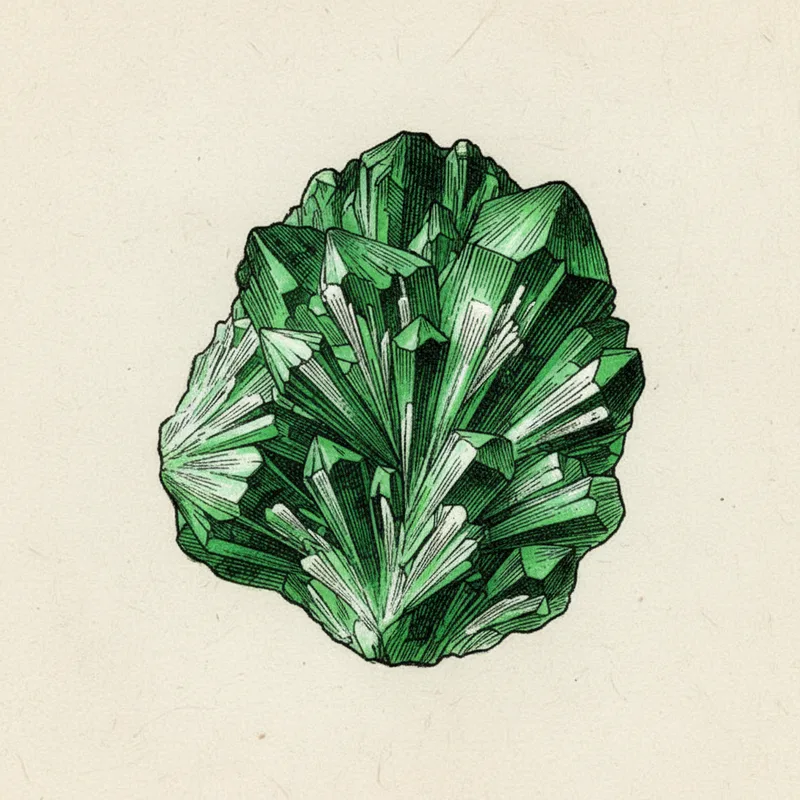
Seraphinite
The Angel Stone
Affiliate links. We may earn a commission, at no cost to you.
Quick Facts
Formation & Origin
Seraphinite is a trade name for a chatoyant variety of clinochlore - a magnesium aluminum silicate in the chlorite group. It forms in metamorphic rocks through the alteration of iron and magnesium-bearing minerals under moderate pressure and temperature.
The distinctive silvery, feather-like patterns that give seraphinite its name (after the seraphim, the six-winged angels of Hebrew tradition) are caused by mica-like inclusions oriented in fan-shaped or radiating patterns within the dark green clinochlore host. When polished, these inclusions catch light and create shimmering silvery streaks that genuinely resemble feathered wings.
Gem-quality seraphinite comes exclusively from the Lake Baikal region of Eastern Siberia. Like charoite (another uniquely Russian mineral), its remote origin, limited supply, and distinctive appearance have made it a sought-after collector's stone.
Identification Guide
Seraphinite is identified by its unique feathery, silvery shimmer pattern on a dark green background - no other mineral produces this specific visual effect. At hardness 2-4 (variable, typically around 2.5), it's quite soft and scratches easily.
Distinguish from serpentine (lacks the feathery shimmer), malachite (banded rather than feathered, copper-green), and aventurine (sparkly but not feathered). The radiating, fan-shaped silver patterns on dark green are diagnostic and essentially impossible to replicate artificially.
Spotting Fakes
Seraphinite is rarely faked because the feathery internal pattern is extremely difficult to replicate. If you see 'seraphinite' that looks like uniform green stone without the silvery feathered shimmer, it's probably misidentified clinochlore, serpentine, or another green mineral. Genuine seraphinite's pattern has depth - the silvery feathers appear at different levels within the stone, creating a three-dimensional effect when the stone is rotated.
Some links in this post go to Amazon and Etsy. Crystal Almanac earns a commission from qualifying purchases at no extra cost to you. Tools recommended here are ones we would use ourselves to run the tests described - the recommendation comes first, the link is downstream of it.
Cultural & Metaphysical Traditions
Presented as cultural traditions, not scientific evidence
Named for the seraphim (the highest order of angels in Jewish and Christian tradition), seraphinite has been enthusiastically adopted by crystal healers who associate it with angelic connection, spiritual enlightenment, and cellular healing. Its feathery appearance reinforces the angelic association. Since it's only found near Lake Baikal - one of the deepest and oldest lakes on Earth - it also carries associations with ancient Earth wisdom.
Metaphysical and “healing” associations are cultural traditions, not medical advice or scientific fact. Crystals are not a substitute for professional medical care.
Where It's Found
The only known source of gem-quality material
Price Guide
Good to Know
Scratch test: At hardness 2.5, Seraphinite can be scratched with a fingernail. This is a display specimen, not a wearable stone.
Global supply: Found at only one location on Earth - Russia. Supply is inherently limited.
Heft test: Seraphinite has average mineral density (2.65). It feels about as heavy as you'd expect from a stone its size.
Common Questions
What is the chemical formula of Seraphinite?
The chemical formula of Seraphinite is Mg₅Al(AlSi₃O₁₀)(OH)₈.
What is Seraphinite's Mohs hardness?
Seraphinite has a Mohs hardness of 2.5 on the 1 to 10 Mohs scale, soft enough to scratch with a fingernail.
Is Seraphinite a mineral?
Yes. Seraphinite is a naturally occurring mineral (Clinochlore variety) with a definite chemical composition and an ordered crystal structure.
Care & Safety
The water, salt, and sunlight questions people actually ask before cleansing or displaying seraphinite, answered from its hardness (Mohs 2.5) and chemistry (Mg₅Al(AlSi₃O₁₀)(OH)₈).
Can Seraphinite go in water?
Not recommended. At Mohs 2.5, seraphinite is soft enough that water can slowly dull, etch, or wear down the surface, so a water cleanse does more harm than good here. Reach for a dry cloth instead.
Can Seraphinite go in salt water?
No. Seraphinite is best kept away from water altogether, and salt water is the harsher version of that problem: the dissolved salt is corrosive while the stone is wet, then leaves gritty crystals behind in cracks and crevices as it dries.
Sources & References
The mineralogical and gemological data on this page is drawn from and can be cross-checked against these external references.
- WikipediaSeraphinite on Wikipedia
- WebmineralClinochlore mineral data (Webmineral)
- Handbook of MineralogyClinochlore (Handbook of Mineralogy, PDF)
Related Minerals
The parent mineral species of seraphinite
Similar green mineral, lacks feathery shimmer
Another uniquely Siberian decorative stone
Green chrome mica with similar shimmer
Explore More
Save This Stone
%2C%20it's%20quite%20soft%20and%20scratches%20easily.%20Meaning%2C%20properties%20%26%20identification%20at%20Crystal%20Almanac.)
Keep this seraphinite reference handy. Save the card to a Pinterest board and the profile is one tap away.
Save to PinterestNewsletter
Something shiny, now and then
A stone worth knowing, or a fake worth spotting, every so often. No spam.