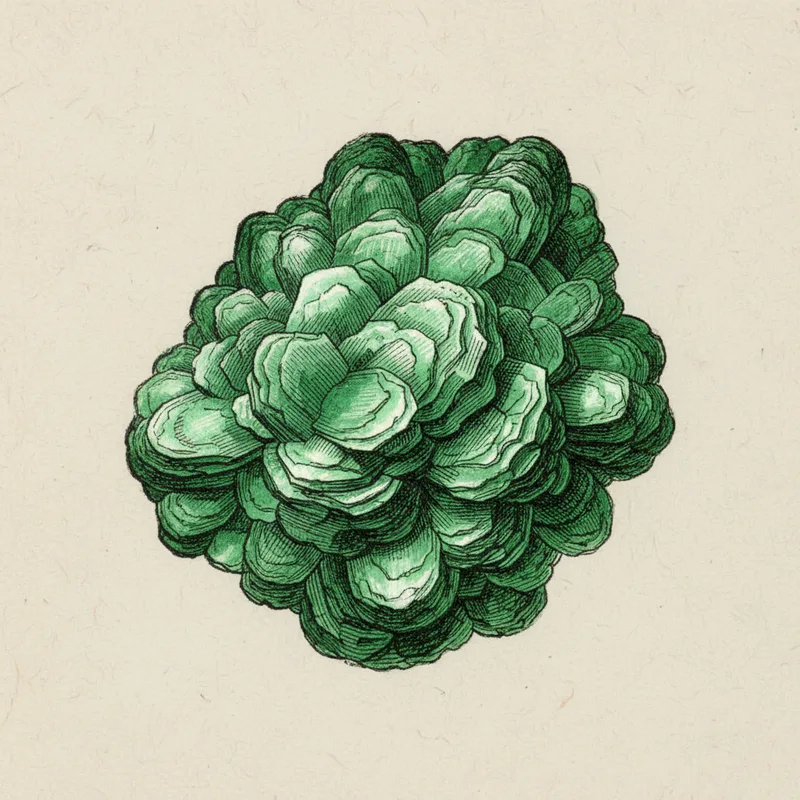
Fuchsite
The Emerald Mica
Affiliate links. We may earn a commission, at no cost to you.
Quick Facts
Formation & Origin
Fuchsite is the chromium-rich variety of muscovite mica. The substitution of chromium for aluminum in the crystal structure produces the distinctive green color. It forms in metamorphic rocks, particularly those that have been subjected to regional metamorphism of chromium-bearing sediments.
Fuchsite commonly occurs in schists and quartzites alongside quartz, kyanite, and other metamorphic minerals. In India and Tanzania, fuchsite is found intergrown with ruby (corundum), creating the popular combination stone known as ruby-fuchsite. The green mica matrix provides a striking backdrop for red ruby crystals.
The mineral was named after Johann Nepomuk von Fuchs, a 19th-century German mineralogist. Like all micas, fuchsite splits into thin, flexible sheets along its perfect basal cleavage. These sheets have a distinctive sparkly, reflective quality.
Identification Guide
Fuchsite is identified by its bright green color, micaceous habit (thin, flexible flakes), and sparkly appearance. The green color from chromium is the key distinguisher from common muscovite (colorless to pale) and biotite (dark brown to black).
Distinguish from verdite (harder, a rock rather than a mineral), green aventurine (quartz containing fuchsite inclusions), and chrome diopside (different crystal system and habit). Fuchsite flakes are flexible and elastic, springing back when bent.
Spotting Fakes
Fuchsite itself is rarely faked, but it's commonly involved in gem trade confusion. Fuchsite inclusions are what give green aventurine its color and sparkle. Some sellers market fuchsite-rich quartzite as 'emerald' or 'green sapphire.' Ruby-fuchsite combinations may have their ruby portions enhanced or dyed. Check that red areas in ruby-fuchsite are genuinely corundum (hardness 9) rather than dyed inclusions.
Some links in this post go to Amazon and Etsy. Crystal Almanac earns a commission from qualifying purchases at no extra cost to you. Tools recommended here are ones we would use ourselves to run the tests described - the recommendation comes first, the link is downstream of it.
Cultural & Metaphysical Traditions
Presented as cultural traditions, not scientific evidence
Crystal practitioners associate fuchsite with the heart chakra and emotional resilience. It's considered a healer's stone that helps practitioners maintain healthy boundaries while caring for others. The sparkly quality of its surface connects it to themes of joy and lightness. Ruby-fuchsite combinations are valued for pairing heart-centered energy with passion and vitality.
Metaphysical and “healing” associations are cultural traditions, not medical advice or scientific fact. Crystals are not a substitute for professional medical care.
Where It's Found
Major source for green mica specimens
Ruby-fuchsite combinations
Associated with chromite deposits
Historic source, named after J.N. von Fuchs
Price Guide
Good to Know
Scratch test: At hardness 2.5, Fuchsite can be scratched with a fingernail. This is a display specimen, not a wearable stone.
Global supply: Found in 4 notable locations worldwide, from Brazil to Russia.
Heft test: Fuchsite has average mineral density (2.80-2.90). It feels about as heavy as you'd expect from a stone its size.
Common Questions
What is the chemical formula of Fuchsite?
The chemical formula of Fuchsite is K(Al,Cr)₂(AlSi₃O₁₀)(OH)₂.
What is Fuchsite's Mohs hardness?
Fuchsite has a Mohs hardness of 2.5 on the 1 to 10 Mohs scale, soft enough to scratch with a fingernail.
Is Fuchsite a mineral?
Yes. Fuchsite is a naturally occurring mineral (Silicate Mineral (Mica Group)) with a definite chemical composition and an ordered crystal structure.
Care & Safety
The water, salt, and sunlight questions people actually ask before cleansing or displaying fuchsite, answered from its hardness (Mohs 2.5) and chemistry (K(Al,Cr)₂(AlSi₃O₁₀)(OH)₂).
Can Fuchsite go in water?
Not recommended. At Mohs 2.5, fuchsite is soft enough that water can slowly dull, etch, or wear down the surface, so a water cleanse does more harm than good here. Reach for a dry cloth instead.
Can Fuchsite go in salt water?
No. Fuchsite is best kept away from water altogether, and salt water is the harsher version of that problem: the dissolved salt is corrosive while the stone is wet, then leaves gritty crystals behind in cracks and crevices as it dries.
Sources & References
The mineralogical and gemological data on this page is drawn from and can be cross-checked against these external references.
- WikipediaFuchsite on Wikipedia
- WebmineralMuscovite mineral data (Webmineral)
- Handbook of MineralogyMuscovite (Handbook of Mineralogy, PDF)
Explore More
Mica & Sheet Silicates
Crystals for Your Home: A Room-by-Room Guide
Best Crystals for 2026: Match Stones to Your Goals
Best Crystals for Money and Abundance in 2026
Mohs Hardness Scale
See where Fuchsite sits on the scale
Crystal Care Guide
Water safety, sunlight, and handling tips
Save This Stone
%20rather%20than%20dyed%20inclusions.%20Meaning%2C%20properties%20%26%20how%20to%20spot%20fakes%20at%20Crystal%20Almanac.)
Keep this fuchsite reference handy. Save the card to a Pinterest board and the profile is one tap away.
Save to PinterestNewsletter
Something shiny, now and then
A stone worth knowing, or a fake worth spotting, every so often. No spam.