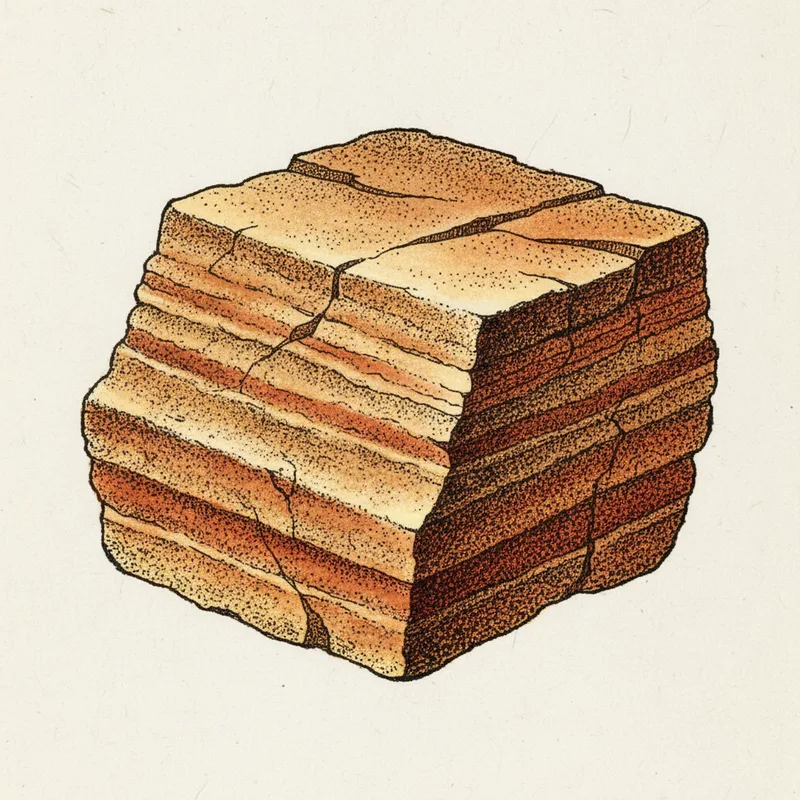
Sandstone
The Desert Archive
Affiliate links. We may earn a commission, at no cost to you.
Quick Facts
Formation & Origin
Sandstone is compressed and cemented sand. Each grain is typically a tiny quartz crystal that was eroded from older rocks, transported by rivers or wind, deposited in layers, and eventually lithified (turned to stone) by mineral cements filling the spaces between grains.
The colors tell the story of the environment: red sandstone (iron oxide cement, deposited in arid conditions), white sandstone (pure quartz, typically beach or dune deposits), and brown sandstone (iron and clay cements). Cross-bedding patterns (angled layers within the rock) record ancient sand dunes and river channels.
Sandstone landscapes are among the most spectacular on Earth. The red rock country of Utah and Arizona, Uluru in Australia, and the rose-red city of Petra in Jordan are all sculpted from sandstone. These formations were shaped by millions of years of water and wind erosion acting on horizontal rock layers.
Identification Guide
Sandstone is identified by its gritty texture (you can feel individual sand grains), visible layering or cross-bedding, and warm colors. It breaks around grains rather than through them, leaving a rough, granular fracture surface.
Distinguish from quartzite (breaks through grains, much harder), limestone (effervesces in acid), and shale (much finer-grained, clay-based).
Spotting Fakes
Sandstone is not faked. The main quality concern is durability. Well-cemented sandstone makes excellent building stone (many medieval cathedrals), while poorly cemented sandstone crumbles. The brown sandstone buildings of New York City ('brownstones') demonstrate both: some have lasted 150+ years while others require constant repair.
Some links in this post go to Amazon and Etsy. Crystal Almanac earns a commission from qualifying purchases at no extra cost to you. Tools recommended here are ones we would use ourselves to run the tests described - the recommendation comes first, the link is downstream of it.
Cultural & Metaphysical Traditions
Presented as cultural traditions, not scientific evidence
Sandstone is associated with creativity, truth, and collective unity (millions of individual grains forming a cohesive whole). The layered structure connects it to understanding life in stages and chapters. Red sandstone carries additional associations with passion and the transformative energy of desert environments.
Metaphysical and “healing” associations are cultural traditions, not medical advice or scientific fact. Crystals are not a substitute for professional medical care.
Where It's Found
Spectacular red sandstone formations
Iconic red sandstone monolith
Ancient city carved from sandstone
Millstone grit and building stone
Price Guide
Good to Know
Scratch test: At hardness 6, Sandstone resists scratching from a knife but can be scratched by quartz. Best for pendants and earrings rather than rings.
Global supply: Found in 4 notable locations worldwide, from United States to England.
Heft test: With a specific gravity of 2.2-2.8, Sandstone feels lighter than most minerals. This lightness can help identify it.
Common Questions
What is the chemical formula of Sandstone?
The chemical formula of Sandstone is SiO₂ (cemented quartz grains).
What is Sandstone's Mohs hardness?
Sandstone has a Mohs hardness of 6 on the 1 to 10 Mohs scale, hard enough to scratch glass but softer than quartz.
Is Sandstone a mineral?
Not quite. Sandstone is a rock (a naturally occurring mixture of minerals), not a single mineral species.
Care & Safety
The water, salt, and sunlight questions people actually ask before cleansing or displaying sandstone, answered from its hardness (Mohs 6) and chemistry (SiO₂ (cemented quartz grains)).
Can Sandstone go in water?
Yes. Sandstone is not water-soluble and durable enough (Mohs 6), so a rinse or a quick wash with mild soap is no problem, cleanse it in water freely if that is your practice. A long soak does nothing for it either way, so skip that, and dry the stone afterward.
Can Sandstone go in salt water?
Not recommended, even though sandstone itself is hard and not water-soluble. Salt is both corrosive and mildly abrasive: it can dull a polished surface, attack metal settings, and crystallize inside small fractures as the stone dries. A quick dip will not destroy sandstone, but rinse it with fresh water afterward and dry it. For routine cleaning, plain water is the kinder choice.
Sources & References
The mineralogical and gemological data on this page is drawn from and can be cross-checked against these external references.
- WikipediaSandstone on Wikipedia
Explore More
Rocks & Multi-Mineral Composites
Is My Sunstone Real? How to Spot Goldstone Glass
Crystal of the Year 2026: Why Carnelian Is Everywhere
Moonstone vs Opal: The Ethereal Stone Showdown
Mohs Hardness Scale
See where Sandstone sits on the scale
Crystal Care Guide
Water safety, sunlight, and handling tips
Save This Stone

Keep this sandstone reference handy. Save the card to a Pinterest board and the profile is one tap away.
Save to PinterestNewsletter
Something shiny, now and then
A stone worth knowing, or a fake worth spotting, every so often. No spam.