Quartzite
The Indestructible Sandstone
Affiliate links. We may earn a commission, at no cost to you.
Quick Facts
Formation & Origin
Quartzite is a hard metamorphic rock composed almost entirely of recrystallized quartz (SiO₂), formed when sandstone is altered by heat and pressure. Quartzite forms when sandstone is metamorphosed by heat and pressure. The original sand grains (which were individual quartz crystals) recrystallize and fuse together, creating an interlocking mosaic of quartz that is far harder and more durable than the original sandstone.
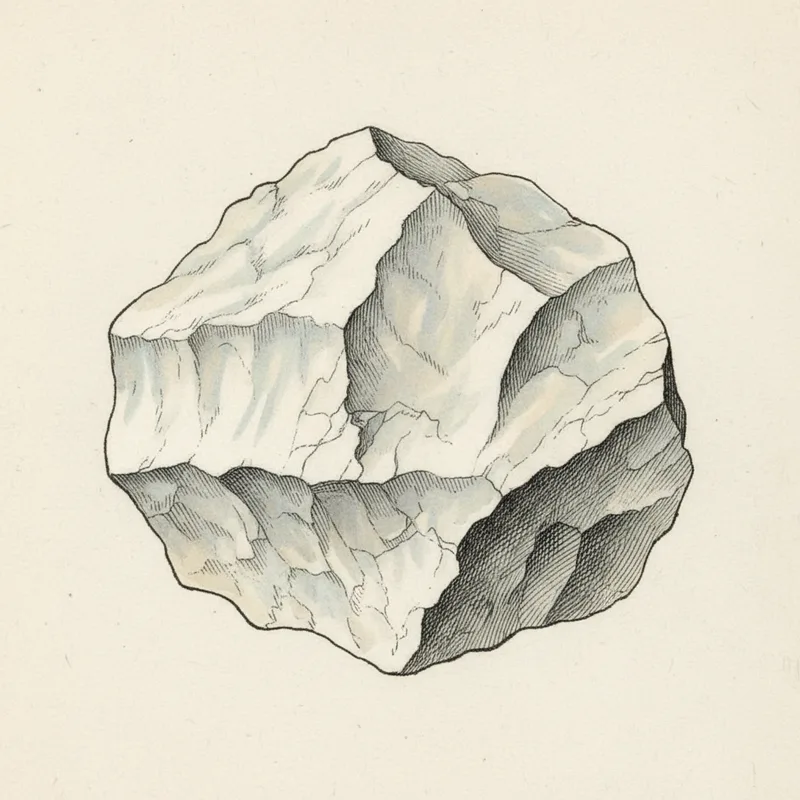
The transformation is dramatic. Sandstone breaks around its grains (you can see individual sand grains on broken surfaces). Quartzite breaks through its grains, producing a smooth, conchoidal fracture because the grain boundaries have been obliterated by recrystallization.
Pure quartzite is white. Pink quartzite (like South Dakota's Sioux Quartzite) contains iron oxide. Green quartzite may contain fuchsite mica. Quartzite is one of the most durable natural materials available, resisting weathering, heat, and chemicals. It's increasingly popular as a countertop material, marketed as a premium alternative to granite.
Identification Guide
Quartzite is identified by its extreme hardness (Mohs 7, scratches steel and glass), granular texture of fused quartz grains, conchoidal fracture (breaks through grains, not around them), and lack of acid reaction.
Distinguish from marble (softer, effervesces in acid), sandstone (softer, breaks around grains, gritty feel), and granite (contains visible feldspar and mica in addition to quartz).
Spotting Fakes
In the countertop industry, some 'quartzite' is actually dolomite marble or other softer stone that won't hold up as well. True quartzite should scratch glass easily and not react with acid. The term 'soft quartzite' is sometimes used for dolomite marble, which is misleading. If you can scratch it with a knife, it's not quartzite.
Some links in this post go to Amazon and Etsy. Crystal Almanac earns a commission from qualifying purchases at no extra cost to you. Tools recommended here are ones we would use ourselves to run the tests described - the recommendation comes first, the link is downstream of it.
Cultural & Metaphysical Traditions
Presented as cultural traditions, not scientific evidence
Quartzite is associated with endurance, determination, and the transformation of something ordinary into something extraordinary. The metamorphic journey from loose sand to fused stone mirrors themes of personal growth through pressure. Practitioners use it for persistence and long-term goal setting.
Metaphysical and “healing” associations are cultural traditions, not medical advice or scientific fact. Crystals are not a substitute for professional medical care.
Where It's Found
Very common globally
Decorative quartzite slabs
Commercial quarrying
Famous pink quartzite, 1.7 billion years old
Price Guide
Good to Know
Scratch test: At hardness 7, Quartzite can scratch glass and steel. It's durable enough for any type of jewelry.
Global supply: Found in 4 notable locations worldwide, from Worldwide to United States.
Heft test: Quartzite has average mineral density (2.65). It feels about as heavy as you'd expect from a stone its size.
Common Questions
What is the chemical formula of Quartzite?
The chemical formula of Quartzite is SiO₂ (recrystallized quartz grains).
What is Quartzite's Mohs hardness?
Quartzite has a Mohs hardness of 7 on the 1 to 10 Mohs scale, hard enough to scratch glass and stand up to daily wear.
Is Quartzite a mineral?
Not quite. Quartzite is a rock (a naturally occurring mixture of minerals), not a single mineral species.
Care & Safety
The water, salt, and sunlight questions people actually ask before cleansing or displaying quartzite, answered from its hardness (Mohs 7) and chemistry (SiO₂ (recrystallized quartz grains)).
Can Quartzite go in water?
Yes. Quartzite is hard (Mohs 7) and chemically stable, so a rinse or a quick wash with mild soap is no problem, cleanse it in water freely if that is your practice. A long soak does nothing for it either way, so skip that, and dry the stone afterward.
Can Quartzite go in salt water?
Not recommended, even though quartzite itself is hard and not water-soluble. Salt is both corrosive and mildly abrasive: it can dull a polished surface, attack metal settings, and crystallize inside small fractures as the stone dries. A quick dip will not destroy quartzite, but rinse it with fresh water afterward and dry it. For routine cleaning, plain water is the kinder choice.
Sources & References
The mineralogical and gemological data on this page is drawn from and can be cross-checked against these external references.
- WikipediaQuartzite on Wikipedia
Explore More
Rocks & Multi-Mineral Composites
Best Crystals for 2026: Match Stones to Your Goals
Is My Amethyst Real? 5 Tests for Glass and Synthetic Fakes
Best Crystals for Money and Abundance in 2026
Mohs Hardness Scale
See where Quartzite sits on the scale
Crystal Care Guide
Water safety, sunlight, and handling tips
Save This Stone

Keep this quartzite reference handy. Save the card to a Pinterest board and the profile is one tap away.
Save to PinterestNewsletter
Something shiny, now and then
A stone worth knowing, or a fake worth spotting, every so often. No spam.