Rutilated Quartz
Venus Hair Stone
Affiliate links. We may earn a commission, at no cost to you.
Quick Facts
Formation & Origin
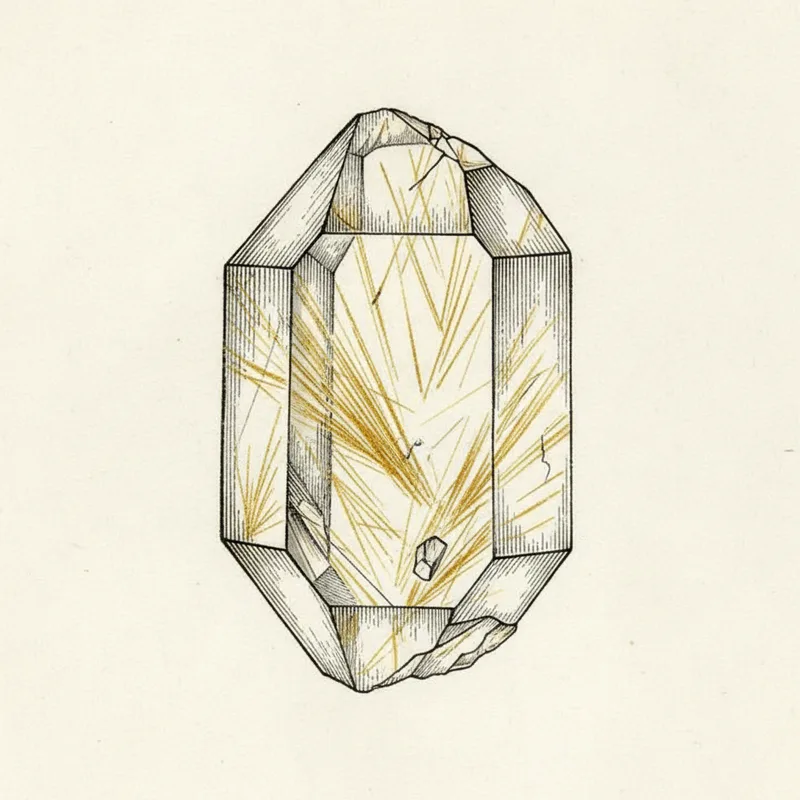
Rutilated quartz is clear or smoky quartz that contains needle-like crystals of rutile (titanium dioxide) trapped within it. The rutile crystallized first, and quartz later grew around it, permanently encapsulating the delicate rutile needles.
Rutile needles inside quartz can be golden yellow (the most common and sought-after), coppery red, silvery, or nearly black depending on iron content and crystal thickness. The needles range from fine hair-like threads to thick, brilliant bars. Some specimens contain dense networks of crossed or star-like rutile sprays, while others have just a few elegantly placed needles.
In gemology, inclusions generally reduce a stone's value. Rutilated quartz is one of the rare exceptions - here, the inclusions ARE the value. A clear quartz without rutile is worth very little; the same quartz with a dramatic spray of golden rutile needles becomes a sought-after collector's gem.
Identification Guide
Rutilated quartz is immediately identifiable by the visible needle-like inclusions within clear or smoky quartz. The needles are straight, metallic-looking, and often criss-cross at specific angles determined by rutile's crystal structure.
Distinguish from tourmalinated quartz (black tourmaline needles instead of metallic rutile), sagenite (various acicular mineral inclusions), and hair-like actinolite in quartz (green, not golden). The metallic golden color of rutile needles and their straight, geometric arrangement are diagnostic.
Spotting Fakes
Rutilated quartz is common enough and affordable enough that faking is rare. Glass with embedded metallic wires exists but is easy to spot - the 'needles' look too uniform and lack the natural randomness of real rutile. In genuine specimens, rutile needles taper at their ends and may show slight bends or intersections at crystallographically determined angles. Synthetically grown rutilated quartz doesn't exist commercially.
Some links in this post go to Amazon and Etsy. Crystal Almanac earns a commission from qualifying purchases at no extra cost to you. Tools recommended here are ones we would use ourselves to run the tests described - the recommendation comes first, the link is downstream of it.
Cultural & Metaphysical Traditions
Presented as cultural traditions, not scientific evidence
Called 'Venus hair stone' since antiquity because the golden needles were thought to be strands of the goddess Venus's hair trapped in crystal. In Chinese tradition, rutilated quartz is popular for its association with wealth and prosperity - the golden needles represent streams of gold. Modern practitioners associate it with amplified intentions, accelerated manifestation, and illuminating hidden truths.
Metaphysical and “healing” associations are cultural traditions, not medical advice or scientific fact. Crystals are not a substitute for professional medical care.
Where It's Found
World's primary source, exceptional quality
Good quality, both golden and dark rutile
Some fine specimens
Quartz with interesting rutile patterns
Price Guide
Good to Know
Scratch test: At hardness 7, Rutilated Quartz can scratch glass and steel. It's durable enough for any type of jewelry.
Global supply: Found in 4 notable locations worldwide, from Brazil to Pakistan.
Heft test: Rutilated Quartz has average mineral density (2.65). It feels about as heavy as you'd expect from a stone its size.
Common Questions
What is the chemical formula of Rutilated Quartz?
The chemical formula of Rutilated Quartz is SiO₂ with TiO₂ inclusions.
What is Rutilated Quartz's Mohs hardness?
Rutilated Quartz has a Mohs hardness of 7 on the 1 to 10 Mohs scale, hard enough to scratch glass and stand up to daily wear.
Is Rutilated Quartz a mineral?
Yes. Rutilated Quartz is a naturally occurring mineral (Quartz Family) with a definite chemical composition and an ordered crystal structure.
Care & Safety
The water, salt, and sunlight questions people actually ask before cleansing or displaying rutilated quartz, answered from its hardness (Mohs 7) and chemistry (SiO₂ with TiO₂ inclusions).
Can Rutilated Quartz go in water?
Yes. Rutilated Quartz is hard (Mohs 7) and chemically stable, so a rinse or a quick wash with mild soap is no problem, cleanse it in water freely if that is your practice. A long soak does nothing for it either way, so skip that, and dry the stone afterward.
Can Rutilated Quartz go in salt water?
Not recommended, even though rutilated quartz itself is hard and not water-soluble. Salt is both corrosive and mildly abrasive: it can dull a polished surface, attack metal settings, and crystallize inside small fractures as the stone dries. A quick dip will not destroy rutilated quartz, but rinse it with fresh water afterward and dry it. For routine cleaning, plain water is the kinder choice.
Sources & References
The mineralogical and gemological data on this page is drawn from and can be cross-checked against these external references.
- WikipediaQuartz on Wikipedia
- WebmineralQuartz mineral data (Webmineral)
- Handbook of MineralogyQuartz (Handbook of Mineralogy, PDF)
Related Minerals
Similar concept, black tourmaline instead of rutile
The included mineral, titanium dioxide
Often hosts rutile inclusions
General term for acicular inclusions in minerals
Explore More
Save This Stone

Keep this rutilated quartz reference handy. Save the card to a Pinterest board and the profile is one tap away.
Save to PinterestNewsletter
Something shiny, now and then
A stone worth knowing, or a fake worth spotting, every so often. No spam.