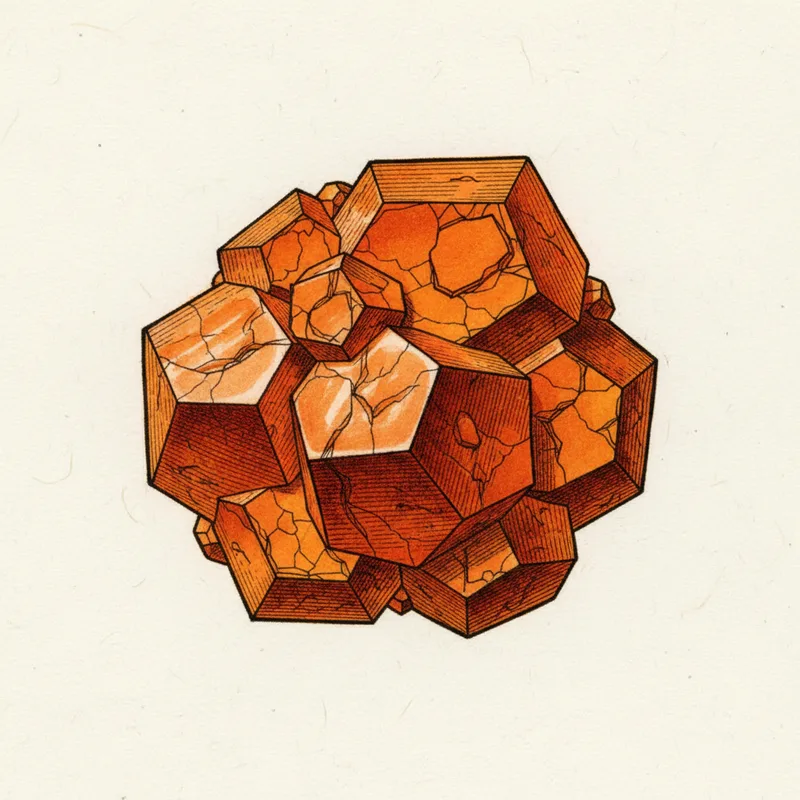
Spessartine Garnet
The Fanta Orange Gem
Affiliate links. We may earn a commission, at no cost to you.
Quick Facts
Formation & Origin
Spessartine is the manganese-aluminum member of the garnet group, a silicate (Mn₃Al₂(SiO₄)₃) whose pure end-member is colored vivid orange by manganese. Spessartine is the manganese-aluminum garnet, named after the Spessart Mountains in Germany where it was first identified. The pure end-member is colored vivid orange by manganese. Most natural spessartine contains some almandine (iron) component, which shifts the color toward reddish tones.
It forms in granitic pegmatites, some metamorphic rocks, and rarely in rhyolites. The finest gem-quality material comes from pegmatites where manganese-rich fluids created pockets of clean, intensely colored crystals. The Nigerian and Namibian sources that produce the most vivid 'mandarin garnet' quality stones formed in such environments.
In the late 1990s, electric-orange spessartine from Namibia hit the market and was branded 'mandarin garnet.' The trade name stuck, and vivid orange spessartine is now among the most sought-after colored garnets. Nigerian production from around 2000 onward increased supply of this electric orange material significantly.
Identification Guide
Spessartine is identified by its vivid orange color, isometric crystal system (forming dodecahedra and trapezohedra), and relatively high specific gravity (4.18) for a garnet. It's singly refractive, which helps separate it from similarly colored doubly refractive gems.
Distinguish from hessonite garnet (grossular species, lower RI, different SG), fire opal (amorphous, lower SG, lower hardness), and citrine (hexagonal, much lower RI and SG). Spessartine's combination of vivid orange, high SG, and garnet crystal habit is distinctive.
Spotting Fakes
Spessartine is not commonly faked, but it is sometimes confused with hessonite garnet (the 'cinnamon stone' grossular garnet). Hessonite has lower RI (1.734 vs 1.800) and lower SG (3.65 vs 4.18). Orange CZ could imitate spessartine but has very different properties under testing. Heat treatment of spessartine is not standard practice. Most material is sold as-mined.
Some links in this post go to Amazon and Etsy. Crystal Almanac earns a commission from qualifying purchases at no extra cost to you. Tools recommended here are ones we would use ourselves to run the tests described - the recommendation comes first, the link is downstream of it.
Cultural & Metaphysical Traditions
Presented as cultural traditions, not scientific evidence
Spessartine garnet is associated with creativity, confidence, and taking action in crystal healing. Its vivid orange color connects it strongly to the sacral chakra and themes of passion, joy, and creative expression. Practitioners consider it an energizing stone that encourages bold self-expression and overcomes hesitation.
Metaphysical and “healing” associations are cultural traditions, not medical advice or scientific fact. Crystals are not a substitute for professional medical care.
Where It's Found
Vivid 'mandarin' orange gems, major modern source
'Mandarin garnet' marketing origin
Growing source of orange garnets
Classic crystal specimens on matrix
Price Guide
Good to Know
Scratch test: At hardness 7, Spessartine Garnet can scratch glass and steel. It's durable enough for any type of jewelry.
Global supply: Found in 4 notable locations worldwide, from Nigeria to Brazil.
Heft test: Spessartine Garnet has a specific gravity of 4.18 - noticeably heavier than quartz. You'll feel the density when you pick it up.
Common Questions
What is the chemical formula of Spessartine Garnet?
The chemical formula of Spessartine Garnet is Mn₃Al₂(SiO₄)₃.
What is Spessartine Garnet's Mohs hardness?
Spessartine Garnet has a Mohs hardness of 7 on the 1 to 10 Mohs scale, hard enough to scratch glass and stand up to daily wear.
Is Spessartine Garnet a mineral?
Yes. Spessartine Garnet is a naturally occurring mineral (Garnet Group (Spessartine)) with a definite chemical composition and an ordered crystal structure.
Care & Safety
The water, salt, and sunlight questions people actually ask before cleansing or displaying spessartine garnet, answered from its hardness (Mohs 7) and chemistry (Mn₃Al₂(SiO₄)₃).
Can Spessartine Garnet go in water?
Yes. Spessartine Garnet is hard (Mohs 7) and chemically stable, so a rinse or a quick wash with mild soap is no problem, cleanse it in water freely if that is your practice. A long soak does nothing for it either way, so skip that, and dry the stone afterward.
Can Spessartine Garnet go in salt water?
Not recommended, even though spessartine garnet itself is hard and not water-soluble. Salt is both corrosive and mildly abrasive: it can dull a polished surface, attack metal settings, and crystallize inside small fractures as the stone dries. A quick dip will not destroy spessartine garnet, but rinse it with fresh water afterward and dry it. For routine cleaning, plain water is the kinder choice.
Sources & References
The mineralogical and gemological data on this page is drawn from and can be cross-checked against these external references.
- WikipediaSpessartine on Wikipedia
- WebmineralSpessartine mineral data (Webmineral)
- Handbook of MineralogySpessartine (Handbook of Mineralogy, PDF)
- GIASpessartine Garnet in the GIA Gem Encyclopedia
Related Minerals
Iron garnet, commonly intermixed with spessartine
Pyrope-almandine mix, different garnet species
Orange grossular garnet, different species
Explore More
Garnet Group
The Creative Collection
Called 'mandarin garnet' for its electric orange. Associated with creative confidence, bold self-expression, and the energy to start ambitious projects.
Mohs Hardness Scale
See where Spessartine Garnet sits on the scale
Crystal Care Guide
Water safety, sunlight, and handling tips
Save This Stone

Keep this spessartine garnet reference handy. Save the card to a Pinterest board and the profile is one tap away.
Save to PinterestNewsletter
Something shiny, now and then
A stone worth knowing, or a fake worth spotting, every so often. No spam.