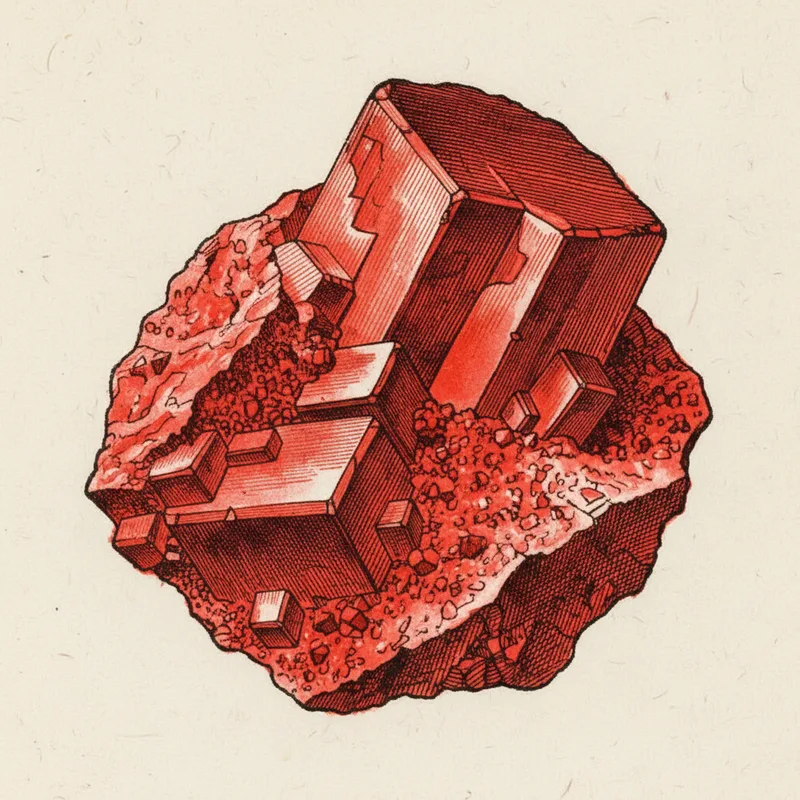
Cinnabar
The Dragon's Blood Mercury
Affiliate links. We may earn a commission, at no cost to you.
Quick Facts
Formation & Origin
Cinnabar is mercury sulfide - the primary ore of mercury and one of the most visually striking (and toxic) minerals collected. Its vivid vermillion-red color is unmistakable and has been prized as a pigment since antiquity. The Chinese used ground cinnabar (called 'zhu sha') for red lacquerware, ink, and ceremonial paint for over 3,000 years.
Cinnabar forms in low-temperature hydrothermal veins associated with recent volcanic activity and hot springs. The mercury is mobilized from deep crustal sources by hot fluids and deposited near the surface when temperatures and pressures drop. Almaden, Spain, has been the world's most important mercury mine for over 2,000 years - Roman prisoners were sent to work the mines, where mercury exposure was essentially a death sentence.
IMPORTANT SAFETY NOTE: Cinnabar contains mercury. While mercury sulfide is relatively stable (less dangerous than liquid mercury or mercury vapor), specimens should be handled with care. Never heat cinnabar, never grind it, never touch it and then touch your face. Wash hands after handling. Keep away from children. Display in enclosed cases. NEVER use for gem elixirs.
Identification Guide
Cinnabar is identified by its vivid scarlet-red color, extremely high density (8.10 - feels very heavy), adamantine luster, and scarlet streak. No other common mineral is both this red and this dense.
Distinguish from realgar (arsenic sulfide - orange-red, much lighter), cuprite (copper oxide - darker red, different associations), and red jasper (much harder, much lighter). Cinnabar's extreme density combined with its specific scarlet color is essentially diagnostic.
Spotting Fakes
Cinnabar is a specialist collector mineral not commonly faked. The main safety concern is more important than authenticity: handle with care due to mercury content. Some carved 'cinnabar' items (particularly Chinese decorative objects) are actually cinnabar-colored lacquer or resin, not the mineral. These are safe to handle. Real mineral cinnabar is extremely heavy for its size.
Some links in this post go to Amazon and Etsy. Crystal Almanac earns a commission from qualifying purchases at no extra cost to you. Tools recommended here are ones we would use ourselves to run the tests described - the recommendation comes first, the link is downstream of it.
Cultural & Metaphysical Traditions
Presented as cultural traditions, not scientific evidence
In Chinese alchemy and traditional medicine, cinnabar was considered the most important mineral - associated with immortality and transformation. Taoist alchemists believed cinnabar could be transformed into the elixir of life. This is grimly ironic, as mercury ingestion killed many who pursued this goal. In Feng Shui, cinnabar-colored objects (not the actual mineral) are used for protection and prosperity. CRITICAL: Never use actual cinnabar internally or in any elixir. Mercury is toxic.
Metaphysical and “healing” associations are cultural traditions, not medical advice or scientific fact. Crystals are not a substitute for professional medical care.
Where It's Found
Historic source, fine crystal specimens
World's most famous mercury mine, 2,000+ years of mining
Historic mercury mining districts
Price Guide
Good to Know
Scratch test: At hardness 2.5, Cinnabar can be scratched with a fingernail. This is a display specimen, not a wearable stone.
Global supply: Found in 3 notable locations worldwide, from China to United States.
Heft test: With a specific gravity of 8.10, Cinnabar feels surprisingly heavy for its size. This weight is actually a useful identification tool.
Common Questions
What is the chemical formula of Cinnabar?
The chemical formula of Cinnabar is HgS.
What is Cinnabar's Mohs hardness?
Cinnabar has a Mohs hardness of 2.5 on the 1 to 10 Mohs scale, soft enough to scratch with a fingernail.
Is Cinnabar a mineral?
Yes. Cinnabar is a naturally occurring mineral (Sulfide Group) with a definite chemical composition and an ordered crystal structure.
Care & Safety
The water, salt, and sunlight questions people actually ask before cleansing or displaying cinnabar, answered from its hardness (Mohs 2.5) and chemistry (HgS).
Can Cinnabar go in water?
Not recommended. TOXIC. Mercury sulfide. Water can release mercury compounds. Handle briefly, wash hands immediately.
Can Cinnabar go in salt water?
No. Cinnabar is best kept away from water altogether, and salt water is the harsher version of that problem: the dissolved salt is corrosive while the stone is wet, then leaves gritty crystals behind in cracks and crevices as it dries.
Is sunlight safe for Cinnabar?
No. Light exposure gradually darkens cinnabar (HgS) toward black, a change documented since Roman times, when cinnabar pigment darkened outdoors in sunlight. It is also a mercury mineral. Keep it in a dim, enclosed display and wash your hands after handling.
Sources & References
The mineralogical and gemological data on this page is drawn from and can be cross-checked against these external references.
- WikipediaCinnabar on Wikipedia
- WebmineralCinnabar mineral data (Webmineral)
- Handbook of MineralogyCinnabar (Handbook of Mineralogy, PDF)
Related Minerals
Another toxic sulfide (arsenic), similar red
Similar red color, completely different and safe
Red oxide mineral, also dense
The liquid metal extracted from cinnabar
Explore More
Sulfide Minerals
Toxic Crystals: The Complete Safety Guide
Crystals for Your Home: A Room-by-Room Guide
Best Crystals for Sleep: What to Know & How to Use
Mohs Hardness Scale
See where Cinnabar sits on the scale
Crystal Care Guide
Water safety, sunlight, and handling tips
Save This Stone

Keep this cinnabar reference handy. Save the card to a Pinterest board and the profile is one tap away.
Save to PinterestNewsletter
Something shiny, now and then
A stone worth knowing, or a fake worth spotting, every so often. No spam.