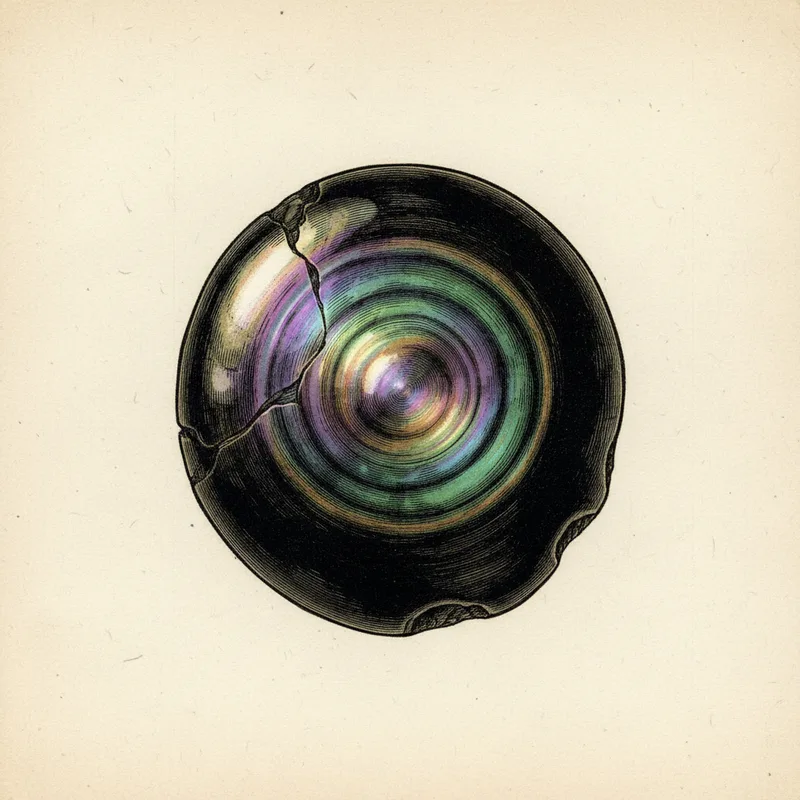
Rainbow Obsidian
The Stone of Light in Darkness
Affiliate links. We may earn a commission, at no cost to you.
Quick Facts
Formation & Origin
Rainbow obsidian is a variety of obsidian, a natural volcanic glass, whose iridescent sheen comes from aligned layers of microscopic mineral inclusions within the glass. Rainbow obsidian displays bands of iridescent color - purple, green, gold, and sometimes blue - visible when polished and viewed at the right angle against a dark background. The effect is caused by thin layers of nanocrystalline inclusions (microscopic crystals of hedenbergite, a pyroxene mineral) aligned within the glass during flow.
These nanoscale layers act as a natural diffraction grating, splitting white light into spectral colors through thin-film interference - the same physics that creates color in soap bubbles, oil films, and the wings of morpho butterflies. The specific colors visible depend on the spacing between the layers, which varies across the specimen.
The finest rainbow obsidian comes from Mexico, where specific volcanic eruptions produced lava with the exact chemistry and cooling rate needed to create the oriented nanocrystalline layers. Not all obsidian from these flows shows the rainbow effect - it requires a precise balance of glass chemistry, cooling rate, and flow dynamics.
Identification Guide
Rainbow obsidian is identified by its iridescent rainbow sheen visible on polished surfaces when viewed at certain angles against a dark background. The base material is black obsidian with standard glassy fracture and hardness 5.5.
Distinguish from labradorite (feldspar, different flash mechanism, crystalline), fire agate (botryoidal form, iron oxide layers), and regular obsidian (no iridescence). The rainbow sheen should show spectral colors that shift as the viewing angle changes.
Spotting Fakes
Rainbow obsidian is uncommon enough that the main concern is quality, not fakes. Strong, vivid rainbow effects are much more valuable than faint shimmer. Some sellers polish regular obsidian at specific angles to create a subtle sheen and market it as 'rainbow obsidian.' Genuine rainbow obsidian shows clear, distinct color bands that shift dramatically with viewing angle. Weak, uniform shimmer is not the same thing.
Some links in this post go to Amazon and Etsy. Crystal Almanac earns a commission from qualifying purchases at no extra cost to you. Tools recommended here are ones we would use ourselves to run the tests described - the recommendation comes first, the link is downstream of it.
Cultural & Metaphysical Traditions
Presented as cultural traditions, not scientific evidence
Rainbow obsidian's metaphorical power is obvious: light emerging from darkness. Modern practitioners associate it with recovering from grief, finding hope during depression, and gentle shadow work. The rainbow within black glass represents the idea that beauty and joy can exist within difficult experiences. Mexican folk traditions associate it with protection and the ability to see truth through darkness.
Metaphysical and “healing” associations are cultural traditions, not medical advice or scientific fact. Crystals are not a substitute for professional medical care.
Where It's Found
World's primary source of quality rainbow obsidian
Some material available
Price Guide
Good to Know
Scratch test: At hardness 5.5, Rainbow Obsidian resists scratching from a knife but can be scratched by quartz. Best for pendants and earrings rather than rings.
Global supply: Found in 2 notable locations worldwide, from Mexico to United States.
Heft test: With a specific gravity of 2.40, Rainbow Obsidian feels lighter than most minerals. This lightness can help identify it.
Common Questions
What is the chemical formula of Rainbow Obsidian?
The chemical formula of Rainbow Obsidian is SiO₂ (with nanocrystalline inclusions).
What is Rainbow Obsidian's Mohs hardness?
Rainbow Obsidian has a Mohs hardness of 5.5 on the 1 to 10 Mohs scale, hard enough to scratch glass but softer than quartz.
Is Rainbow Obsidian a mineral?
No. Rainbow Obsidian is a natural glass (a mineraloid), not a true mineral, because it cooled too fast to develop the ordered crystal structure that defines a mineral.
Care & Safety
The water, salt, and sunlight questions people actually ask before cleansing or displaying rainbow obsidian, answered from its hardness (Mohs 5.5) and chemistry (SiO₂ (with nanocrystalline inclusions)).
Can Rainbow Obsidian go in water?
Yes. Rainbow Obsidian is not water-soluble and durable enough (Mohs 5.5), so a rinse or a quick wash with mild soap is no problem, cleanse it in water freely if that is your practice. A long soak does nothing for it either way, so skip that, and dry the stone afterward.
Can Rainbow Obsidian go in salt water?
Not recommended, even though rainbow obsidian itself is hard and not water-soluble. Salt is both corrosive and mildly abrasive: it can dull a polished surface, attack metal settings, and crystallize inside small fractures as the stone dries. A quick dip will not destroy rainbow obsidian, but rinse it with fresh water afterward and dry it. For routine cleaning, plain water is the kinder choice.
Sources & References
The mineralogical and gemological data on this page is drawn from and can be cross-checked against these external references.
- WikipediaObsidian on Wikipedia
Explore More
Volcanic & Impact Glass
Crystals That Fade in Sunlight (The Chemistry Explained)
Best Crystals for 2026: Match Stones to Your Goals
The 10 Most Faked Crystals on TikTok (With Tests)
Mohs Hardness Scale
See where Rainbow Obsidian sits on the scale
Crystal Care Guide
Water safety, sunlight, and handling tips
Save This Stone

Keep this rainbow obsidian reference handy. Save the card to a Pinterest board and the profile is one tap away.
Save to PinterestNewsletter
Something shiny, now and then
A stone worth knowing, or a fake worth spotting, every so often. No spam.