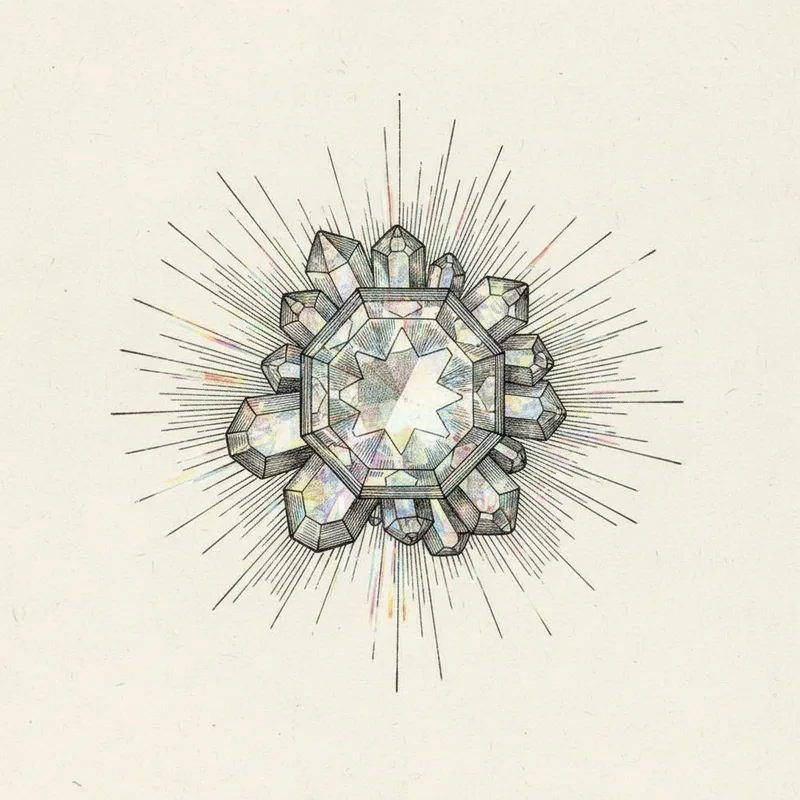
Moissanite
The Space Diamond
Affiliate links. We may earn a commission, at no cost to you.
Quick Facts
Formation & Origin
Moissanite is silicon carbide (SiC), a carbide mineral exceedingly rare in nature and first identified in a meteorite, today produced almost entirely as a synthetic gem. Natural moissanite is one of the rarest minerals on Earth. It was first discovered in 1893 by Henri Moissan in fragments of the Canyon Diablo meteorite in Arizona. For over a century, all known natural moissanite was either meteoritic or found as microscopic inclusions in kimberlite pipes and other mantle-derived rocks. Natural gem-quality moissanite essentially doesn't exist.
All moissanite sold as a gemstone is laboratory-grown silicon carbide. Charles & Colvard developed the first commercial gem-quality moissanite in the late 1990s using a thermal growing process. The resulting crystals are optically superior to diamond in some respects: moissanite has higher refractive index (2.65 vs diamond's 2.42) and significantly more fire/dispersion (0.104 vs 0.044). It literally sparkles more than diamond.
Moissanite has disrupted the engagement ring market by offering diamond-like appearance, superior optical properties, and ethical sourcing at roughly 10% of diamond's price. It's the hardest substance commercially available after diamond (9.25 Mohs), making it genuinely practical for daily wear.
Identification Guide
Moissanite is identified by its extreme brilliance and fire (noticeably more than diamond), hardness of 9.25 (second only to diamond), and double refraction (visible doubling of back facet edges when viewed through the table with a loupe). Diamond is singly refractive.
Distinguish from diamond (singly refractive, less fire, higher thermal conductivity), cubic zirconia (lower hardness at 8.5, no double refraction, higher density), and white sapphire (much less fire and brilliance). Most jewelers use electronic diamond testers - older thermal testers read moissanite as diamond; newer multi-testers can distinguish them.
Spotting Fakes
The 'fake' question is inverted for moissanite. Nobody fakes moissanite - instead, moissanite is sometimes sold as diamond. The double refraction test distinguishes them: look through the crown of the stone at the back facets with a 10x loupe. If the facet edges appear doubled, it's moissanite. Diamond shows single, sharp facet edges. Modern multi-testers (which measure both thermal AND electrical conductivity) can also distinguish them instantly.
Some links in this post go to Amazon and Etsy. Crystal Almanac earns a commission from qualifying purchases at no extra cost to you. Tools recommended here are ones we would use ourselves to run the tests described - the recommendation comes first, the link is downstream of it.
Cultural & Metaphysical Traditions
Presented as cultural traditions, not scientific evidence
Moissanite has no traditional metaphysical associations - it was unknown until 1893 and unavailable as a gemstone until the 1990s. Some modern practitioners associate its meteoritic origin with cosmic energy and transformation. Others connect its lab-grown nature to human creativity and technological achievement. Its growing popularity as an engagement ring stone has given it associations with modern love and ethical choice.
Metaphysical and “healing” associations are cultural traditions, not medical advice or scientific fact. Crystals are not a substitute for professional medical care.
Where It's Found
Original discovery (1893), meteorite fragments
Microscopic natural crystals in diamond deposits
All gem-quality moissanite is lab-grown (Charles & Colvard pioneered)
Price Guide
Good to Know
Scratch test: At hardness 9.25, Moissanite can scratch glass and steel. It's durable enough for any type of jewelry.
Global supply: Found in 3 notable locations worldwide, from United States to Laboratory.
Heft test: Moissanite has average mineral density (3.22). It feels about as heavy as you'd expect from a stone its size.
Common Questions
What is the chemical formula of Moissanite?
The chemical formula of Moissanite is SiC.
What is Moissanite's Mohs hardness?
Moissanite has a Mohs hardness of 9.25 on the 1 to 10 Mohs scale, hard enough to scratch glass and stand up to daily wear.
Is Moissanite a mineral?
Yes. Moissanite is a naturally occurring mineral (Carbide Group) with a definite chemical composition and an ordered crystal structure.
Care & Safety
The water, salt, and sunlight questions people actually ask before cleansing or displaying moissanite, answered from its hardness (Mohs 9.25) and chemistry (SiC).
Can Moissanite go in water?
Yes. Moissanite is hard (Mohs 9.25) and chemically stable, so a rinse or a quick wash with mild soap is no problem, cleanse it in water freely if that is your practice. A long soak does nothing for it either way, so skip that, and dry the stone afterward.
Can Moissanite go in salt water?
Not recommended, even though moissanite itself is hard and not water-soluble. Salt is both corrosive and mildly abrasive: it can dull a polished surface, attack metal settings, and crystallize inside small fractures as the stone dries. A quick dip will not destroy moissanite, but rinse it with fresh water afterward and dry it. For routine cleaning, plain water is the kinder choice.
Sources & References
The mineralogical and gemological data on this page is drawn from and can be cross-checked against these external references.
- WikipediaMoissanite on Wikipedia
- WebmineralMoissanite mineral data (Webmineral)
- Handbook of MineralogyMoissanite (Handbook of Mineralogy, PDF)
Related Minerals
The gem moissanite most closely resembles
Another diamond simulant, lower hardness
Natural diamond alternative, less sparkle
The industrial material moissanite is made from
Explore More
Save This Stone

Keep this moissanite reference handy. Save the card to a Pinterest board and the profile is one tap away.
Save to PinterestNewsletter
Something shiny, now and then
A stone worth knowing, or a fake worth spotting, every so often. No spam.