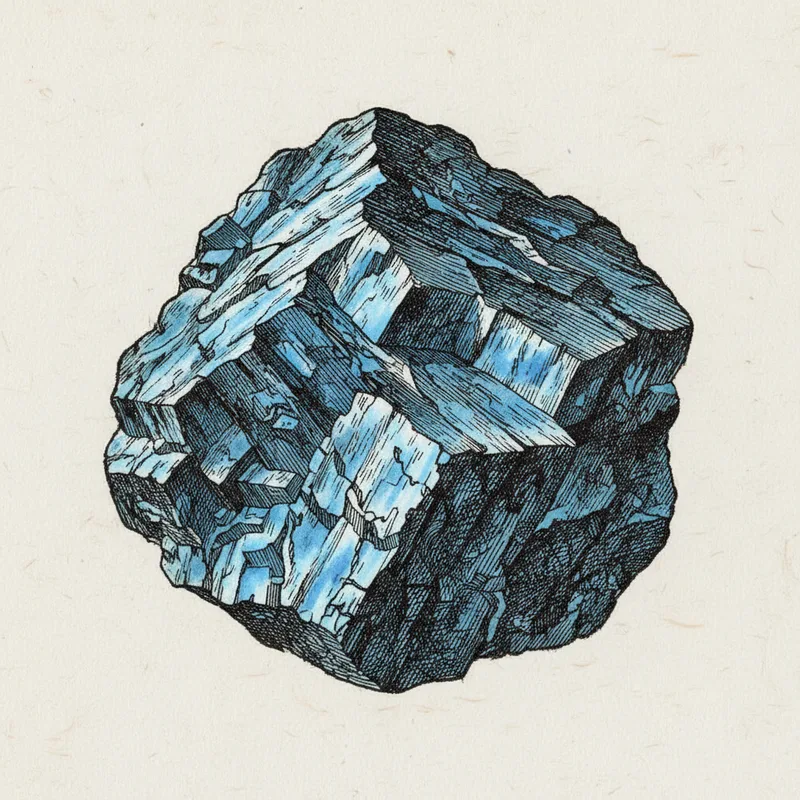
Larvikite
The Norwegian Moonstone
Affiliate links. We may earn a commission, at no cost to you.
Quick Facts
Formation & Origin
Larvikite is an igneous rock composed primarily of ternary feldspar (a feldspar with sodium, potassium, and calcium) with minor augite, biotite, and other minerals. It formed as a plutonic intrusion about 295 million years ago in what is now the Larvik region of southeastern Norway.
What makes larvikite visually stunning is the schiller effect displayed by its large feldspar crystals - a blue to silver flash that appears and disappears as the stone is rotated, similar to labradorite's flash but in a darker, more dramatic matrix. This schiller is caused by thin lamellar intergrowths within the feldspar that scatter light through thin-film interference.
Larvikite is Norway's national stone and is widely used as a dimension stone (building facade material) worldwide. You've probably seen it without knowing it - many modern building facades, countertops, and floor tiles use polished larvikite. In the crystal market, it's sometimes incorrectly sold as 'black moonstone' or 'black labradorite,' but it's neither.
Identification Guide
Larvikite is identified by its dark gray-blue base color with a distinctive silver-blue schiller flash visible on feldspar cleavage faces. The overall appearance is darker than labradorite with a more subtle, silver-toned flash rather than labradorite's vivid blue-green.
Distinguish from labradorite (typically lighter gray, more vivid multi-color flash), black moonstone (a misnomer for larvikite itself), and gabbro (similar dark igneous rock but without schiller). The silver-blue flash on a dark gray background is characteristic.
Spotting Fakes
Larvikite is abundant and inexpensive as a building stone, so faking is unnecessary. The issue is naming: it's frequently sold as 'black moonstone,' 'black labradorite,' or 'Norwegian moonstone.' While the feldspar in larvikite is related to both moonstone and labradorite feldspar, larvikite is a rock (multiple minerals), not a single mineral variety. The naming isn't exactly wrong, but it's misleading.
Some links in this post go to Amazon and Etsy. Crystal Almanac earns a commission from qualifying purchases at no extra cost to you. Tools recommended here are ones we would use ourselves to run the tests described - the recommendation comes first, the link is downstream of it.
Cultural & Metaphysical Traditions
Presented as cultural traditions, not scientific evidence
Larvikite is relatively new to the crystal healing market, having gained popularity in the 2010s partly through the 'black moonstone' trade name. Practitioners associate it with grounding, protection, and connecting to ancestral wisdom. Its Norwegian origin connects it to Norse spiritual traditions. The subtle schiller is interpreted as representing inner light that only reveals itself at the right angle - a metaphor for hidden wisdom.
Metaphysical and “healing” associations are cultural traditions, not medical advice or scientific fact. Crystals are not a substitute for professional medical care.
Where It's Found
The only source, named after this coastal city
Price Guide
Good to Know
Scratch test: At hardness 6, Larvikite resists scratching from a knife but can be scratched by quartz. Best for pendants and earrings rather than rings.
Global supply: Found at only one location on Earth - Norway. Supply is inherently limited.
Heft test: Larvikite has average mineral density (2.70). It feels about as heavy as you'd expect from a stone its size.
Common Questions
What is the chemical formula of Larvikite?
The chemical formula of Larvikite is Variable (ternary feldspar + augite + biotite).
What is Larvikite's Mohs hardness?
Larvikite has a Mohs hardness of 6 on the 1 to 10 Mohs scale, hard enough to scratch glass but softer than quartz.
Is Larvikite a mineral?
Not quite. Larvikite is a rock (a naturally occurring mixture of minerals), not a single mineral species.
Care & Safety
The water, salt, and sunlight questions people actually ask before cleansing or displaying larvikite, answered from its hardness (Mohs 6) and chemistry (Variable (ternary feldspar + augite + biotite)).
Can Larvikite go in water?
Yes. Larvikite is not water-soluble and durable enough (Mohs 6), so a rinse or a quick wash with mild soap is no problem, cleanse it in water freely if that is your practice. A long soak does nothing for it either way, so skip that, and dry the stone afterward.
Can Larvikite go in salt water?
Not recommended, even though larvikite itself is hard and not water-soluble. Salt is both corrosive and mildly abrasive: it can dull a polished surface, attack metal settings, and crystallize inside small fractures as the stone dries. A quick dip will not destroy larvikite, but rinse it with fresh water afterward and dry it. For routine cleaning, plain water is the kinder choice.
Sources & References
The mineralogical and gemological data on this page is drawn from and can be cross-checked against these external references.
- WikipediaLarvikite on Wikipedia
Related Minerals
Related feldspar flash, different rock type
Related feldspar family, different optical effect
Another dark stone with flash, different minerals
Finnish labradorite, more vivid flash
Explore More
Save This Stone

Keep this larvikite reference handy. Save the card to a Pinterest board and the profile is one tap away.
Save to PinterestNewsletter
Something shiny, now and then
A stone worth knowing, or a fake worth spotting, every so often. No spam.