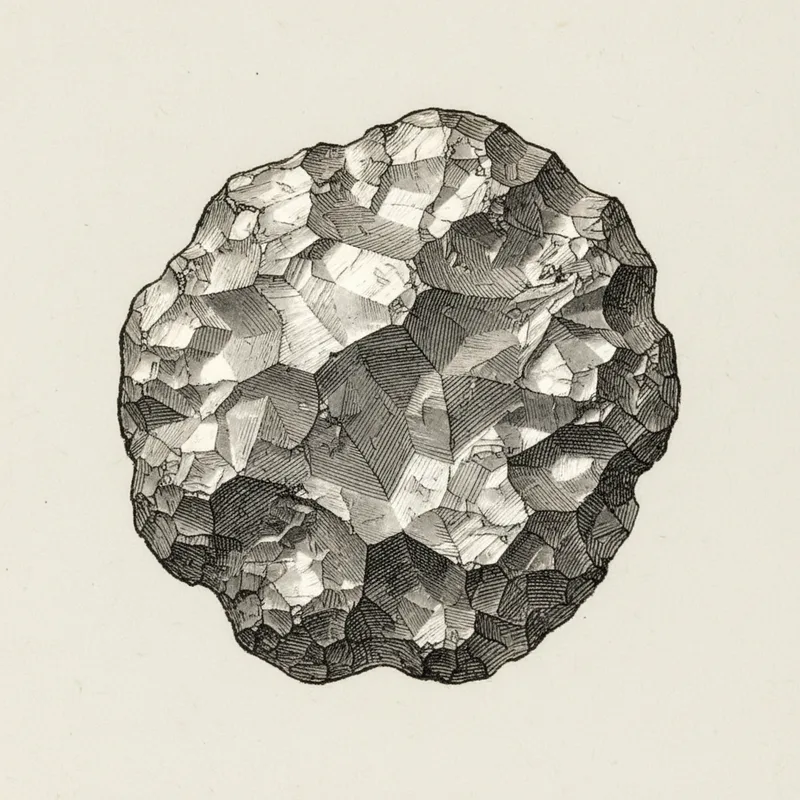
Iron Meteorite
Metal from the Stars
Affiliate links. We may earn a commission, at no cost to you.
Quick Facts
Formation & Origin
Iron meteorites are extraterrestrial masses of iron-nickel alloy, fragments of the metallic cores of ancient protoplanets from the early solar system. Iron meteorites are fragments of the metallic cores of ancient protoplanets that formed in the first few million years of the solar system, approximately 4.5 billion years ago. These protoplanets grew large enough for gravitational differentiation: heavy iron-nickel sank to the core while lighter silicates rose to form a mantle, just as happened on Earth.
Collisions between these protoplanets shattered them, exposing their metallic cores to space. These fragments orbited the Sun for billions of years before eventually crossing Earth's path and falling as meteorites.
The signature feature of iron meteorites is the Widmanstätten pattern, revealed when a polished surface is etched with mild acid. This crystalline pattern of interlocking kamacite (low-nickel iron) and taenite (high-nickel iron) plates formed as the metal cooled at rates of 1-100°C per million years deep inside a protoplanet's core. This cooling rate is so slow that the pattern cannot be replicated artificially, making it an absolute proof of extraterrestrial origin.
Identification Guide
Iron meteorites are identified by their metallic composition, high density (7.0-8.0), magnetic attraction, and the Widmanstätten pattern revealed by acid etching. A polished and etched surface showing the geometric interlocking crystal pattern is definitive.
Distinguish from terrestrial iron ore (not metallic, not magnetic in the same way), industrial slag (irregular vesicles, lower density), and magnetite (mineral, not metallic). Iron meteorites contain 5-25% nickel, which terrestrial iron rarely does. A nickel spot test or XRF analysis confirms meteoritic origin.
Spotting Fakes
The Widmanstätten pattern is the gold standard for authentication. This pattern forms only through millions of years of cooling and cannot be artificially produced. Any polished iron meteorite slice should show this pattern after etching. Fake 'meteorites' are common: industrial slag, magnetite, and man-made iron alloys are all sold as meteorites online. Buy from reputable dealers with classification documentation. Named meteorites (Gibeon, Campo del Cielo, Sikhote-Alin, Muonionalusta) are well-documented falls with established material available through legitimate channels.
Some links in this post go to Amazon and Etsy. Crystal Almanac earns a commission from qualifying purchases at no extra cost to you. Tools recommended here are ones we would use ourselves to run the tests described - the recommendation comes first, the link is downstream of it.
Cultural & Metaphysical Traditions
Presented as cultural traditions, not scientific evidence
Iron meteorites have been revered as sacred objects across cultures for millennia. Ancient Egyptians called meteoritic iron 'iron from heaven' and crafted King Tutankhamun's dagger from it. Tibetans used meteoritic iron for sacred ritual objects. The Black Stone of the Kaaba in Mecca is believed by some scholars to be meteoritic. In crystal healing, iron meteorites are associated with cosmic connection, strength, and grounding higher consciousness into physical reality.
Metaphysical and “healing” associations are cultural traditions, not medical advice or scientific fact. Crystals are not a substitute for professional medical care.
Where It's Found
Famous large shower, fine Widmanstätten patterns
Massive individual specimens, some over 30 tons
1947 witnessed fall, abundant shrapnel fragments
Oldest known meteorite (~1 million years on Earth), exceptional etch patterns
Price Guide
Good to Know
Scratch test: At hardness 5, Iron Meteorite resists scratching from a knife but can be scratched by quartz. Best for pendants and earrings rather than rings.
Global supply: Found in 4 notable locations worldwide, from Namibia to Sweden.
Heft test: With a specific gravity of 7.0-8.0, Iron Meteorite feels surprisingly heavy for its size. This weight is actually a useful identification tool.
Common Questions
What is the chemical formula of Iron Meteorite?
The chemical formula of Iron Meteorite is Fe-Ni alloy (kamacite + taenite).
What is Iron Meteorite's Mohs hardness?
Iron Meteorite has a Mohs hardness of 5 on the 1 to 10 Mohs scale, which a steel knife will scratch.
Care & Safety
The water, salt, and sunlight questions people actually ask before cleansing or displaying iron meteorite, answered from its hardness (Mohs 5) and chemistry (Fe-Ni alloy (kamacite + taenite)).
Can Iron Meteorite go in water?
Not recommended. Iron-nickel alloy that rusts aggressively in water. Store with desiccant packets. Never submerge.
Can Iron Meteorite go in salt water?
Absolutely not. Chlorides are the single worst enemy of iron meteorites: salt residue drives deep, recurring rust pitting that conservators struggle to stop. Never expose an iron meteorite to salt water, sweat, or sea air, and store it with desiccant.
Sources & References
The mineralogical and gemological data on this page is drawn from and can be cross-checked against these external references.
- WikipediaIron meteorite on Wikipedia
Explore More
Save This Stone

Keep this iron meteorite reference handy. Save the card to a Pinterest board and the profile is one tap away.
Save to PinterestNewsletter
Something shiny, now and then
A stone worth knowing, or a fake worth spotting, every so often. No spam.