Hawk's Eye
The Stone of Vision
Affiliate links. We may earn a commission, at no cost to you.
Quick Facts
Formation & Origin
Hawk's eye is the blue precursor to tiger's eye. Both start as crocidolite - a blue asbestos mineral with a fibrous crystal habit. When silica-rich groundwater infiltrates crocidolite deposits, quartz gradually replaces the crocidolite fibers while preserving their fibrous structure. This pseudomorphic replacement creates a fibrous quartz aggregate that shows chatoyancy (the silky, cat's eye shimmer).
In hawk's eye, the replacement is incomplete or the original crocidolite color is preserved - the iron in the fibers remains in its original blue oxidation state (Fe²⁺). When the iron is further oxidized to Fe³⁺ (rust-like state), the color changes from blue to golden brown, producing tiger's eye. So hawk's eye represents an earlier stage in the same geological process that creates tiger's eye.
Some specimens show both blue hawk's eye and golden tiger's eye in the same piece, representing the transition zone where oxidation was partial.
Identification Guide
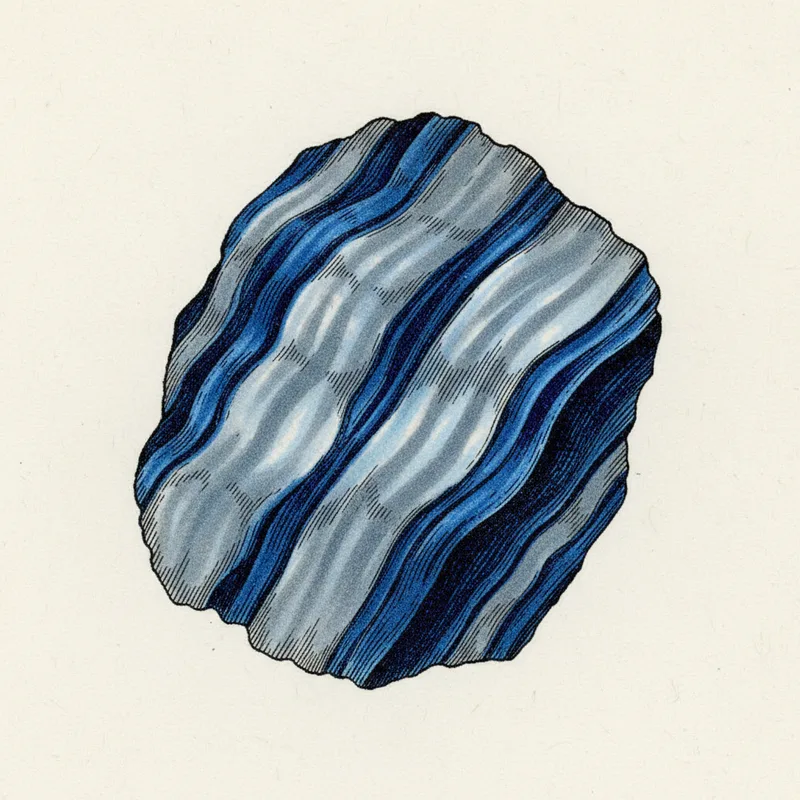
Hawk's eye is identified by its blue-gray to steel-blue color combined with the characteristic silky chatoyancy (cat's eye effect) when the stone is rotated. The shimmer runs across the fibrous structure, creating a moving band of light.
Distinguish from blue tiger's eye (same material, just a name preference), sodalite (massive, no chatoyancy), and blue aventurine (sparkly rather than silky, different mineral). The chatoyant shimmer is the key diagnostic feature - no other common blue stone shows this specific silky light effect.
Spotting Fakes
Hawk's eye is abundant and inexpensive, so faking is uncommon. Fiber optic glass (cat's eye glass) can simulate the chatoyant effect but feels warmer and lighter than genuine hawk's eye. Some hawk's eye is dyed to intensify the blue color - natural hawk's eye tends toward gray-blue rather than vivid blue. The chatoyant effect should come from fibrous structure visible under magnification, not from surface treatment.
Some links in this post go to Amazon and Etsy. Crystal Almanac earns a commission from qualifying purchases at no extra cost to you. Tools recommended here are ones we would use ourselves to run the tests described - the recommendation comes first, the link is downstream of it.
Cultural & Metaphysical Traditions
Presented as cultural traditions, not scientific evidence
Hawk's eye shares much of its metaphysical tradition with tiger's eye, with the addition of associations related to its blue color - intuition, perspective, and seeing the bigger picture. The hawk metaphor connects to aerial vision, rising above problems for clarity. Ancient Egyptians used both hawk's eye and tiger's eye in the eyes of deity statues, believing the chatoyant effect mimicked divine sight.
Metaphysical and “healing” associations are cultural traditions, not medical advice or scientific fact. Crystals are not a substitute for professional medical care.
Where It's Found
Primary world source, same deposits as tiger's eye
Some blue chatoyant material
Minor commercial source
Price Guide
Good to Know
Scratch test: At hardness 7, Hawk's Eye can scratch glass and steel. It's durable enough for any type of jewelry.
Global supply: Found in 3 notable locations worldwide, from South Africa to India.
Heft test: Hawk's Eye has average mineral density (2.65). It feels about as heavy as you'd expect from a stone its size.
Common Questions
What is the chemical formula of Hawk's Eye?
The chemical formula of Hawk's Eye is SiO₂ (pseudomorph after crocidolite).
What is Hawk's Eye's Mohs hardness?
Hawk's Eye has a Mohs hardness of 7 on the 1 to 10 Mohs scale, hard enough to scratch glass and stand up to daily wear.
Is Hawk's Eye a mineral?
Yes. Hawk's Eye is a naturally occurring mineral (Quartz Family (Chalcedony)) with a definite chemical composition and an ordered crystal structure.
Care & Safety
The water, salt, and sunlight questions people actually ask before cleansing or displaying hawk's eye, answered from its hardness (Mohs 7) and chemistry (SiO₂ (pseudomorph after crocidolite)).
Can Hawk's Eye go in water?
Yes. Hawk's Eye is hard (Mohs 7) and chemically stable, so a rinse or a quick wash with mild soap is no problem, cleanse it in water freely if that is your practice. A long soak does nothing for it either way, so skip that, and dry the stone afterward.
Can Hawk's Eye go in salt water?
Not recommended, even though hawk's eye itself is hard and not water-soluble. Salt is both corrosive and mildly abrasive: it can dull a polished surface, attack metal settings, and crystallize inside small fractures as the stone dries. A quick dip will not destroy hawk's eye, but rinse it with fresh water afterward and dry it. For routine cleaning, plain water is the kinder choice.
Sources & References
The mineralogical and gemological data on this page is drawn from and can be cross-checked against these external references.
- WikipediaTiger's eye on Wikipedia
- WebmineralQuartz mineral data (Webmineral)
- Handbook of MineralogyQuartz (Handbook of Mineralogy, PDF)
Related Minerals
Same mineral further oxidized from blue to gold
Brecciated hawk's eye and tiger's eye mixed
The original blue asbestos mineral before replacement
Similar chatoyancy from different fiber inclusions
Explore More
Quartz & Chalcedony
Best Crystals for 2026: Match Stones to Your Goals
Best Crystals for Work, Focus, and Your Desk
Best Crystals for Confidence and Self-Esteem
Mohs Hardness Scale
See where Hawk's Eye sits on the scale
Crystal Care Guide
Water safety, sunlight, and handling tips
Save This Stone

Keep this hawk's eye reference handy. Save the card to a Pinterest board and the profile is one tap away.
Save to PinterestNewsletter
Something shiny, now and then
A stone worth knowing, or a fake worth spotting, every so often. No spam.