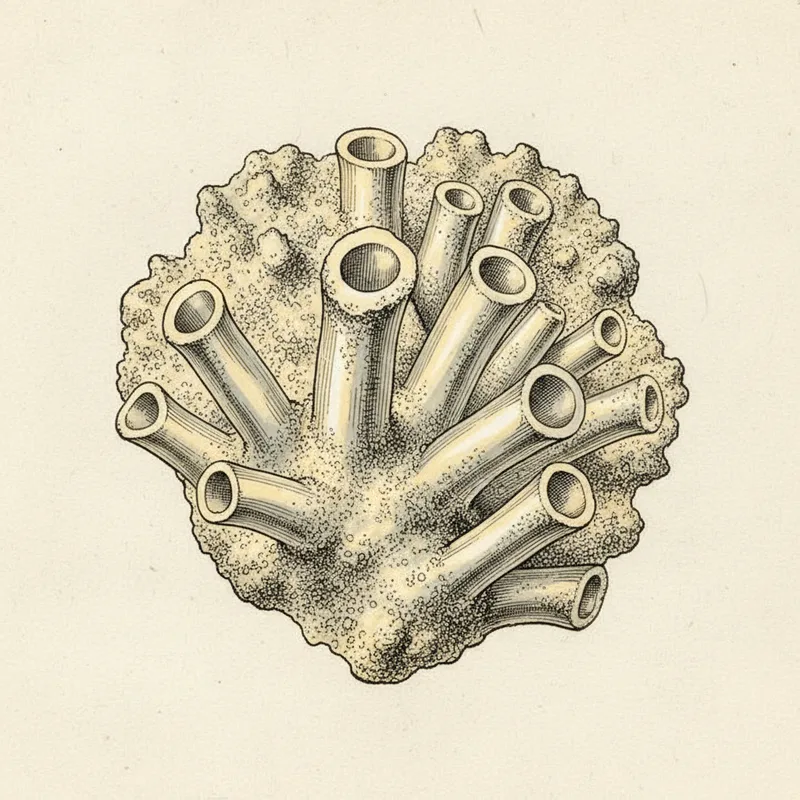
Fulgurite
Lightning Captured in Glass
Affiliate links. We may earn a commission, at no cost to you.
Quick Facts
Formation & Origin
Fulgurite is a natural glass formed when lightning fuses sand or rock, producing the amorphous silica glass lechatelierite (SiO₂). Fulgurites are natural hollow glass tubes formed when lightning strikes sand, soil, or rock. A single lightning bolt delivers temperatures of approximately 30,000°C (54,000°F), roughly five times the surface temperature of the sun. This instantaneous heat fuses silica grains into glass in a fraction of a second.
The resulting tube follows the lightning's path into the ground, often branching like a root system. Sand fulgurites have rough, sandy exteriors where partially melted grains are sintered together, but their interiors are smooth, glassy lechatelierite (amorphous silica). Rock fulgurites form on exposed rock surfaces as thin glassy crusts.
Fulgurites range from a few centimeters to several meters in length. The longest documented specimen exceeded 5 meters. They're extremely fragile, especially the thinner branches, which is why complete specimens are rare. Each fulgurite is a unique record of an individual lightning strike, preserving the exact path the electrical discharge took into the earth.
Identification Guide
Fulgurites are identified by their hollow, tubular form with a glassy interior and rough, sand-coated exterior. They're typically irregularly shaped, often branching. The interior glass is usually clear to gray and has a vitreous luster. The exterior is rough and sandy.
Distinguish from tubes created by plant roots (smoother, no glass lining), insect tunnels (organic, no glass), and manufactured glass tubes (uniform wall thickness, no sand coating). Break a small fragment if in doubt: fulgurite glass will show conchoidal fracture.
Spotting Fakes
Manufactured fulgurite fakes exist, created by melting sand in tube-shaped molds. Genuine fulgurites have irregular wall thickness, natural branching, and sand grains partially fused to the exterior. The interior glass shows bubbles and flow patterns. Fake fulgurites tend to be too uniform in shape and wall thickness. Very large, perfectly preserved specimens should be viewed with some skepticism, as natural fulgurites are fragile and rarely survive extraction intact.
Some links in this post go to Amazon and Etsy. Crystal Almanac earns a commission from qualifying purchases at no extra cost to you. Tools recommended here are ones we would use ourselves to run the tests described - the recommendation comes first, the link is downstream of it.
Cultural & Metaphysical Traditions
Presented as cultural traditions, not scientific evidence
Fulgurites hold a unique place in crystal healing as the literal intersection of heaven and earth. Practitioners associate them with sudden transformation, divine connection, and breakthrough moments. They are sometimes used in manifestation practices. Many cultures consider lightning-struck objects sacred, and fulgurites carry this tradition of reverence for electrical phenomena.
Metaphysical and “healing” associations are cultural traditions, not medical advice or scientific fact. Crystals are not a substitute for professional medical care.
Where It's Found
Sandy environments produce the best-preserved tubes
Common in beach and desert sand areas
Commercial specimens often from here
Excellent specimens from sandy soils
Price Guide
Good to Know
Scratch test: At hardness 5.5, Fulgurite resists scratching from a knife but can be scratched by quartz. Best for pendants and earrings rather than rings.
Global supply: Found in 4 notable locations worldwide, from Worldwide to Australia.
Heft test: With a specific gravity of 2.1-2.5, Fulgurite feels lighter than most minerals. This lightness can help identify it.
Common Questions
What is the chemical formula of Fulgurite?
The chemical formula of Fulgurite is SiO₂ (fused, amorphous).
What is Fulgurite's Mohs hardness?
Fulgurite has a Mohs hardness of 5.5 on the 1 to 10 Mohs scale, hard enough to scratch glass but softer than quartz.
Is Fulgurite a mineral?
No. Fulgurite is a natural glass (a mineraloid), not a true mineral, because it cooled too fast to develop the ordered crystal structure that defines a mineral.
Care & Safety
The water, salt, and sunlight questions people actually ask before cleansing or displaying fulgurite, answered from its hardness (Mohs 5.5) and chemistry (SiO₂ (fused, amorphous)).
Can Fulgurite go in water?
Yes. Fulgurite is not water-soluble and durable enough (Mohs 5.5), so a rinse or a quick wash with mild soap is no problem, cleanse it in water freely if that is your practice. A long soak does nothing for it either way, so skip that, and dry the stone afterward.
Can Fulgurite go in salt water?
Not recommended, even though fulgurite itself is hard and not water-soluble. Salt is both corrosive and mildly abrasive: it can dull a polished surface, attack metal settings, and crystallize inside small fractures as the stone dries. A quick dip will not destroy fulgurite, but rinse it with fresh water afterward and dry it. For routine cleaning, plain water is the kinder choice.
Sources & References
The mineralogical and gemological data on this page is drawn from and can be cross-checked against these external references.
- WikipediaFulgurite on Wikipedia
Explore More
Save This Stone

Keep this fulgurite reference handy. Save the card to a Pinterest board and the profile is one tap away.
Save to PinterestNewsletter
Something shiny, now and then
A stone worth knowing, or a fake worth spotting, every so often. No spam.