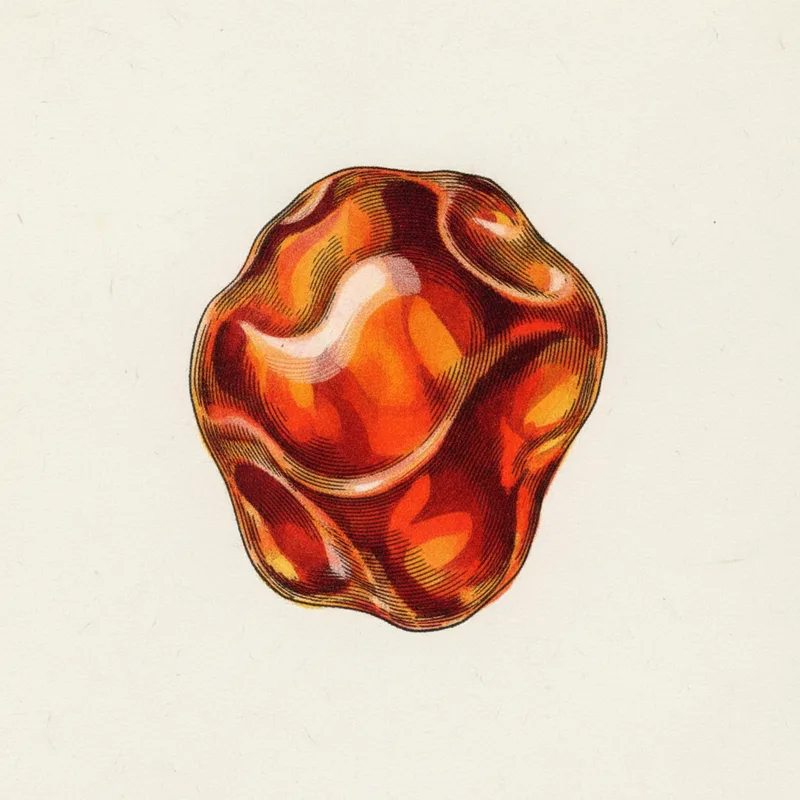
Fire Opal
The Aztec Sun Stone
Affiliate links. We may earn a commission, at no cost to you.
Quick Facts
Formation & Origin
Fire opal is a transparent to translucent variety of opal, an amorphous hydrated silica mineraloid (SiO₂·nH₂O), prized for its warm orange to red body color rather than play-of-color. Fire opal forms in volcanic environments where silica-rich fluids percolate through rhyolitic lava flows and tuffs. Unlike precious opal (which gets its value from play-of-color), fire opal is valued for its vivid body color, which ranges from yellow through orange to cherry red.
The intense colors come from submicroscopic iron oxide particles dispersed within the silica gel structure. Fire opal typically has a lower water content (3-6%) than Australian opal, which makes it slightly more stable but still sensitive to dehydration and sudden temperature changes.
Mexico's Querétaro mines, active since the Aztec period, produce the world's most prized fire opals. The Aztecs called opal 'quetzalitzlipyollitli' (the stone of the bird of paradise) and associated it with the feathered serpent Quetzalcoatl. Some Mexican fire opal displays play-of-color in addition to body color. These 'contra luz' specimens are especially prized.
Identification Guide
Fire opal's transparent to translucent body with vivid warm colors is distinctive. Unlike most opal, high-quality fire opal can be faceted like a conventional gemstone. The lack of play-of-color (in most specimens) combined with the warm body color separates it from other opal varieties.
Distinguish from carnelian (harder, opaque, chalcedony), spessartine garnet (higher RI and SG, isotropic), and orange sapphire (much harder). Fire opal has a waxy to vitreous luster and may show a faint opalescence or haziness.
Spotting Fakes
Synthetic fire opal exists and can be difficult to distinguish without magnification. Look for flow structures or columnar patterns under a loupe, which indicate synthetic origin. Glass imitations lack the unique internal character of opal. Be cautious with treated material. Some pale opals are dyed or smoke-treated to enhance color. Natural Mexican fire opal should have a warm, even body color that looks organic rather than artificially saturated.
Some links in this post go to Amazon and Etsy. Crystal Almanac earns a commission from qualifying purchases at no extra cost to you. Tools recommended here are ones we would use ourselves to run the tests described - the recommendation comes first, the link is downstream of it.
Cultural & Metaphysical Traditions
Presented as cultural traditions, not scientific evidence
The Aztecs and Mayans revered fire opal as a stone of the gods, associating it with the intensity of the sun and creative passion. Modern crystal practitioners connect fire opal with vitality, courage, and passionate energy. It is sometimes used in meditative practices aimed at releasing inhibitions and embracing spontaneity.
Metaphysical and “healing” associations are cultural traditions, not medical advice or scientific fact. Crystals are not a substitute for professional medical care.
Where It's Found
World's finest, intensely saturated colors
Good quality orange specimens
Some fire opal alongside play-of-color material
Historical source, beautiful matrix specimens
Price Guide
Good to Know
Scratch test: At hardness 6, Fire Opal resists scratching from a knife but can be scratched by quartz. Best for pendants and earrings rather than rings.
Global supply: Found in 4 notable locations worldwide, from Mexico to Honduras.
Heft test: With a specific gravity of 1.98-2.20, Fire Opal feels lighter than most minerals. This lightness can help identify it.
Common Questions
What is the chemical formula of Fire Opal?
The chemical formula of Fire Opal is SiO₂·nH₂O.
What is Fire Opal's Mohs hardness?
Fire Opal has a Mohs hardness of 6 on the 1 to 10 Mohs scale, hard enough to scratch glass but softer than quartz.
Is Fire Opal a mineral?
Not exactly. Fire Opal is a mineraloid: it has a mineral-like composition but lacks the ordered, repeating crystal structure required to be a true mineral.
Care & Safety
The water, salt, and sunlight questions people actually ask before cleansing or displaying fire opal, answered from its hardness (Mohs 6) and chemistry (SiO₂·nH₂O).
Can Fire Opal go in water?
Yes. Fire Opal is not water-soluble and durable enough (Mohs 6), so a rinse or a quick wash with mild soap is no problem, cleanse it in water freely if that is your practice. A long soak does nothing for it either way, so skip that, and dry the stone afterward.
Can Fire Opal go in salt water?
Not recommended, even though fire opal itself is hard and not water-soluble. Salt is both corrosive and mildly abrasive: it can dull a polished surface, attack metal settings, and crystallize inside small fractures as the stone dries. A quick dip will not destroy fire opal, but rinse it with fresh water afterward and dry it. For routine cleaning, plain water is the kinder choice.
Is sunlight safe for Fire Opal?
Direct sun is risky for fire opal through heat and dehydration rather than bleaching. Like all opal it contains structural water, and drying out can cause crazing (fine permanent cracks). Mexican fire opal is somewhat more stable than many opals, but a shaded display spot is still the safe choice.
Sources & References
The mineralogical and gemological data on this page is drawn from and can be cross-checked against these external references.
- WikipediaOpal on Wikipedia
- WebmineralOpal mineral data (Webmineral)
- GIAFire Opal in the GIA Gem Encyclopedia
Explore More
Quartz & Chalcedony
The Creative Collection
The Aztec 'sun stone,' associated with Quetzalcoatl and creative fire. Its vivid body color glows like a live ember - pure creative intensity in stone form.
October Birthstones: Opal and Tourmaline
Mohs Hardness Scale
See where Fire Opal sits on the scale
Crystal Care Guide
Water safety, sunlight, and handling tips
Save This Stone

Keep this fire opal reference handy. Save the card to a Pinterest board and the profile is one tap away.
Save to PinterestNewsletter
Something shiny, now and then
A stone worth knowing, or a fake worth spotting, every so often. No spam.