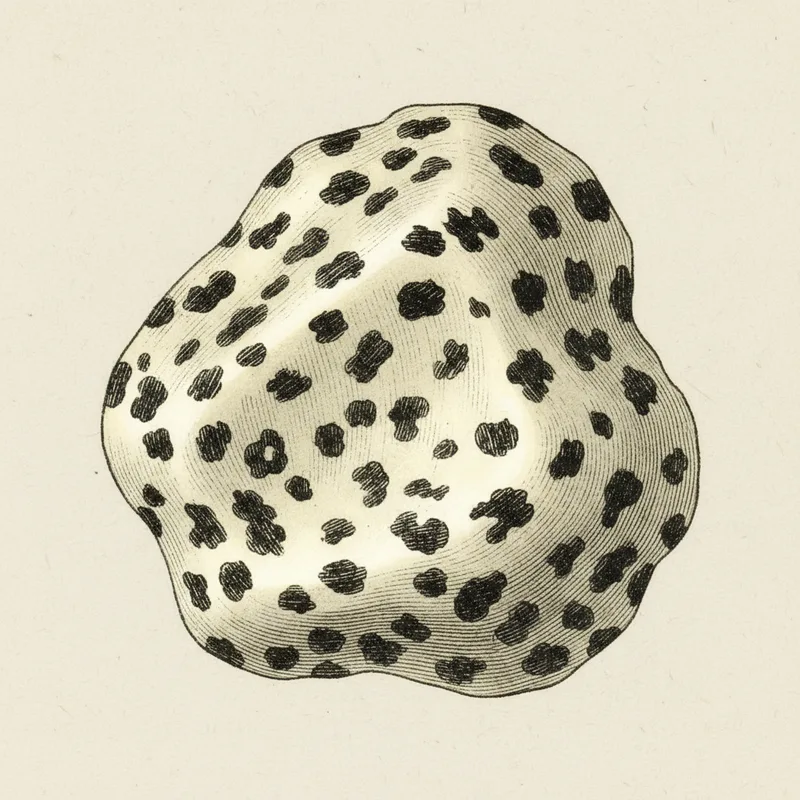
Dalmatian Stone
The Spotted Companion
Affiliate links. We may earn a commission, at no cost to you.
Quick Facts
Formation & Origin
Dalmatian stone, often marketed as dalmatian jasper despite not being a true jasper, is a speckled igneous rock of feldspar and quartz peppered with dark inclusions of minerals such as tourmaline. Dalmatian stone (also called dalmatian jasper, though it is not technically a jasper) is an igneous rock composed primarily of feldspar and quartz with black or brown spots created by inclusions of iron oxide minerals, tourmaline (schorl), or arfvedsonite.
The rock formed from cooling magma. The pale matrix crystallized from a felsic (silica-rich) melt, while the dark spots formed when iron-rich and boron-rich minerals crystallized as the temperature dropped. Recent studies have identified many of the black spots as arfvedsonite (an amphibole mineral) rather than the previously assumed black tourmaline, though both can be present.
The name comes from its obvious resemblance to the spotted coat pattern of Dalmatian dogs. It's widely available as tumbled stones, beads, and decorative objects.
Identification Guide
Dalmatian stone is easy to recognize: a cream-to-beige background peppered with distinct black or brownish spots. It's a rock rather than a single mineral, so it has a grainy texture visible under magnification. The spots are usually 2-5mm across and irregularly distributed.
Distinguish from snowflake obsidian (volcanic glass base, white spots on black rather than black spots on white), Atlantic granite (similar look but different spot distribution), and dyed stones (spots should be integral, not painted).
Spotting Fakes
Dalmatian stone is inexpensive and widely available, so fakes are rare. The main issue is mislabeling. It's often sold as 'dalmatian jasper,' but it's an igneous rock, not a jasper. This doesn't affect its value or beauty but is worth knowing for accuracy. Very uniform spot distribution or spots that appear painted on rather than embedded should raise concerns.
Some links in this post go to Amazon and Etsy. Crystal Almanac earns a commission from qualifying purchases at no extra cost to you. Tools recommended here are ones we would use ourselves to run the tests described - the recommendation comes first, the link is downstream of it.
Cultural & Metaphysical Traditions
Presented as cultural traditions, not scientific evidence
Crystal practitioners associate dalmatian stone with playfulness, joy, and childlike wonder. Its spotted appearance connects it to themes of loyalty and companionship. Some traditions use it for grounding excess energy and finding balance between responsibility and fun.
Metaphysical and “healing” associations are cultural traditions, not medical advice or scientific fact. Crystals are not a substitute for professional medical care.
Where It's Found
Primary commercial source
Secondary source for the market
Some commercial material
Price Guide
Good to Know
Scratch test: At hardness 6.5, Dalmatian Stone resists scratching from a knife but can be scratched by quartz. Best for pendants and earrings rather than rings.
Global supply: Found in 3 notable locations worldwide, from Mexico to India.
Heft test: Dalmatian Stone has average mineral density (2.60-2.70). It feels about as heavy as you'd expect from a stone its size.
Common Questions
What is the chemical formula of Dalmatian Stone?
The chemical formula of Dalmatian Stone is Complex (feldspar/quartz matrix with tourmaline/arfvedsonite inclusions).
What is Dalmatian Stone's Mohs hardness?
Dalmatian Stone has a Mohs hardness of 6.5 on the 1 to 10 Mohs scale, hard enough to scratch glass but softer than quartz.
Is Dalmatian Stone a mineral?
Not quite. Dalmatian Stone is a rock (a naturally occurring mixture of minerals), not a single mineral species.
Care & Safety
The water, salt, and sunlight questions people actually ask before cleansing or displaying dalmatian stone, answered from its hardness (Mohs 6.5) and chemistry (Complex (feldspar/quartz matrix with tourmaline/arfvedsonite inclusions)).
Can Dalmatian Stone go in water?
Yes. Dalmatian Stone is not water-soluble and durable enough (Mohs 6.5), so a rinse or a quick wash with mild soap is no problem, cleanse it in water freely if that is your practice. A long soak does nothing for it either way, so skip that, and dry the stone afterward.
Can Dalmatian Stone go in salt water?
Not recommended, even though dalmatian stone itself is hard and not water-soluble. Salt is both corrosive and mildly abrasive: it can dull a polished surface, attack metal settings, and crystallize inside small fractures as the stone dries. A quick dip will not destroy dalmatian stone, but rinse it with fresh water afterward and dry it. For routine cleaning, plain water is the kinder choice.
Related Minerals
Reverse pattern: white spots on black
One of the inclusion minerals creating spots
Major component of the matrix
Explore More
Save This Stone

Keep this dalmatian stone reference handy. Save the card to a Pinterest board and the profile is one tap away.
Save to PinterestNewsletter
Something shiny, now and then
A stone worth knowing, or a fake worth spotting, every so often. No spam.